

Benchmarking Cost vs Audit Quality: Control Costs Safely
TL;DR: Benchmarking audit fees is useful when it supports better questions about scope, risk and effort.
It becomes dangerous when benchmarks are used as hard fee caps that reduce audit hours, evidence and professional skepticism.
Benchmarking, in this context, means comparing audit fees or audit effort against similar engagements to see whether the planned cost looks reasonable. Used well, it improves transparency, exposes outliers and supports better planning. Used badly, it becomes a blunt cost-cutting target. For a broader cost-management context, it helps to start with understanding cost benchmarking as a reference-based comparison method rather than a replacement for professional judgment.
Benchmarking and audit quality often sit in tension. Organisations want to know whether audit fees, assurance costs and professional service budgets are reasonable. At the same time, they need confidence that the work is thorough enough to find material issues before they become expensive surprises.
That tension appears in financial audits, internal control reviews and capital-project cost assurance. Benchmarks can improve transparency, expose outliers and support better planning. What they cannot do is prove, by themselves, that the work is sufficient.
This article explains how to use benchmarking as a decision-support tool rather than a blunt cost-cutting target. It also looks at how audit committees, project teams and cost assurance professionals can control fees without weakening the evidence, judgment and independence that quality depends on.
Benchmarking vs Audit Quality: The Core Trade-Off in Fee and Effort
Benchmarking audit fees is a perfectly legitimate exercise. If an audit committee wants to know whether external auditors are charging a fair amount, comparing fees against similar organisations gives everyone a more grounded starting point. The comparison should account for size, sector, complexity, risk and scope. Done well, it makes fee discussions less vague and helps management ask sharper questions.
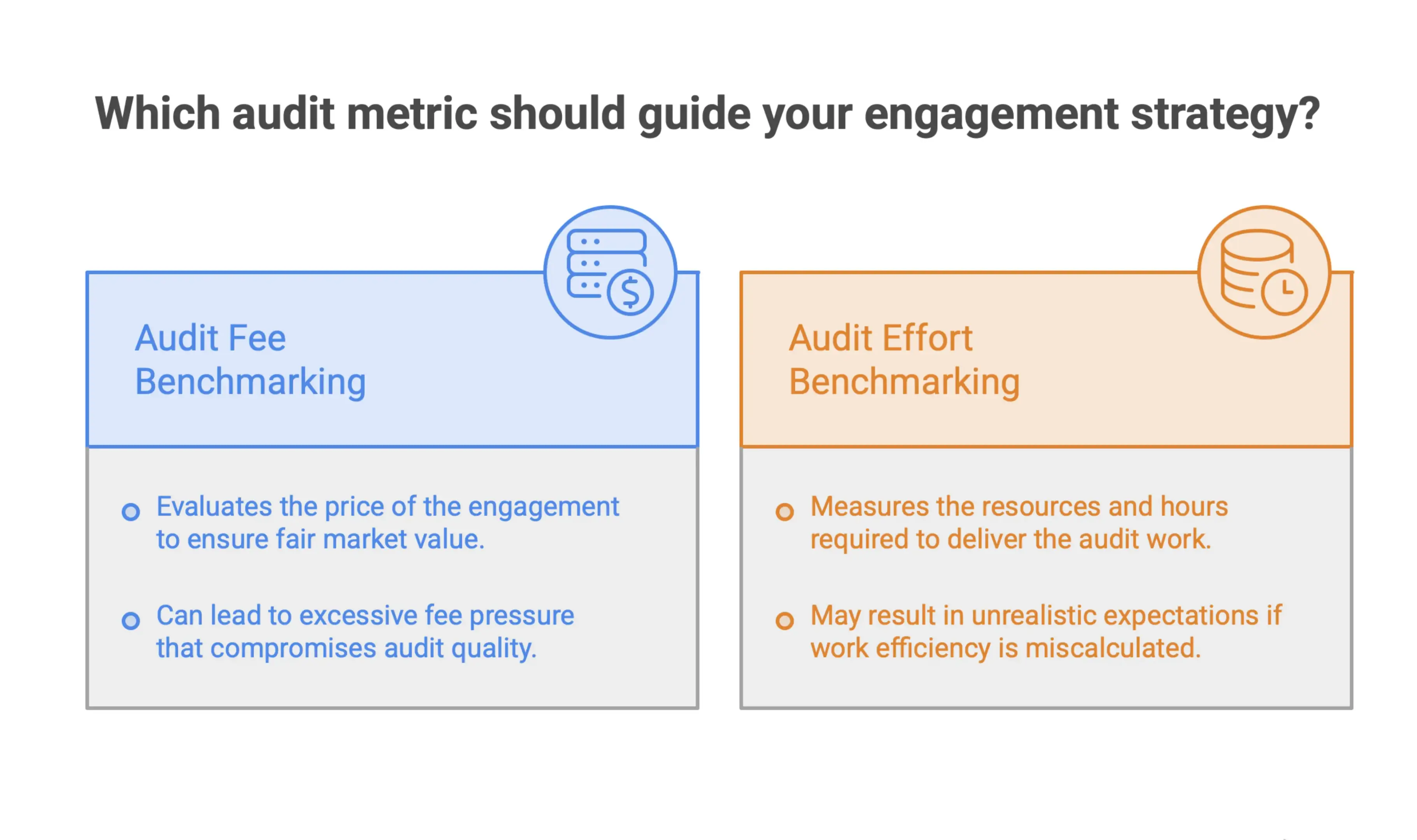
It is also important to separate benchmark audit fees from benchmark audit effort or hours. The first is about the price of the engagement. The second is about the resources needed to deliver it. The two are related, but not identical. A fee benchmark can look acceptable while the planned hours are too low, or the reverse may be true if the work is unusually efficient.
The problem starts when benchmarks stop being reference points and become targets.
If fee pressure pushes the audit below what the work actually requires, the shortfall has to show up somewhere. Hours are reduced. Testing is narrowed. More work may be pushed down to junior staff. Review time gets squeezed. The space for professional skepticism, challenge and supervision starts to shrink.
That does not create a leaner audit. It creates a thinner one. And a thinner audit raises the risk that a material misstatement in the financial statements is missed.
Why Benchmarks Help, but Cannot Define Quality Alone
Audit quality has several dimensions. The IAASB's audit quality framework describes it through input and output factors at engagement, firm and national level, influenced by context and stakeholder interaction.
In practice, quality shows up in the strength of the risk assessment, the sufficiency of audit evidence, the depth of internal controls testing, the quality of review and the independence of the conclusions reached. A benchmark fee does not tell you those things. It may tell you whether the cost looks high or low compared with peers, but it cannot tell you whether the audit work is strong enough.
The Risk of Turning Benchmarks into Fee-Cutting Targets
The issue is not benchmarking. It is how the result is used.
A benchmark that leads to the question, “Is this fee reasonable for the scope and risk profile?” is useful. A benchmark used by procurement or management as a hard ceiling can introduce real risk into the assurance process.
Lower fees can be justified when they come from better data, tighter planning, smarter automation or more efficient sampling. They become a problem when they are achieved by removing work that still needs to be done.
That distinction sits at the heart of the benchmarking versus audit quality debate.
What Audit Quality Means in Practice
Audit quality is more than issuing a clean opinion on the financial statements. It covers the work behind that conclusion: gathering sufficient appropriate evidence, assessing risk properly, testing internal controls and applying professional skepticism wherever judgment is involved.
In practical terms, a high-quality audit reduces the risk of undetected material misstatement to an acceptable level. That means the auditor has identified the right risks, tested the right areas with enough rigour, challenged management’s assumptions where needed and documented the reasoning behind significant judgments.
Evidence, Judgment and Professional Skepticism
What separates a strong audit from a weak one is not simply the volume of work. It is the quality of the decisions made along the way.
Which risks were prioritised? How far did testing go? When were management’s explanations challenged? Can the file provide evidence for the key judgments reached? Improved audit quality comes from doing the necessary audit work, not just issuing a clean opinion. Professional skepticism is not a slogan. It is the habit of questioning, corroborating and refusing to accept a neat explanation just because it sounds plausible. The vast majority of the auditing profession still approaches that responsibility seriously.
In public companies, higher audit quality supports stronger confidence in financial reporting and the wider market.
The Financial Reporting Council reflects this in its Audit Quality Review function. Its inspections examine audit evidence, key judgments and whether the evidence obtained is sufficient and appropriate. That focus is consistent with prior literature, accounting research and contemporary accounting research, and one accounting review article notes that a study investigates how audit effort and benchmark choices shape materiality judgments. The point is not academic for its own sake: empirical evidence helps explain why the substance of the work matters across the profession. That matters because audit quality is judged by the substance of the work, not by whether a file looks tidy. Inadequate investment in audit services can lead to regulatory sanctions and reputational damage, while lower audit quality raises the risk of financial reporting misstatements.
Internal Controls, Financial Reporting Risk and Material Misstatement
Internal controls testing is central to audit quality. Under the Sarbanes Oxley Act, that work became especially important for public companies and shaped how audit services address control risk. When controls are well designed, effective and properly documented, auditors may be able to rely on them. That affects the type and extent of further testing needed.
When controls are weak, or when they have not been tested properly, the auditor has to do more work elsewhere. That is not optional. It is a response to where the risk of financial reporting misstatements sits, and stronger work here can help reduce financial statement restatements.
For that reason, audit quality cannot be judged from the final opinion alone. The real indicators are the depth of the risk assessment, the rigour of control testing, the quality of documentation, the level of supervision and whether junior team members were given clear direction. A clean opinion reached through weak procedures offers limited comfort, however polished the audit report looks. In the wider market, firms that invest in these basics are more likely to deliver higher quality audits. The vast majority of the auditing profession continues to perform this work responsibly, even though inspection findings still matter.
Benchmark Audit Fees vs Actual Audit Fees: How to Compare Them
Benchmark audit fees are reference points, not invoices. They come from comparable engagements and are adjusted for factors such as client size, revenue, industry sector, operational complexity, geographic footprint, regulatory requirements and inherent risk.
Actual audit fees are the negotiated and billed costs for a specific engagement between a client and its external auditors.
The two figures will rarely match exactly. That is normal. What matters is whether the gap is explainable, and whether the right questions are being asked.
What a Reliable Benchmark Should Include
A useful audit fee benchmark needs to go beyond company size. It should reflect scope of work, number of reporting entities, transaction complexity, strength of internal controls, the audit firm’s risk assessment and any extra procedures driven by prior-year findings, acquisitions or regulatory scrutiny.
Benchmarks based only on revenue or headcount often create misleading comparisons.
Industry matters too. Financial services, energy, pharmaceuticals and construction all carry different compliance requirements, revenue recognition issues and audit risks. Comparing a simple retail business with an EPC contractor managing multi-currency contracts, percentage-of-completion accounting and joint ventures will not produce much insight.
Legitimate Reasons Actual Fees May Exceed the Benchmark
Higher actual audit fees do not automatically point to a problem. They may reflect weak internal controls, recent acquisitions, a restatement, new accounting standards, specialist review or outdated benchmark data.
Audit scope changes are another separate driver. If the engagement has expanded, added entities or required extra procedures, the fee can rise even when the underlying quality of the audit remains strong.
The useful question is whether the extra cost reflects extra audit effort and stronger evidence. If it does, the higher fee may be entirely justified.
When Lower-Than-Benchmark Fees Become a Warning Sign
A fee below benchmark deserves just as much attention.
If actual audit fees sit well below a reasonable benchmark without a clear improvement in data quality, process efficiency, internal controls or audit scope, the audit plan may be too light. The saving may have come from cutting hours, reducing testing or limiting senior review.
Fee pressure that pushes external auditors below the level needed for an effective risk assessment and testing programme can leave material misstatement undetected. In that case, the benchmark is not the problem. It is the warning signal.
Fee Pressure, Audit Effort and Audit Hours
Fee pressure is one of the clearest ways benchmarking can undermine audit quality. When clients, management teams or procurement groups treat benchmark audit fees as a hard ceiling, external auditors can be left trying to deliver a demanding engagement with too little time and resource.
The mechanics are straightforward. If fees are squeezed too far, audit firms have only a few levers to pull. They can cut audit hours, rely more heavily on junior staff, shorten review cycles, reduce testing or give complex judgments less senior attention.
One of those changes may be manageable. Several together can weaken the foundations of good audit work. There is less time to challenge assumptions, less experienced review of risk areas and less testing to build reliable evidence across the financial statements.
Audit hours are a useful measure of effort, but they are not a quality guarantee. A well-run engagement with strong data, effective controls and efficient sampling may genuinely need fewer hours than a messy engagement with poor records and unresolved findings.
The concern is when hours fall because the fee has been squeezed, not because the work has become more efficient.
Regulators and standard-setters recognise that difference. The Accounting and Corporate Regulatory Authority, or ACRA, includes audit hours in its audit quality indicators alongside staff oversight, experience levels and inspection results. In other words, hours matter, but only as part of a wider picture.
Empirical evidence from the 2008 financial-crisis audit market is often cited here: one study investigates fee pressure and reports that 47% of clients experienced it in 2008. The same research lets analysts examine the scale of that pressure, with median fee pressure of $163,000, or about 29% of fees. Those findings provide evidence of a positive association between fee pressure and lower audit quality, including roughly a 1.1% increase in financial reporting misstatements, but they should still be handled carefully. Studies differ in scope, method and context, and figures repeated in secondary sources are not always checked against the original work.
The broader point is more reliable. When audit fees fall below what the engagement’s complexity and risk profile can reasonably justify, audit effort often follows. Audit committees that use fee benchmarks to challenge external auditors should ask one simple question.
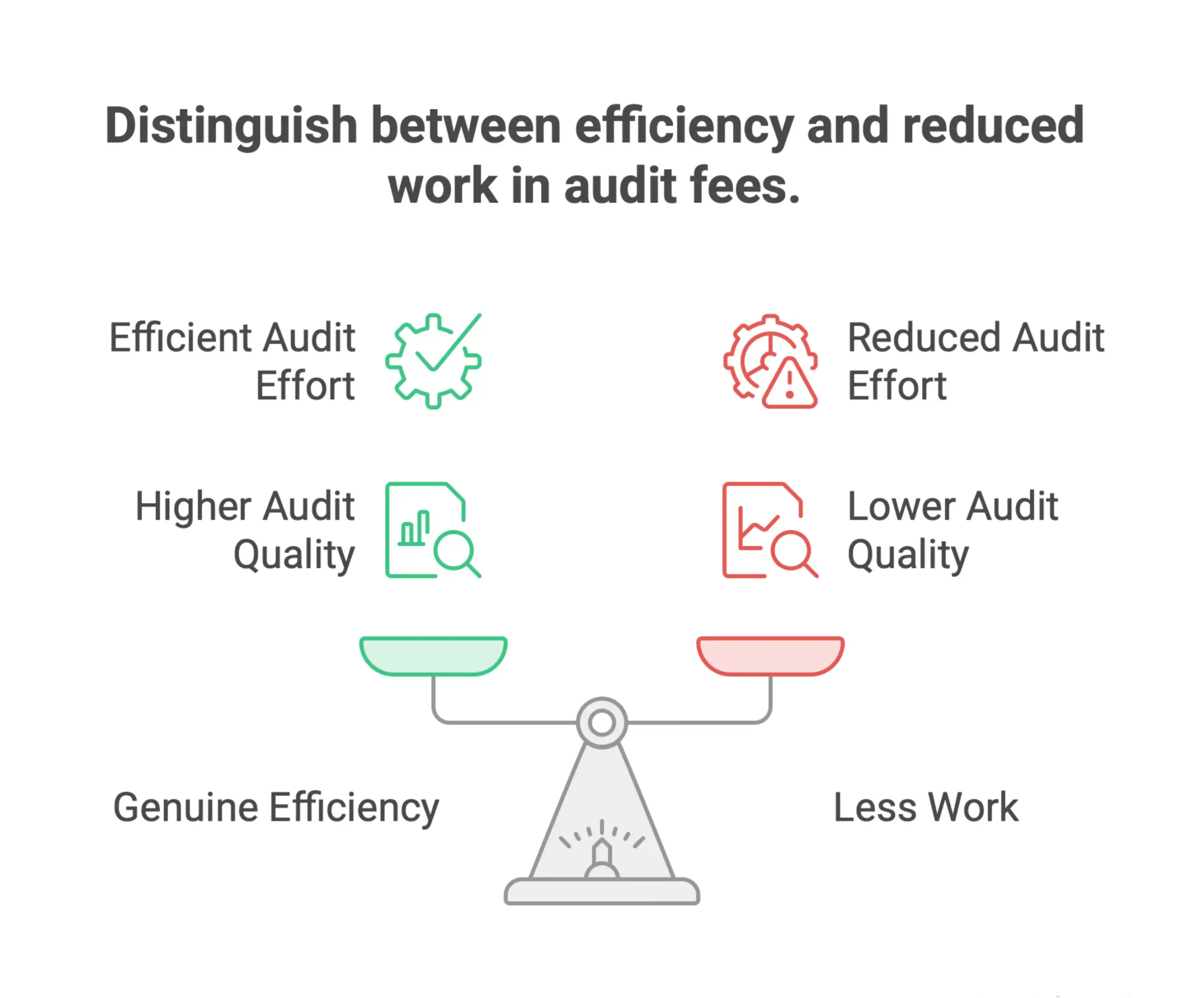
Does the lower fee reflect genuine efficiency, or just less work?
Those are very different outcomes, and the difference shows up in the reliability of financial reporting, not in the invoice.
Why Higher Audit Fees Do Not Automatically Mean Higher Audit Quality
A common assumption works both ways. Low audit fees must mean corners were cut. High audit fees must mean the work was thorough.
The second assumption needs just as much scrutiny as the first.
Higher audit fees often come from factors that have little to do with audit quality. A larger company with more entities, jurisdictions and transactions will cost more to audit. A business with weak internal controls will require more substantive testing. Restated financials, recent acquisitions, new reporting systems, regulatory scrutiny or a higher-risk profile all add scope and increase cost.
In those cases, the higher fee reflects the client’s situation. It does not automatically prove the audit is better.
Complexity and Risk Drive Costs Up
When fees rise because the engagement is genuinely more complex or risky, the extra cost usually reflects necessary work. The auditor may need more hours, specialist input, deeper testing or additional review. That is a reasonable response to the job.
But higher fees caused by poor data quality, weak audit readiness, inefficient processes or poor client coordination do not improve assurance. They create friction. The extra spend is paying for avoidable problems, not necessarily for stronger evidence or better conclusions.
Valuable Audit Effort Versus Inefficiency
The real question is not whether the fee is high or low. It is whether the hours and resources applied match the actual risk.
A well-planned audit with structured data, clear evidence and efficient workflows can produce stronger assurance at a lower cost than a poorly scoped engagement that burns hours without adding much value. Digital tools and cleaner data can help teams spend more time on judgment and less time chasing missing information.
Audit committees and management should avoid using cost as a proxy for quality in either direction. The better question is whether scope, effort and evidence are proportionate to the entity’s risks and complexity.
Materiality Benchmarks and Their Effect on Audit Effort
Materiality is one of the most important judgments in an audit, and it has a direct effect on effort. Raise the threshold, and some procedures, sample sizes and follow-up work may no longer be required, which often means fewer audit hours. Lower it, and the same audit usually needs more testing, wider samples and closer review of items that might otherwise be below the line. Digital tools, including AI tools that help teams process large data sets and focus attention where judgment matters most, can reduce audit effort while supporting better audit quality rather than replacing professional judgment.
How Materiality Thresholds Shape Testing and Review
Auditors usually calculate materiality using a benchmark linked to a financial metric, often a percentage of pre-tax profit, total assets or revenue. The choice should reflect what a reasonable user of the financial statements would see as significant, and auditors may examine prior-year volatility, using sources such as Audit Analytics and insights from accounting research.
If profit is unusually low or volatile, an assets-based or revenue-based benchmark may give a better view of what matters to users.
Once materiality is set, it influences almost every stage of the audit. A higher threshold can mean fewer audit hours and reduced audit effort, while a lower threshold usually requires more testing. It affects which balances are tested, how many transactions are sampled, whether an identified error needs correction and how much time the team spends reviewing the file. In practical terms, materiality affects audit hours and audit fees, and firms often support that judgment with descriptive statistics from comparable engagements.
When Alternative Benchmarks Need Extra Justification
Sometimes auditors or management may suggest non-GAAP or project-specific benchmarks as the basis for materiality. That is not automatically wrong.
The FRC required disclosure of audit materiality thresholds in 2012, which increased visibility into how firms set these benchmarks.
For a capital-intensive business where profit is suppressed during a build phase, revenue or gross assets may better reflect what users care about. On a major infrastructure programme, project-level thresholds may need to reflect the scale of individual contracts rather than consolidated group figures.
The key is justification. Alternative benchmarks should be tied to the needs of financial statement users, documented in audit planning and applied consistently. Empirical studies provide evidence that benchmark choice can affect materiality thresholds and when teams increase audit effort.
Choosing a different benchmark simply because it produces a higher materiality figure and reduces audit effort is not valid. Auditing standards require materiality to reflect user needs, not internal cost pressure, and not to avoid necessary audit work.
That distinction matters because materiality can become too mechanical. A higher threshold may reduce procedures and lower fees, which looks attractive when budgets are tight. But if the threshold does not match what users genuinely consider material, the audit may look efficient while leaving more room for undetected misstatement.
Professional judgment still counts. Benchmarks are the starting point, not the answer.
Data Quality and Comparability: The Weak Point in Benchmarking
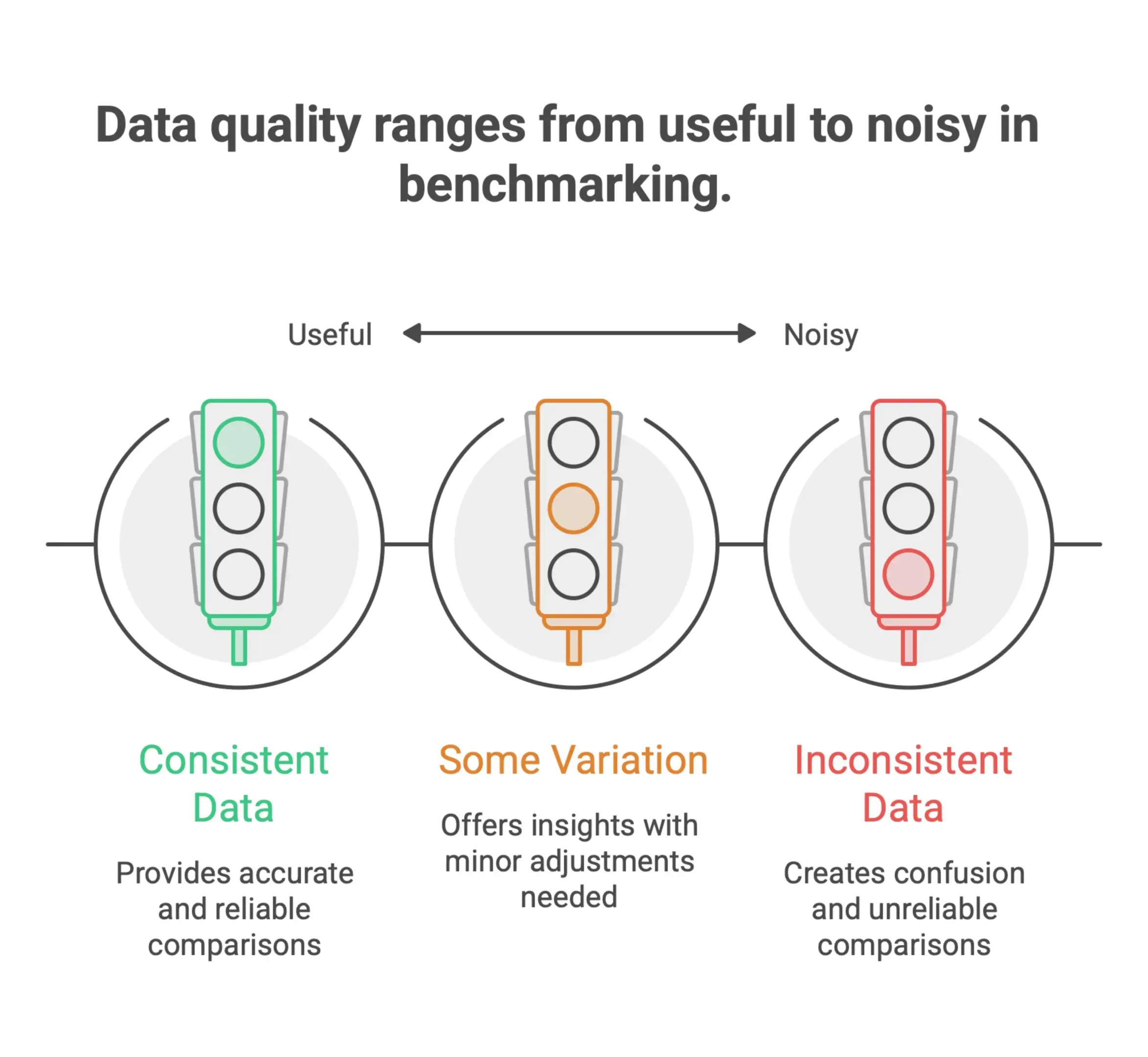
A benchmark is only as good as the data behind it. If the comparators come from different industries, company sizes, risk profiles, accounting policies or scope boundaries, the benchmark stops being useful and starts creating noise.
That is the common failure point in fee and effort benchmarking, whether you are comparing audit fees across companies or project costs across capital programmes.
Why Comparability Matters Before Any Comparison Is Made
In financial audit benchmarking, two audit fees may look similar on paper while reflecting very different realities.
One engagement might be a single-entity statutory audit with mature controls and clean records. Another might cover multiple subsidiaries, complex financial instruments, a first-year reporting standard change and a higher risk of material misstatement. Comparing those fees without adjusting for those differences does not create insight. It creates misleading pressure.
The same issue appears in capital project benchmarking. Two datasets may both be labelled road construction, but one could relate to a simple rural highway while the other covers an urban elevated structure with ground remediation, staged phasing and complex contract packaging. For teams dealing with these variables, a practical cost benchmarking in construction approach depends on comparing like with like before drawing conclusions.
Treating those figures as directly comparable without adjusting for scope, location, time, quantities and risk will distort the cost plan and weaken any assurance work built on top of it, especially where benchmark data is being used alongside cost estimating best practices.
Structuring Data Before You Compare It
Normalisation is not a nice-to-have. It is the basis of sound benchmarking.
In construction cost analysis and project benchmarking, RICS guidance is clear that cost data has to be captured and structured consistently before it can be compared meaningfully across projects. That means aligning elemental breakdowns, adjusting for time and location, confirming scope boundaries and making sure the items being compared actually describe the same thing.
The same discipline applies to audit benchmarking. Before using benchmark audit fees to assess an engagement, reviewers need to confirm that the comparators share the same core characteristics: entity type, industry sector, transaction complexity, reporting framework, reliance on internal controls, prior-year findings and risk profile.
When those checks are missed, benchmarks stop supporting judgment and start distorting it. Lower-than-benchmark fees might reflect genuine efficiency, or they might mean necessary work has been cut. Higher-than-benchmark fees might reflect inefficiency, or they might be justified by real complexity.
Without comparable, current and well-structured data, neither conclusion can be made with much confidence. Benchmark freshness matters too. Outdated data can be just as misleading as poorly matched comparators, especially when business models, reporting demands or audit methods have changed.
How Audit Committees Should Use Audit Fee Benchmarking
Benchmarking audit fees and audit effort can be very useful for audit committees, but only when it leads to better questions. The goal is not to buy the cheapest audit. It is to understand whether the planned work matches the company’s risk profile, complexity and reporting requirements.
Ask Questions, Not for Reductions
When audit fees sit above or below benchmark audit fees, the first response should be curiosity, not pushback.
A fee above benchmark may reflect higher-risk areas, weak internal controls, expanded scope, new systems, acquisitions or specialist input. A fee below benchmark may point to real efficiency gains through better data or automation, but it can also mean the audit plan is too thin for the risk.
Either way, it deserves a closer look.
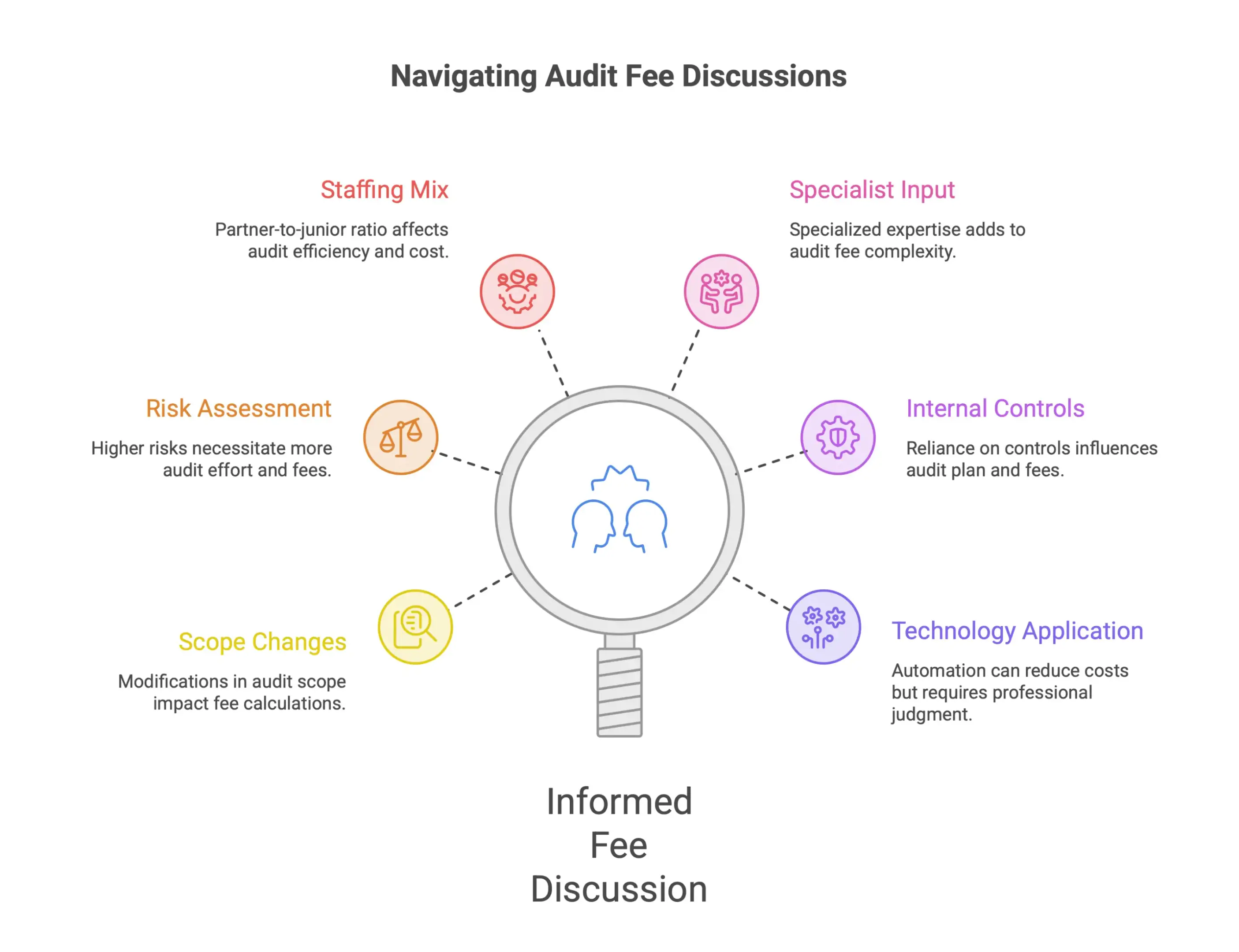
Useful questions to raise with external auditors include:
- What has changed in scope, risk assessment or staffing mix compared to the prior year?
- How many audit hours are planned, and how are they split across partners, managers and juniors?
- Where are specialists being used, and why?
- How much reliance is placed on internal controls, and what testing supports that reliance?
- What technology is being applied, and does it reduce manual procedures without removing professional judgment?
- Are prior-year findings fully resolved, and how have they affected planned testing?
These questions move the discussion away from the fee number and toward the substance behind it.
Use Audit Quality Indicators Alongside Fee Benchmarks
Fee benchmarks alone cannot tell an audit committee whether assurance is strong. The PCAOB's audit quality indicators initiative was developed to support a broader view, grouping potential indicators across audit professionals, audit process and audit results.
Measures such as partner hours, restatement rates, staff turnover and findings from regulatory inspections give fee data context. That is far more useful than comparing cost in isolation.
Protect Auditor Independence During Fee Negotiations
Fee pressure creates a governance risk. When management drives audit fees down through procurement-style negotiations, auditor independence can be weakened in practice, even if it still appears intact on paper.
Audit committees, not management, should own the fee discussion with external auditors.
That matters because agreeing to lower fees without understanding which hours or procedures are being removed shifts risk to the committee without full visibility. A lower number is only helpful if the underlying work still supports the level of assurance the company needs.
If a fee lands outside the peer range, the committee should also document why it accepted that exception. The rationale might be scope expansion, higher risk, a one-off change in systems or a confirmed efficiency gain. Clear documentation helps show that the decision was based on judgment, not simply price pressure.
The discipline is similar to sound project controls thinking. Reducing cost makes sense when it comes from genuine efficiency, which is why teams should understand the difference between cost benchmarking and cost control. It does not make sense when it cuts out work that still needs to be done.
Applying the Same Principles to Capital-Project Cost Assurance
The tension between benchmarking and quality is not unique to financial auditing. Anyone responsible for cost assurance on a capital project faces a similar trade-off.
Benchmarks can help teams judge whether review effort, validation scope and assurance fees are proportionate. Used as a blunt cost-cutting tool, they create the same risks audit committees worry about in financial reporting.
Construction Cost Audits Face the Same Benchmarking Trap
In EPC and major capital projects, cost assurance can include independent cost reviews, quantity verification, change-order audits, contractor invoice audits and structured reviews of project cost forecasts. Each activity takes time, people and budget. The difference between cost benchmarking and forecasting matters here because benchmark comparisons can inform the review, while forecasting and control activities track how current project performance is likely to develop.
When project owners or procurement teams use benchmark comparisons mainly to trim those costs, the result is predictable. Fewer review hours mean less verification of quantities, weaker scrutiny of variation claims and less time to test whether forecasts still match current scope.
Errors that should have been flagged during review can slip into the project cost baseline, where they tend to grow as the job progresses.
The parallel to fee pressure in financial auditing is clear. A cost audit compressed to fit a benchmark budget is not more efficient. It is simply less complete.
Where Better Data and Automation Can Improve Efficiency Safely
The better question is whether review hours can be reduced through better data, not through less scrutiny.
Structured cost data, consistent quantity formats, normalised unit rates and well-maintained historical cost databases help reviewers spot anomalies faster and focus on the areas where risk actually sits. For project teams managing comparable project data and benchmark databases, CosMO can support the discipline of cost normalization and cost modelling.
Automated checks on invoice line items against contract rates, or flags for quantities outside expected ranges, can cut routine effort without weakening professional judgment.
That is the same principle seen in financial auditing. Technology and better data quality are valid ways to improve efficiency, but only when expertise, controls and independent review remain in place.
Automation should handle repetitive checks. It should not replace the person who understands project risk, scope change and contractor behaviour.
What Project Teams Should Benchmark Beyond Cost Alone
Cost assurance benchmarks are most useful when they go beyond fee levels. Teams should also look at scope coverage, finding rates, change-order approval accuracy and forecast accuracy over time.
A review that costs less but keeps missing overruns or misstated contingencies is not efficient. It is cheap in the short term and expensive later.
Teams that measure the outcome of their assurance process, not just the cost of running it, are in a much stronger position to tell whether benchmarks are supporting quality or quietly undermining it.
Practical Takeaways: Use Benchmarks to Improve Judgment, Not Replace It
Benchmarking audit fees and audit effort is useful. It improves transparency, makes comparisons more meaningful and gives audit committees a better basis for challenging assumptions.
The problem starts when benchmarks stop being decision-support tools and become blunt levers for cutting cost, regardless of whether the work being removed is actually needed.
The balance is straightforward. Lower costs are positive when they come from better data, smarter sampling, stronger planning, tighter internal controls or technology that removes low-value manual work. They are a concern when they come from squeezed audit hours, reduced supervision or weaker testing.
The same applies in the other direction. Higher costs are only justified when they reflect real complexity, broader scope, greater risk or the evidence demands of the engagement. They are not justified by poor execution, messy data or inefficient processes.
A Simple Checklist for Balancing Cost and Audit Quality
Before using a benchmark to challenge audit fees or audit effort, work through these questions:
- Is the comparison valid? Are the organisations in the benchmark truly comparable in size, industry, risk profile, internal controls maturity and reporting requirements?
- What is driving the gap? If actual fees sit above the benchmark, is that due to complexity, scope growth, poor data quality or a risk factor specific to this engagement?
- Where would the reduction fall? If fees are cut, which audit hours disappear, which tests get scaled back and which evidence is no longer collected?
- Is efficiency the source of the saving? Better planning, automation and structured data can lower cost without weakening coverage. Arbitrary fee caps cannot.
- Has professional skepticism been preserved? External auditors still need the independence and time to challenge, investigate and conclude without pressure shaping their judgment.
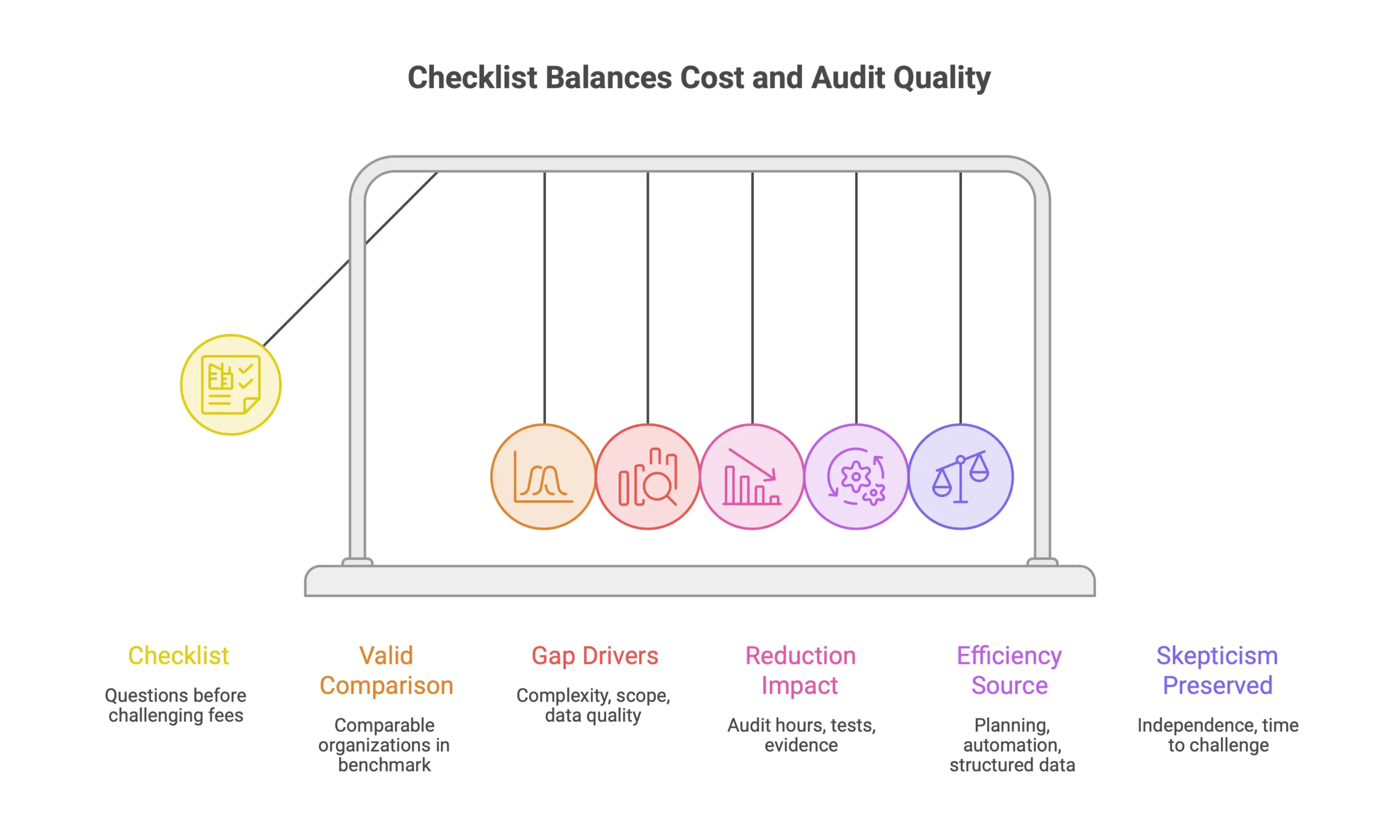
Audit committees and project assurance teams that use benchmarks well treat them as the start of a structured conversation, not a shortcut to cutting costs first and asking questions later.
The aim is a well-evidenced, appropriately scoped engagement at a cost that reflects genuine efficiency. Tools that improve data consistency and workflow visibility can support that discipline, but they should not make the judgment for you.
Benchmarks sharpen judgment. They do not replace it.
Frequently Asked Questions
Is benchmarking audit fees bad for audit quality?
No. Benchmarking is useful when it helps audit committees understand whether fees are reasonable for the scope, risk and complexity of the engagement. It becomes risky when benchmark figures are treated as hard caps, leading to reduced audit hours, weaker review and less evidence.
Why can a lower audit fee be a warning sign?
A lower fee is not automatically a problem if it reflects better data, stronger controls or genuine efficiency. It becomes a warning sign when there is no clear explanation for the reduction and the saving appears to come from cutting testing, supervision or professional judgment.
How should project teams apply benchmarking to cost assurance?
Project teams should benchmark more than the cost of assurance. They should also review scope coverage, finding rates, change-order accuracy, forecast reliability and data quality. A cheaper review that misses overruns, weak quantities or misstated contingencies can create higher costs later.
Ready to Take the Next Step?
If you want to use benchmarking to improve cost assurance without weakening review quality, explore Nomitech’s full suite or get in touch to discuss your data, benchmarking and project controls needs.





Stay Up to Date
Subscribe to our Newsletter today and receive the latest updates, trends, expert insights, and exclusive offers tailored to your specific industry.