

What Is Price Benchmarking? Definition and Examples
TL;DR: Price benchmarking compares prices against relevant market, supplier, competitor or historical data to judge whether they are fair and competitive. It is most useful when data is normalized for scope, location, timing, quality and contract terms before decisions are made.
Price benchmarking helps answer a practical question: is this price reasonable? For pricing teams, procurement professionals, estimators, cost engineers and project teams, it is the practice of comparing a price with relevant market evidence so they can judge fairness, competitiveness and commercial fit before they set rates, approve budgets or negotiate.
That question comes up everywhere. A business may be deciding what to charge customers, taking into account market position and customer willingness to pay. A procurement team may be reviewing supplier quotes. An estimator may be checking whether a budget still reflects the market. A project team may be preparing for negotiation. In construction, engineering and project delivery, that matters even more because prices are shaped by scope, quantities, location, schedule pressure, risk allocation and market conditions.
A benchmark gives those decisions a reference point beyond instinct, habit or a single proposal. Used well, it supports pricing strategy, procurement negotiations, budget validation and cost control. This guide explains what price benchmarking is, how it differs from cost benchmarking, how the process works, which data sources are commonly used, why normalization matters, where it is applied, and the mistakes to avoid.
What Is Price Benchmarking? Definition and Examples
Price benchmarking is the practice of comparing prices with relevant competitors, suppliers, industry peers, market averages or historical internal data to understand whether a price is high, low, fair or out of step with the market.
As the World Bank describes it, price benchmarking uses market analysis, cost estimating tools and design analysis to establish a fair market price and support like-for-like comparisons across works, goods or services.
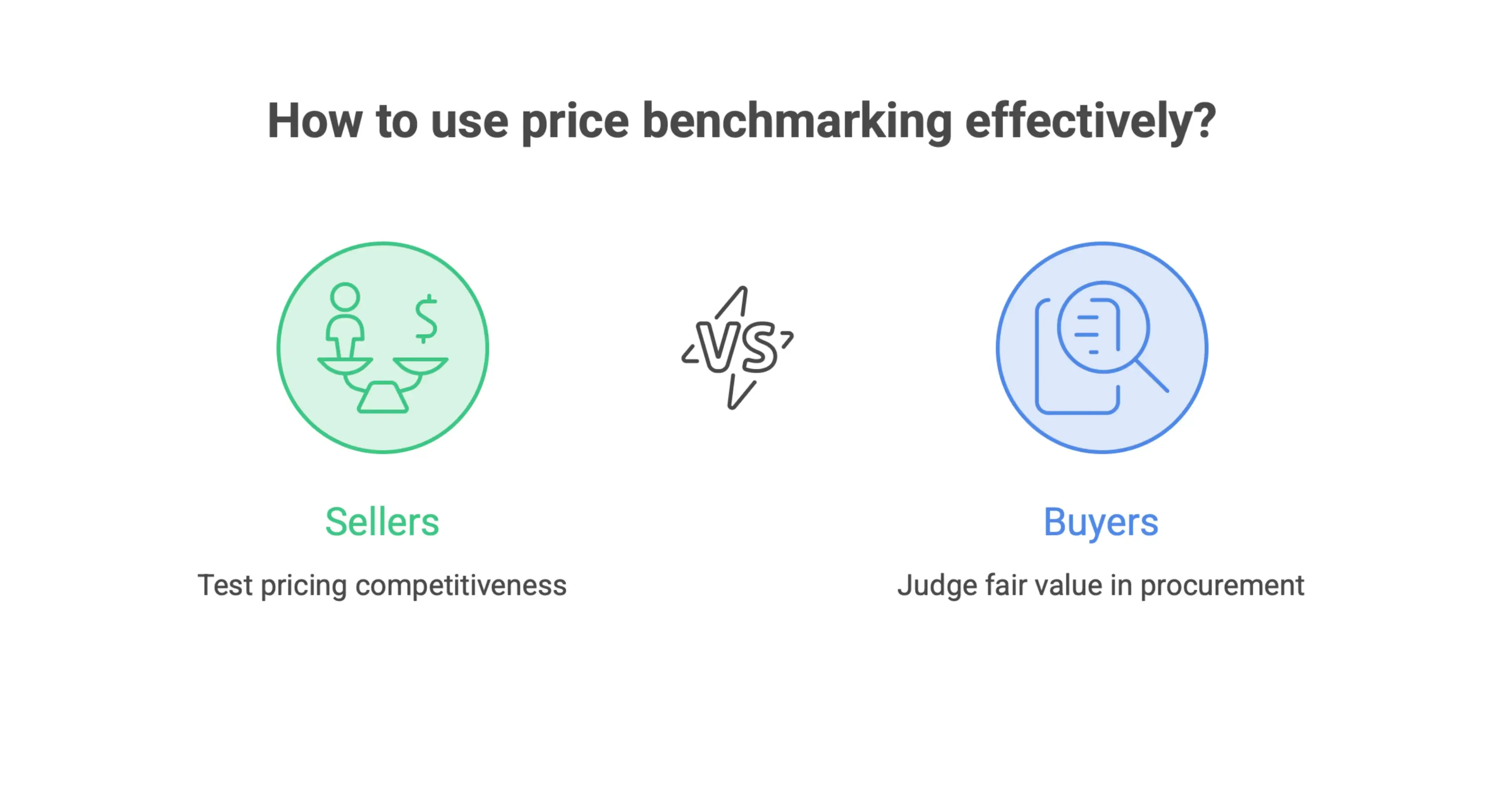
It can be used from either side of a transaction. Sellers use price benchmarking to test whether their pricing is competitive and aligned with customer expectations. Buyers use it in procurement to judge whether supplier quotes, tender returns or contract rates represent fair value.
Price Benchmarking vs Cost Benchmarking
Price benchmarking and cost benchmarking are closely related, but they do not measure the same thing.
Price benchmarking looks at the amount charged or paid. That may be the figure on a quote, tender, invoice, framework agreement or contract. Cost benchmarking looks beneath that number and examines the drivers behind it, such as quantities, productivity, scope, resources, delivery conditions and risk.
Both are useful. A benchmark price tells you where a number sits against the market. A cost benchmark helps explain why it sits there. Understanding the difference between cost benchmarking and cost estimating is especially important for procurement teams reviewing subcontractor packages or estimators validating unit rates. It affects whether the right response is to challenge the price, review the scope, adjust the estimate or
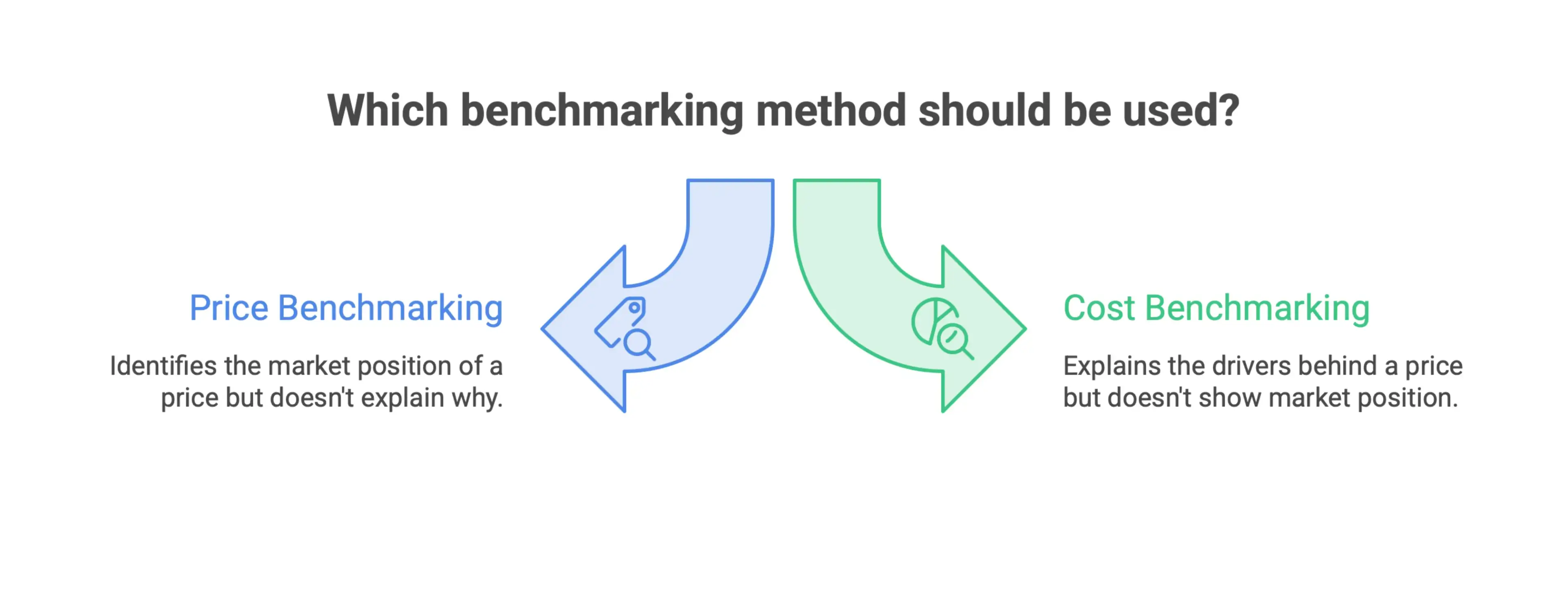
accept that the difference is justified.
Why Price Benchmarking Matters
Price benchmarking has two main commercial uses. It helps organisations set more competitive prices for what they sell, and it gives buyers a clearer view of whether what they are paying is fair.
Commercial Pricing
On the sales side, benchmarking gives businesses a more grounded view of their position in the market. By comparing prices with competitors, industry peers and market averages, teams can see whether they are priced above, below or in line with comparable alternatives.
That insight feeds directly into pricing strategy. If a company is consistently above market without a clear value case, the price may be difficult to defend. If prices sit below comparable competitors, there may be room to improve margins. Either way, benchmarking replaces gut feel with evidence and supports decisions about holding, lowering or increasing prices.
Benchmarking in Procurement
For procurement teams, price benchmarking provides an independent reference point when reviewing supplier quotes, tender returns or contract rates. Instead of relying only on what a supplier submits, teams can compare those figures with historical purchases, previous tenders, market intelligence and comparable supplier data.
That gives teams more leverage in supplier negotiations because benchmark data shows when a quoted rate is above market. If a proposed rate sits well above relevant benchmark prices, procurement can challenge it with evidence rather than opinion. As UK Government bid evaluation guidance notes, benchmark prices can provide a useful objective standard for assessing tenders, provided the benchmark is based on robust market analysis.
In practice, this helps teams validate budgets, identify opportunities for cost savings, improve supplier discussions and focus spending on business value in future procurement. It also supports procurement strategy by helping teams assess whether the organization pays above market.
How the Price Benchmarking Process Works
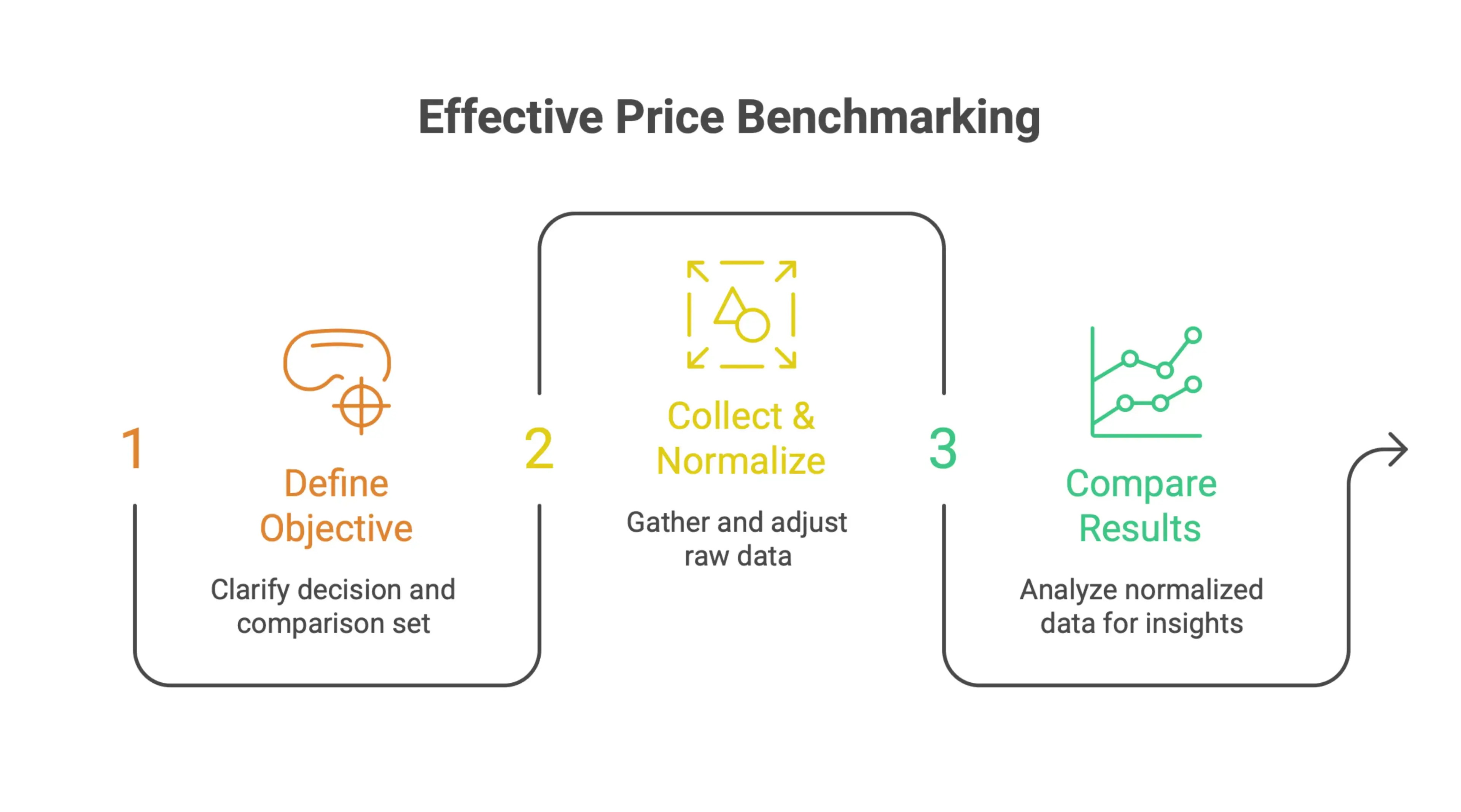
Effective price benchmarking follows a simple logic. Define the goal, choose the right comparisons, collect and normalize the data, compare the results, then decide what to do next. The steps are straightforward, but each one matters.
Define the objective and comparison set. Start with the decision you need to make. Are you checking whether a supplier quote is competitive? Validating a budget estimate? Testing whether your own prices reflect the market? The answer shapes the comparison set. It determines which products, services, work packages, suppliers, locations or contract types should be included. If the comparison set is wrong, the benchmark will point you in the wrong direction.
Collect, normalize and compare benchmarking data. Once the scope is clear, gather relevant information from internal records, historical jobs, supplier quotes, tender returns, market intelligence and industry sources. Collection is only the first step. Raw prices often reflect different specifications, volumes, geographies, dates, contract terms and service levels. A subcontractor rate in a busy metropolitan market today is not automatically comparable with a rate from another region a year ago. Normalization adjusts for those differences so the comparison is closer to like for like.
Turn benchmarking results into decisions. A benchmark should not just sit in a report. It should support action. That may mean renegotiating a supplier rate, challenging an allowance, updating a pricing model, refining an estimate or flagging a procurement outcome for review. Benchmarking and estimating systems, including cost benchmarking tools for large organizations, can help by keeping pricing and estimating data easier to structure, compare and reuse across projects. The value comes when the analysis changes a decision
Common Data Sources for Price Benchmarking
The quality of price benchmarking depends on the quality of the data behind it. No single source tells the whole story, so strong benchmarking usually combines several inputs and checks them against one another.
Internal Data and Historical Data
Internal records are often the best starting point. Invoices, purchase orders, contract rates and historical project data show what was actually paid or charged. They may also include useful detail by supplier, location, period, package or scope.
That detail is valuable because it reflects real transactions, not theory. The limitation is that internal data may also reflect outdated agreements, unusual negotiations or project conditions that no longer apply, so internal records alone cannot answer questions about market competitiveness or whether current pricing still reflects current market conditions. When structured well enough to compare costs over time, spend analytics can reveal hidden opportunities and save companies $20 million per $1 billion analyzed, while effective benchmarking can also save $20M per $1B analyzed. Used carefully, it gives a solid baseline. It should not be treated as the whole market.
Supplier Quotes, Tender Returns and Market Intelligence
Live supplier quotes, tender returns, and related data collection are among the most current benchmarking inputs available. They are especially useful in procurement and construction, where the scope can often be defined clearly enough to compare bid tabs, subcontractor rates, material prices and package pricing.
Supplier intelligence adds context. It may explain why prices have moved, which suppliers are capacity constrained, where premiums are appearing, or whether a low price comes with exclusions. It can also be informed by win loss analysis or customer feedback where those signals help explain why a quote succeeded, failed, what competitors quoted in deals, or was perceived as strong value. These inputs give procurement leaders more actionable insights into price competitiveness and performance gaps. That kind of insight is hard to get from a spreadsheet alone.
Public Prices, Industry Reports and Third-Party Databases
Published price lists, government procurement data, trade association reports and third-party cost databases can broaden the benchmark beyond your own experience, and many companies use these public sources when direct price visibility is limited. They are useful reference points, particularly where internal data is thin. Over half of vendors keep pricing details hidden from buyers, which is why public sources still matter.
They also need care. Public pricing pages usually show competitor list prices and packaging rather than final negotiated rates. They may not fully reflect discounts, service levels, delivery terms, regional conditions or project-specific scope. Industry reports can also show market-wide pricing trends and adoption of different pricing models. Industry benchmarking data works best when it is combined with internal records and direct market intelligence, then normalized before being used for decisions. Platforms such as CosMO can support benchmarking workflows that depend on historical cost data, normalization, cost modeling and benchmark databases.
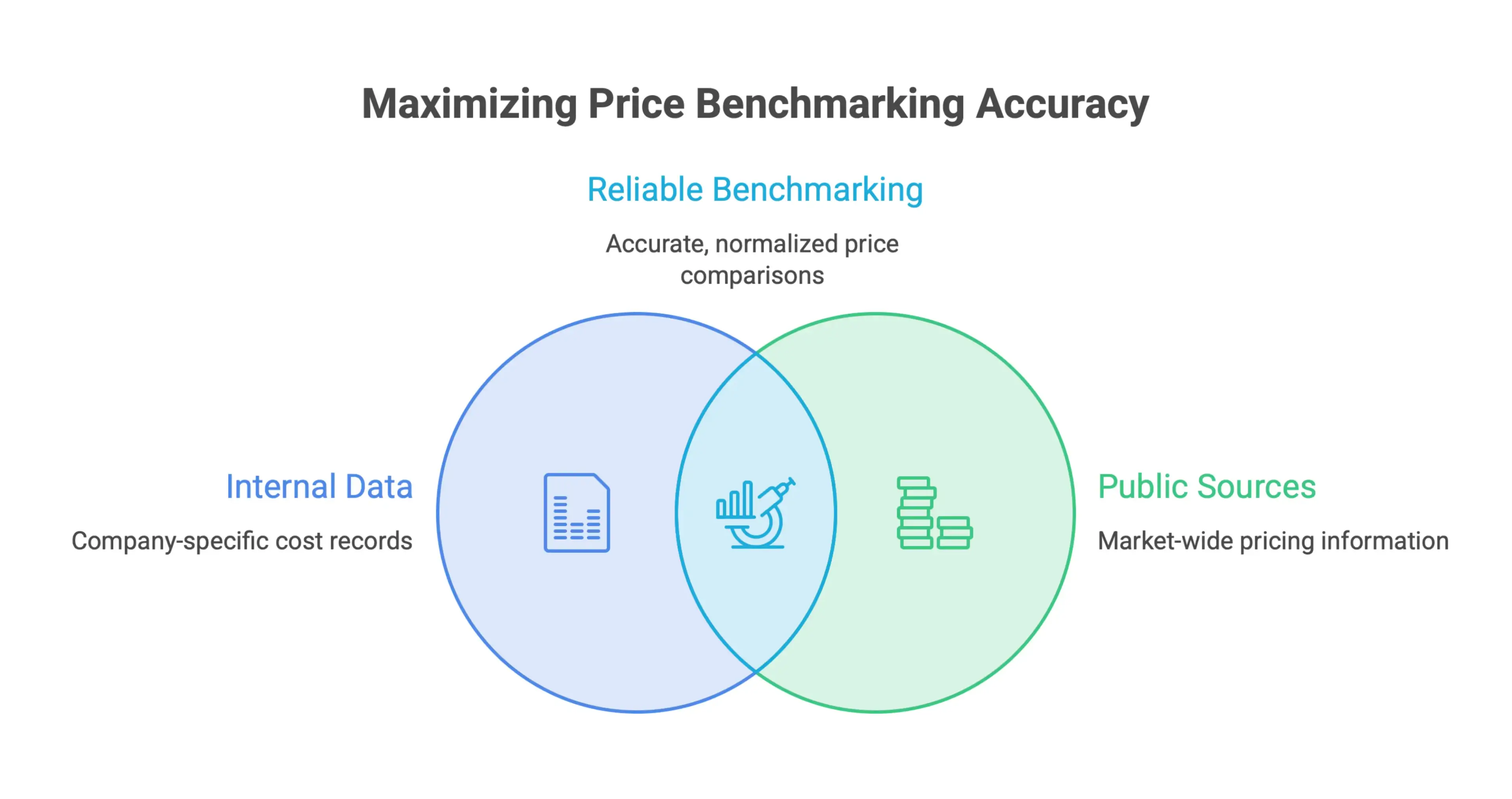
The strongest approach is not to pick one perfect source. It is to triangulate several credible sources and make the comparison fair.
Why Normalization Is Essential
Comparing headline prices without adjustment is one of the most common mistakes in price benchmarking. A rate that looks cheaper may simply include less scope, a lower specification, different service quality, softer service obligations or a different allocation of risk. Without normalization, the comparison may look precise but still be misleading.
Reliable benchmark prices need to account for variables such as specification, quality, scope, volume, geography, timing, currency movements, inflation, contract terms, delivery obligations, discounts, service levels, risk transfer and total cost. Those adjustments turn raw figures into prices that can be compared more fairly.
Construction makes this easy to see. Two concrete prices from different regions may appear far apart. But once local aggregate costs, delivery distance, admixture requirements, pour method and curing conditions are considered, the gap may shrink. The same applies to steel fabrication rates across countries, where material grade, section size, surface treatment, lead time and import duties can change the final price. A rate excluding shop drawings, coating and site delivery is not equivalent to an all-in rate that includes them.
The same logic applies to labour rates, MEP package prices, equipment hire and subcontractor tenders. A low lump-sum bid may exclude commissioning, testing or temporary works that another bidder has allowed for. Two equipment hire rates may look identical, while the real risk position differs because mobilisation, maintenance and downtime are handled differently.
As RICS guidance on cost analysis and benchmarking makes clear, normalizing data for scope, specification, location and time is a basic requirement before any meaningful comparison can be made.
The aim is not to force every price into the same number. It is to make sure the differences you see are real commercial differences, not mismatches in what is being measured, and that the benchmark criteria align with industry standards.
Price Benchmarking in Construction and Engineering
For estimators, quantity surveyors, cost engineers and project controls teams, price benchmarking is a practical way to keep estimates, procurement decisions, the wider procurement function and cost models tied to market reality. For a deeper look at cost benchmarking in construction, the same principles of relevant data, normalization and project context are central to meaningful comparison.
At the estimate stage, benchmarking is often used to check a draft cost plan before it becomes a committed number. A cost engineer preparing a Class 3 estimate for a process plant, for example, may compare unit rates for structural steel, concrete foundations and mechanical packages with historical data from similar projects, adjusted for location and current market conditions. If a line item falls well outside the benchmark range, it is usually a prompt to review the scope assumptions, productivity factors or procurement approach behind it and identify areas where assumptions or rates need closer review. It is not automatically proof that the estimate is wrong.
During procurement, the focus shifts to live market pricing. Procurement teams and quantity surveyors reviewing subcontractor packages or supplier quotes may compare bid tabs across tenderers, check returned rates against internal history and validate material prices against current market intelligence. Labour rates, equipment hire, bulk materials and MEP packages are common areas for this kind of review. When there is only one tender, or limited competitive tension, a credible benchmark gives the team a way to judge whether the price is reasonable before negotiating or awarding, which can also support stronger supplier relationships by making pricing discussions more evidence-based.
At project completion, actual costs should feed back into benchmark databases. This closes the loop. The next estimate is stronger because it is based on lessons from completed work, not just assumptions made at tender stage. Good benchmarking workflows make this easier by keeping historical pricing data structured, comparable and usable.
The main point, as CNBA's construction cost benchmarking guide makes clear, is that benchmarks are decision aids. They help professionals ask sharper questions and make better calls. They are not a replacement for project-specific estimating, and they only work when scope, location, timing and contract conditions are taken into account.
Common Price Benchmarking Mistakes
Even a well-intentioned benchmarking exercise can lead to poor decisions if the method is weak. These are the mistakes most likely to undermine the value of the analysis.
Comparing non-equivalent items. Headline rates are only useful when the scope, specification, volume, contract terms and service levels are aligned. Comparing a lump-sum subcontract price with a reimbursable rate, or a bulk material price with a small-order quote, will distort the result no matter how neat the spreadsheet looks, especially when usage patterns differ, such as high volume demand.
Relying on public list prices alone. Published prices rarely show what organisations actually pay. Discounts, rebates, framework agreements and negotiated terms can move the real price significantly. If list prices are the main reference, the benchmark may overstate the market and weaken negotiations.
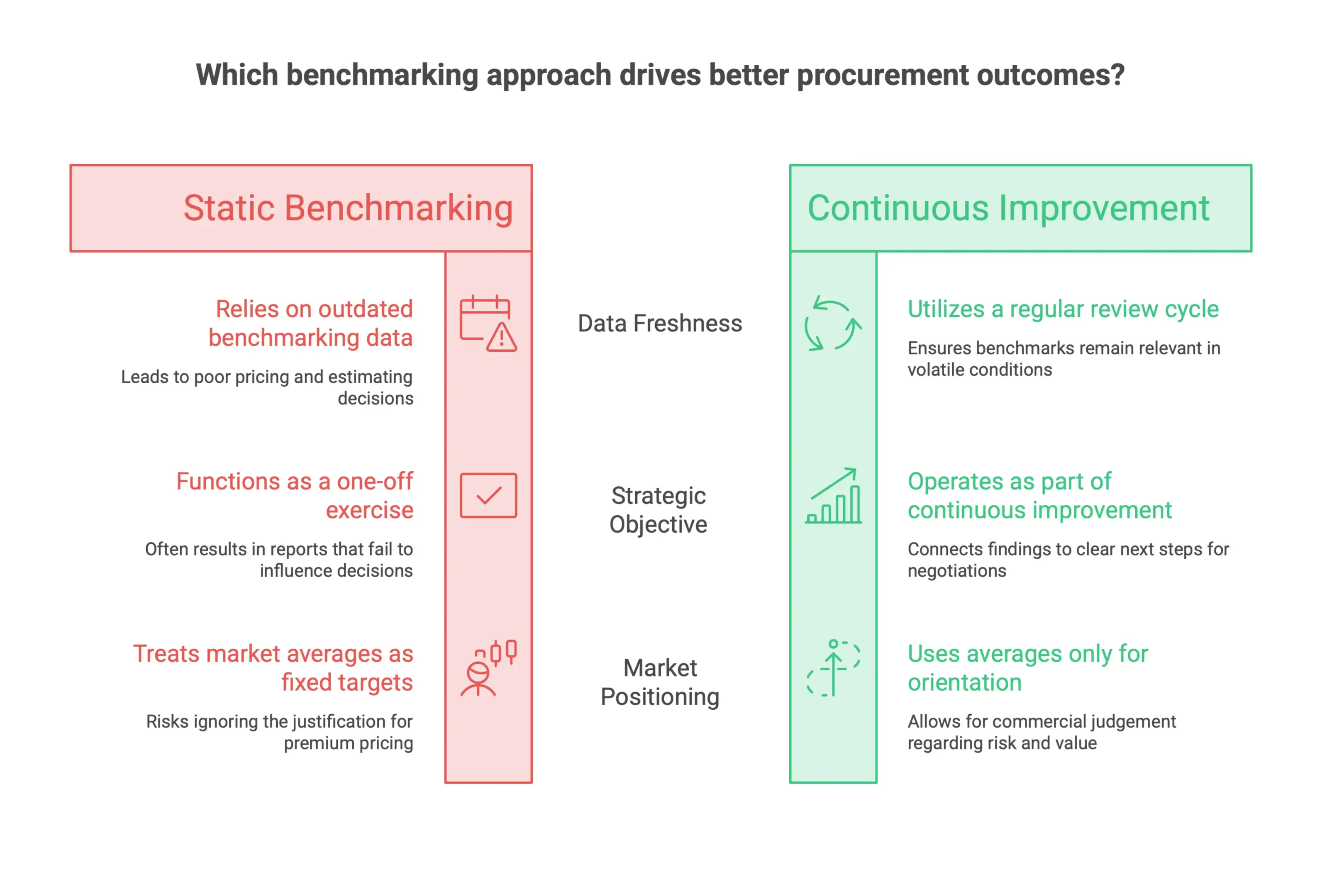
Using outdated benchmarking data. Markets move. Labour rates, material prices, supplier capacity, demand and competitor behaviour all change over time. A benchmark based on old data can lead to poor pricing, estimating or procurement decisions, especially in volatile conditions. Benchmarks need a review cycle, not a one-off exercise. Organisations use benchmarking as part of continuous improvement to stay competitive, not as a one-time check.
Ignoring context. A price that looks high may reflect a premium supplier, a tight programme, a remote site, difficult logistics or risk that other bidders have excluded. Remove that context and the benchmark may look objective while missing the point.
Treating market averages as fixed targets. Averages show where the middle of the market sits. They are useful for orientation, but they are not targets in themselves. A price above average may be justified, and a price below average may carry risk.
Failing to act on the findings. Benchmarking that ends in a report, without influencing a decision, negotiation or pricing model, has limited value. The benefit comes when the findings are connected to a clear next step.
Good price benchmarking combines reliable data, careful normalization, commercial judgement and enough technical context to understand what the numbers really mean.
Frequently Asked Questions
What is the main purpose of price benchmarking?
The main purpose is to determine whether a price is reasonable compared with relevant alternatives. It helps sellers assess competitiveness and helps buyers validate quotes, tenders or contract rates so they can make informed decisions before making commercial decisions.
What makes a price benchmark reliable?
A reliable benchmark is based on relevant, current and comparable data. The figures should be normalized for differences such as scope, quality, volume, location, timing, contract terms and risk allocation so the comparison reflects real price differences.
How often should price benchmarks be updated?
Price benchmarks should be reviewed regularly to maintain competitive positioning and reflect current market changes, especially in markets affected by changing labour rates, material prices, supply conditions or demand. Frequent updates help teams stay aligned with price competitiveness rather than relying on stale benchmarks. In fast-moving construction and engineering environments, outdated benchmarks can quickly weaken estimating, procurement and negotiation decisions.
Ready to Take the Next Step?
If you want to turn price benchmarking into more reliable cost comparisons, estimates and procurement decisions, explore Nomitech’s full suite or get in touch with the team.




Stay Up to Date
Subscribe to our Newsletter today and receive the latest updates, trends, expert insights, and exclusive offers tailored to your specific industry.