

Cost Benchmarking in Construction: A Complete Guide
TL;DR: Cost benchmarking in construction empowers project teams to compare project costs using real project data, identify variances and cost deviations, and optimize budgets. This guide covers the benchmarking process, key cost data sources, regional and sector examples, common pitfalls, and how leveraging digital tools leads to continuous improvement, predictable outcomes, and more competitive bids.
Introduction to Cost Benchmarking in Construction
Construction leaders today are facing higher stakes than ever: expectations for speedy delivery, increased complexity, tight budgets, and shifting market conditions. A blown estimate, a material price spike, or a single error in a spreadsheet can quickly derail construction projects, threatening profit margins and a company’s reputation. Fragmented cost data and inconsistent processes add risk and uncertainty.
With construction projects spread across multiple business units, regions, and delivery models, precise cost management requires much more than guesswork. Traditional cost estimating alone often falls short, leaving too much room for cost outliers and missed opportunities to improve project performance.
Cost benchmarking in construction provides a structured approach to evaluating project costs by systematically comparing them against historical data, internal and external industry benchmarks, and similar projects. Using dedicated cost benchmarking platforms and digital tools, project teams and project managers can identify inefficiencies, highlight opportunities for resource allocation, and drive continual, meaningful analysis on every project’s life cycle.
This ultimate guide explains how benchmarking results and the right cost management framework can transform estimating discipline. It is the backbone for reliable, market-driven budgets and competitive decision making.
What is Cost Benchmarking in Construction?
Cost benchmarking in construction is the practice of comparing project costs against historical data or established standards across similar projects. The benchmarking process uses both internal benchmarking, within the same organization or business units, and external benchmarking, against industry peers or broader industry standards, to reveal performance gaps and identify opportunities for cost efficiency.
As ResearchGate outlines, effective cost benchmarking helps identify cost deviations, inefficiencies, and best practices throughout the entire project’s life cycle. It serves as a reference point for evaluating current project data, controlling costs, and improving estimate accuracy.
Key aspects of construction cost benchmarking include:
- Standardized cost coding to ensure comparability and align cost data across multiple projects and different business units.
- Unit cost benchmarking, such as cost per gross square foot or other relevant metrics for each specific project type.
- Continuous comparison of actual project performance and productivity rates against established industry benchmarks and historical data.
- Feedback loops that drive continuous improvement by learning from both completed and ongoing projects.

By systematically comparing project data to benchmarks, construction firms can identify variances that highlight underperformance in labor, materials, overhead, or indirect costs. This allows for targeted corrective actions and more predictable outcomes.
The Role of Cost Benchmarking in Executive Decision Making
When executive leaders oversee multiple construction projects, clear benchmarks create a transparent, unbiased basis for decision making. They provide essential reference points for comparing performance, evaluating project managers, and reallocating resources among business units or sites.
One popular example comes from the University of Texas System, which uses standardized benchmarking to compare project costs per gross square foot, excluding non-comparable extras. This way, true cost performance is visible.
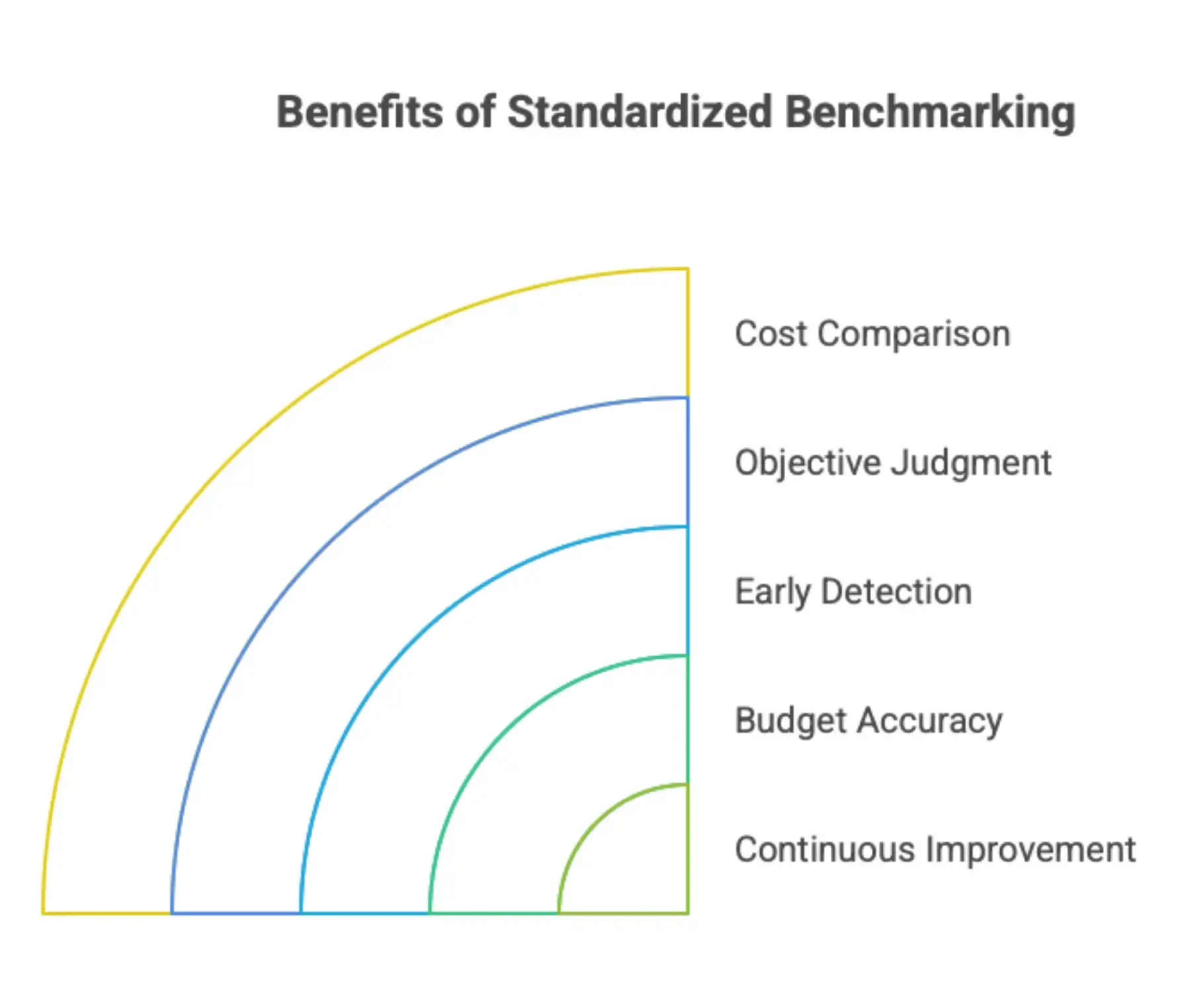
Standardized benchmarking empowers decision makers to:
- Compare project costs across business units or different business models
- Use key performance indicators instead of subjective judgment
- Spot cost outliers and operational deficiencies early in the project’s life cycle
- Improve budget accuracy by basing decisions on objective historical data and proven benchmarks
- Enable continuous improvement by feeding lessons learned back into each new project
Leveraging benchmarking allows executives to move confidently beyond average costs or gut feeling, ensuring budgets are both ambitious and realistic in line with industry standards and market conditions.
Digital tools such as Nomitech’s benchmarking suite reduce the friction of collecting data, organizing benchmarking results, and implementing a cost management framework at scale. This paves the way for predictable outcomes on even the largest portfolios.
Key Benefits of Cost Benchmarking in Construction Projects
Applied strategically, cost benchmarking transforms construction management from reactive troubleshooting into a proactive process focused on continuous improvement and cost efficiency. The benefits of rigorous benchmarking ripple through every stage of construction projects.
Informed Design Development and Cost Planning
Early-stage design and conceptual cost estimating are packed with uncertainty. By benchmarking project costs using historical data and industry benchmarks, project managers and design teams can anchor cost models and design development in reality. Accurate benchmarking shifts estimating away from guesswork and closer to the real market conditions faced by similar projects.
- Set cost targets using actual project costs tracked on prior builds
- Inform resource allocation and evaluate design options with cost performance in mind
- Improve estimate accuracy by referencing cost models proven valid on past projects
- Enable quick adjustment for scope changes, reducing the risk of budget busts
With benchmarking, everyone from architects to owners works from the same set of reference points. The outcome is more collaborative, productive project teams and fewer late-stage surprises.
Value Engineering and Financial Certainty Through Benchmarking
Cost benchmarking supports more than budget compliance. It provides key feedback for smart value engineering and for delivering financial certainty across the project's life cycle. Firms like IPS show how early integration of construction cost benchmarking enables:
- Continuous comparison of proposed design options to cost data and historical norms
- Identification of cost outliers or overspending early in the process
- Evidence-based evaluation of project performance and trade-offs
- Greater stakeholder trust and buy-in using benchmarking results over estimates alone
Robust benchmarking supports both operational savings and long-term cost efficiency, not just the lowest upfront bid. It strengthens negotiations, validates project funding decisions, and helps drive accountability throughout project management.
Data Collection Methods and Benchmarking Process
The success of your cost benchmarking initiative hinges on three foundations: data collection, consistent methodology, and relevance to your project scope. Here’s how to develop an overall cost management framework that produces meaningful benchmarking results.
Leveraging Global and Local Benchmark Data
Effective benchmarking demands access to both global market conditions and local project data. Industry leaders such as Currie & Brown provide localized and international cost databases that account for different business units, labor rates, and supply chain realities.
- Cross-check project costs against local and industry benchmarks
- Identify variances in material and labor pricing across locations
- Anchor estimates to the actual cost data documented in sector-specific databases
By drawing on both micro-level detail and large-scale market trends, benchmarking delivers sharper, more relevant analysis for every construction project.
Building and Utilizing Historical Data Repositories
A robust benchmarking process relies on historical data pooled from previous similar projects. Providers like Compass International focus on historical data for every type of construction project, across sectors and markets.
- Create and maintain a centralized cost estimating database within the same organization
- Use granular breakdowns, such as cost per square foot, cost per parking space, or unit cost benchmarks, to isolate cost drivers
- Apply historical norms to normalize cost data, enabling clear, apples-to-apples comparison across different sizes and scopes
Maintaining project data for unit cost benchmarking also enables continuous improvement and estimate accuracy over time, supporting new bids and ongoing project management.
Collecting Data for Infrastructure Projects
Benchmarking in infrastructure projects (mass transit, energy, utilities) faces unique challenges. The scale, regulatory scrutiny, and technical complexity of infrastructure projects demand a deliberate data collection strategy.
- Gather cost data at every project phase for consistent performance metrics and comparability
- Use standardized metrics and cost coding, such as cost per gross square foot or per specific function (e.g., per megawatt), to ensure meaningful analysis
- Normalize the diverse dataset to eliminate distortions and create representative benchmarks
isurv emphasizes that for infrastructure projects, benchmarking supports both justification for public funding and ongoing continuous improvement.
Overcoming Data Challenges and Normalization
One of the most persistent benchmarking challenges in the construction industry is acquiring enough reliable data. Every project is unique, and confidentiality can limit sharing. Standardizing cost collection, sharing data internally, and investing in sector databases help address these hurdles.
- Data normalization allows information from different types of projects to be pooled, creating stronger benchmarks within business units or among industry peers
- A phased approach, focusing first on the highest-value or most repeatable work, streamlines data collection and helps project teams learn the benchmarking process efficiently
Real-World Examples: Regional and Sector Construction Cost Benchmarks
Contextualized benchmarking transforms cost estimates from finger-in-the-wind guesses into insights grounded in actual project data.
Texas Construction Cost Benchmarking Examples
Texas remains one of America’s busiest markets for construction projects, yet per square foot costs fluctuate widely.
- Class A office building: According to Texas Commercial Authority, Class A offices in Texas cost $180–$320 per square foot. High-end finishes and complex systems explain this spread.
- Warehouse shell: Usually $55–$95 per square foot, reflecting lower fit-out requirements.
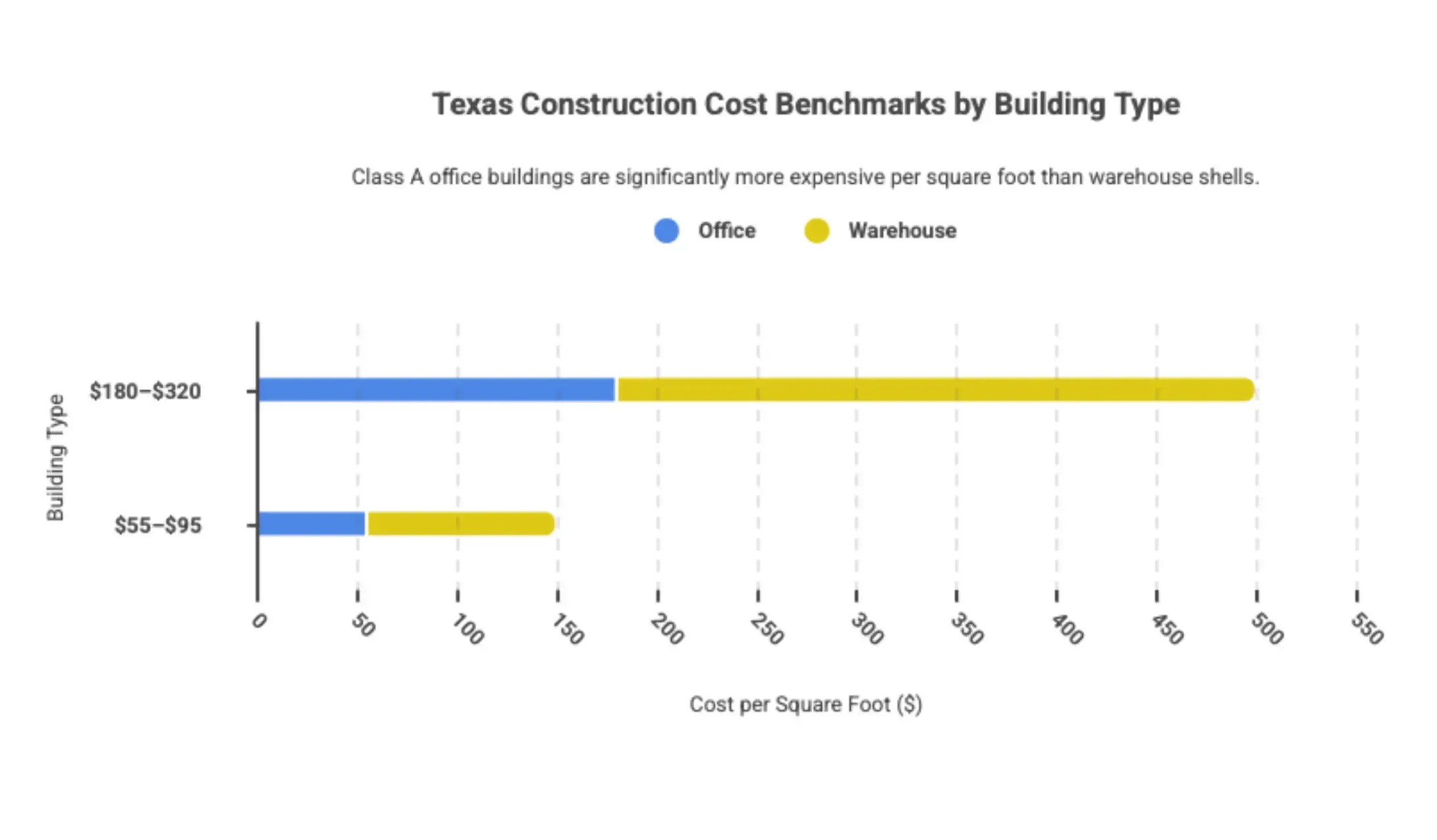
Having these reference points is vital for comparing project costs or benchmarking a new proposal during cost estimating or final bid reviews. Benchmarking your project data against current industry standards and actual regional pricing avoids reliance on outdated averages.
Unit Cost and Performance Metrics Across Sectors
While square foot or per square metrics are common, other benchmarks are often applied to different business models:
- Healthcare: Cost per hospital bed or per treatment room
- Parking structures: Cost per parking space
- Education: Cost per classroom or student seat
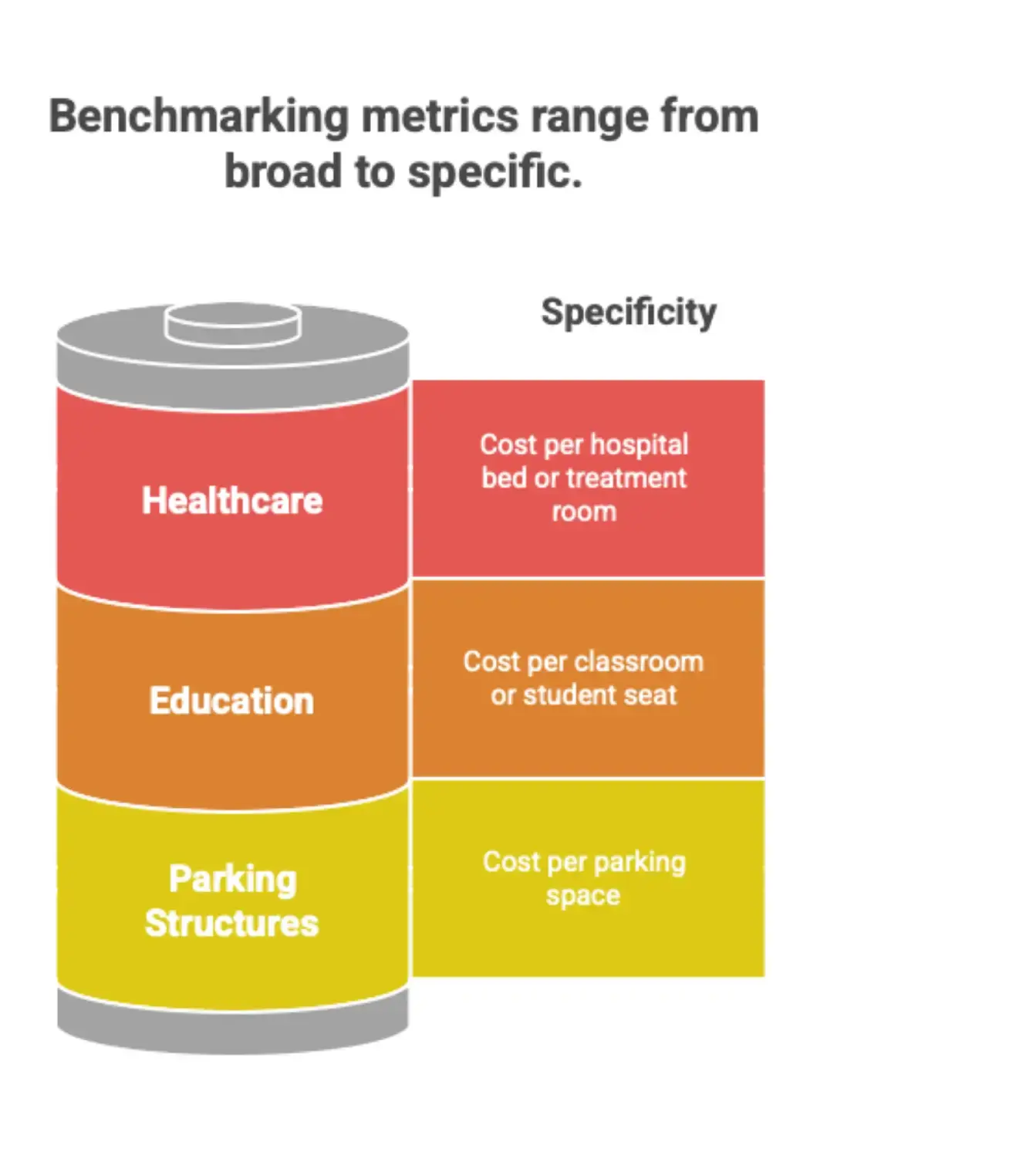
Using these industry standards to compare project performance within the same organization or against industry peers and industry leaders increases the validity and impact of your benchmarking results.
Contextualized vs. Average Benchmarking in Construction Projects
Too often, estimates are guided by industry cost averages. These broad numbers obscure site-specific risks and resource allocation realities.
The Limitations and Pitfalls of Averages
Trimble warns that “average” costs rarely capture the true diversity of construction projects:
- Diversity in market conditions, design quality levels, and productivity rates are ignored
- Cost outliers in local materials or labor are hidden
- External benchmarking based on broad figures may miss operational inefficiency or structural differences between business units
To improve project performance, benchmarking should always match project scope, region, and project data as closely as possible. Context ensures estimate accuracy and predictability.
Ensuring Benchmark Comparability
- Use standardized cost coding and data normalization to align costs across different project types and sizes
- Match similar projects not only by type but also by complexity, market conditions, and timeline
- Compare business units within the same organization for internal benchmarking, and against industry benchmarks for external benchmarking
This careful matching ensures meaningful benchmarking results, leading to truly better outcomes rather than just theoretical savings.
Practical Tools, Digital Platforms, and the Rise of Real-Time Benchmarking
The evolution of digital tools in the construction industry has made benchmarking more accessible, reliable, and actionable than ever.
Technology-Driven Benchmarking Process in Construction Projects
Modern benchmarking platforms, like InEight, integrate past project data, automate data collection, and provide instant comparisons as part of the active cost estimating and project management workflow.
- Real-time benchmarking allows project teams to verify project costs as they build their estimates
- Automated benchmarking uncovers cost outliers and alerts project managers to variances in estimate accuracy
- Digital tools support collaborative feedback, drive continuous improvement, and reduce the risk of costly inefficiency
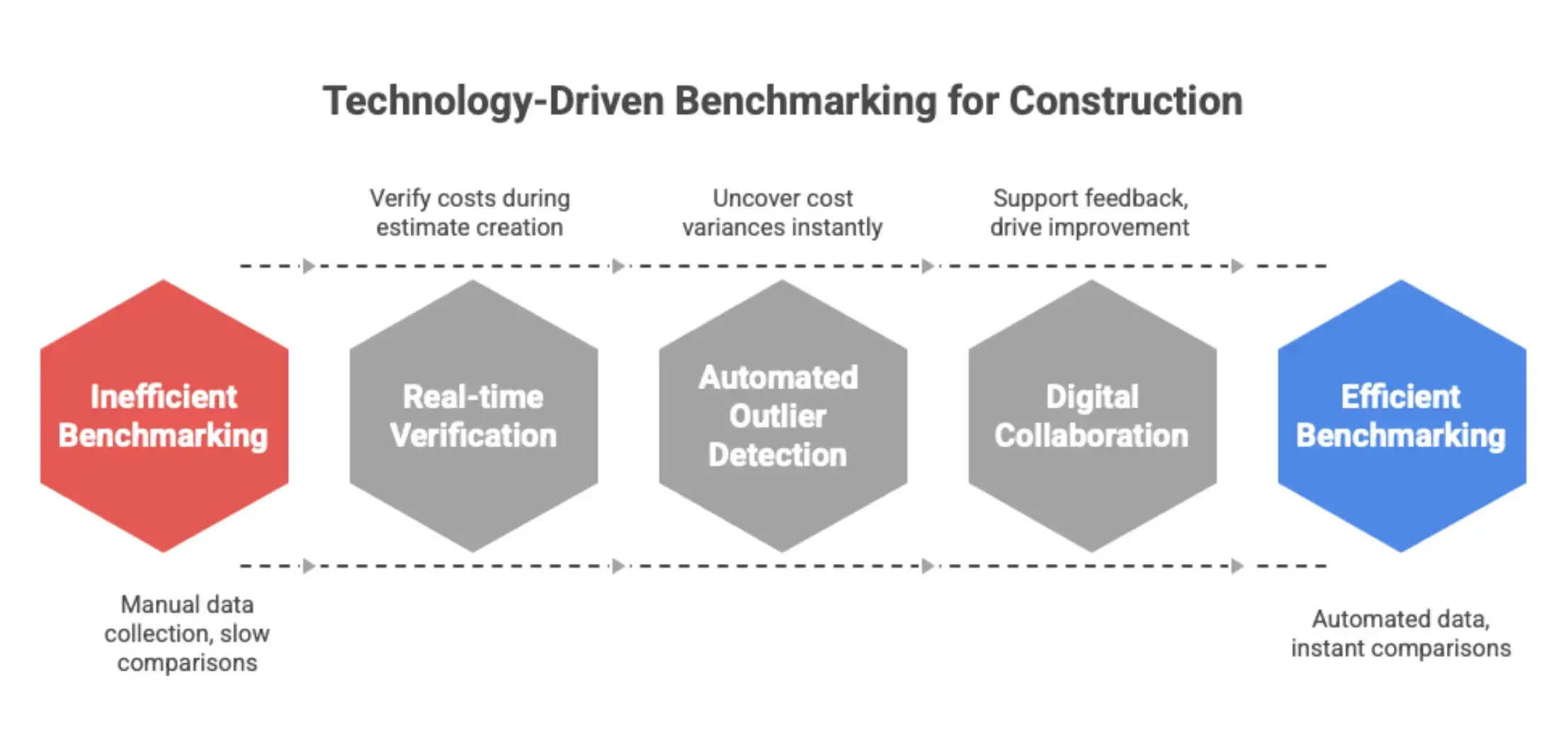
Leveraging analytics and workflow integration, technology ensures the benchmarking process is ongoing, not a one-time validation. It helps teams improve project performance continuously as market conditions shift.
Benchmarking Results for Commercial Viability and Fair Market Validation
Beyond just internal performance measurement, construction cost benchmarking is a critical tool for market alignment:
- Verifies that project costs are in line with fair market pricing and current industry standards
- Benchmarks support risk-adjusted decision making before committing major resources
- Supports sharper negotiations with contractors and subs by using data-driven reference points
By adopting benchmarking as part of the overall cost management framework, property developers and owners safeguard budgets, reduce risk of overruns, and secure funding with greater confidence.
Frequently Asked Questions
What is cost benchmarking in construction and why is it important?
Cost benchmarking in construction is the practice of comparing project costs to trustworthy historical data or standards across similar projects in the construction industry. This method identifies inefficiencies, sets realistic budget targets, and enables continuous improvement, helping teams and business units achieve better project performance and profitability.
How do construction teams use the benchmarking process to improve estimates?
Project teams compare their cost estimating outputs and project data against benchmarks established using past projects and reliable industry data. This highlights cost deviations, inefficiencies, and improvement opportunities; it keeps bids more accurate, competitive, and aligned with current market conditions.
Why is contextualized benchmarking better than using industry averages?
Contextualized benchmarking matches each project or business unit by region, size, complexity, and actual market conditions. Using averages ignores unique project scope and risk factors, often leading to budgets or bids that fail in reality. Accurate benchmarking provides a structured approach for continuous improvement and predictable outcomes.
What are the most valuable data sources for construction cost benchmarking?
The most useful cost data combines local insight, global trends, and sector-based historical data repositories—such as your internal cost estimating database, third-party industry benchmarks, and academic or government sources.
How has technology enhanced the benchmarking process for construction projects?
Digital tools and dedicated software automate data collection, benchmarking analysis, and real-time validation. This reduces manual mistakes, moves benchmarking from a slow, reactive process to an integrated part of project management, and boosts both efficiency and estimate accuracy.
What is the difference between cost benchmarking and cost estimating?
Cost estimating is used early, before construction projects begin, to set budgets, secure funding, and define project scope. Cost benchmarking is applied throughout the benchmarking process as projects progress, measuring actual project costs against industry benchmarks or historical data to validate performance and enable continuous improvement.
What are internal and external benchmarking?
Internal benchmarking focuses on comparing the performance and costs of projects within the same organization or business units, driving continuous improvement. External benchmarking evaluates performance against industry leaders, standards, or peers, helping companies validate competitiveness in the broader construction industry.
Which performance metrics or key performance indicators are common in construction benchmarking?
Common benchmarking metrics include cost per gross square foot, per parking space, per bed (for healthcare projects), or other unit-based cost models tailored to the specific project type. Key performance indicators might also include schedule adherence or productivity rates, linked to the overall cost management framework.
Conclusion
Cost benchmarking in construction is essential to modern project management. It brings cost estimating, performance measurement, and data collection together within a structured approach that improves project performance and protects profitability. Through a combination of robust project data, historical data analysis, digital tools, and consistent benchmarking process, teams deliver better outcomes, continuous improvement, and more predictable results.
By standardizing cost coding, applying phased approaches for collecting data, and leveraging both internal and external benchmarking, construction companies can highlight opportunities for savings, control costs, and drive superior decision making across all their projects.
Ready to Take the Next Step?
Thinking about an upgrade to your cost estimation or benchmarking process? Explore Nomitech’s full suite or get in touch with our team to find the most effective digital tools for your business units and specific project needs.





Stay Up to Date
Subscribe to our Newsletter today and receive the latest updates, trends, expert insights, and exclusive offers tailored to your specific industry.