

How Are Labor Cost Benchmarks Measured? Methods & Best Practices
TL;DR: Labor cost benchmarks are vital for staying competitive. They give your team the context needed to back up bids, keep budgets on track, and shape smart workforce plans. This article unpacks how labor cost benchmarks are measured, what’s behind the numbers, and how to put them to work using the best sources, smart methods, and tech tools for sharper decisions, labor efficiency, and tighter cost control.
How Are Labor Cost Benchmarks Measured?
Understanding the Fundamentals of Labor Costs and Benchmarking
Ever found yourself second-guessing labor costs, whether in a project bid or routine budgeting? You’re certainly not alone. Labor costs are one of the largest expenses for many businesses, often eating up as much as 70% of total production costs in manufacturing. They have a significant impact on profit margins, operational efficiency, and a company’s overall financial health. Local economic conditions, government regulations, and business models all shape how labor cost benchmarks are set and measured.
Project managers, HR teams, and cost management professionals constantly wrestle with labor cost management: keeping labor budgets tight while still attracting good people, and staying compliant with minimum wage and overtime rules. If your labor cost data is outdated, estimation and cost control become guesswork, which can lead to profit margin shrinkage.
Today’s environment isn’t making things easier. Scopes change fast, bids are tight, and cost data can be scattered. Increasingly, organizations are turning to labor benchmarks and benchmarking solutions like CostOS for clarity. These tools offer structured labor cost data such as wages, payroll taxes, overtime pay, and more. Decisions around labor expenses and cost control go beyond gut feelings.
We’ll explore how labor cost benchmarks are measured, covering core metrics, sources, and calculation methods. You can compare your numbers with industry benchmarks, optimize spending, and boost profitability.
Defining Direct and Indirect Labor Costs
What Makes Up Labor Costs?
Labor costs include both direct labor costs and indirect labor costs. Direct labor costs refer to wages paid to employees whose work is directly tied to producing goods or delivering services. Think assembly line technicians or customer-facing service reps. Indirect labor costs are the expenses for those not directly involved in production but crucial for operations, like supervisors, administrative and maintenance staff.
Major components of total labor cost include:
- Direct wages (direct labor)
- Indirect labor (administrative, supervisory, support roles)
- Overtime pay and shift premiums (variable labor costs)
- Payroll taxes (Social Security, Medicare, unemployment insurance)
- Health insurance and other benefits
- Paid time (vacation, sick pay, holidays)
- Workers compensation insurance
- Retirement and savings contributions
Variable labor costs, such as overtime pay and additional hires during peak periods or for special projects, fluctuate with business demands. Fixed labor costs, such as salaries, are predictable, while variable costs adjust with hours worked or production volume.
Having all these data points standardized matters. It means everyone can calculate labor costs by the same rules, allowing apples-to-apples comparison and true cost control.
Methods to Calculate Labor Costs and Benchmarks
Standardized Labor Cost Sources
Strong labor cost benchmarks start with reliable data. In the United States, Employer Costs for Employee Compensation (ECEC) from the U.S. Bureau of Labor Statistics (BLS) is a prime resource, covering direct and indirect labor costs broken down by industry, workforce role, and region. Local economic conditions and laws (such as minimum wage and overtime rules) drive significant differences in these benchmarks.
The ECEC covers:
- Wages, salaries, hourly wages
- Payroll taxes and legally required employer costs
- Employer contributions to health insurance and other benefits
- Overtime pay and paid time
- Comprehensive labor expenses including direct and indirect labor
Geographic pay differentials also adjust compensation for the cost of living in each region. These benchmarks are keenly affected by operational complexity, government regulations, and business model differences.
How Are Labor Cost Benchmarks Measured?
Labor cost benchmarks are measured using actual labor expenses: direct labor, indirect labor, wages paid, payroll taxes, and benefits totaled for a given period. The true labor cost is then normalized, often by dividing total labor cost by gross revenue, labor hour, or cost per unit. This makes it possible to compare internally over time or against external industry benchmarks for cost management and performance.
Common measurement approaches include:
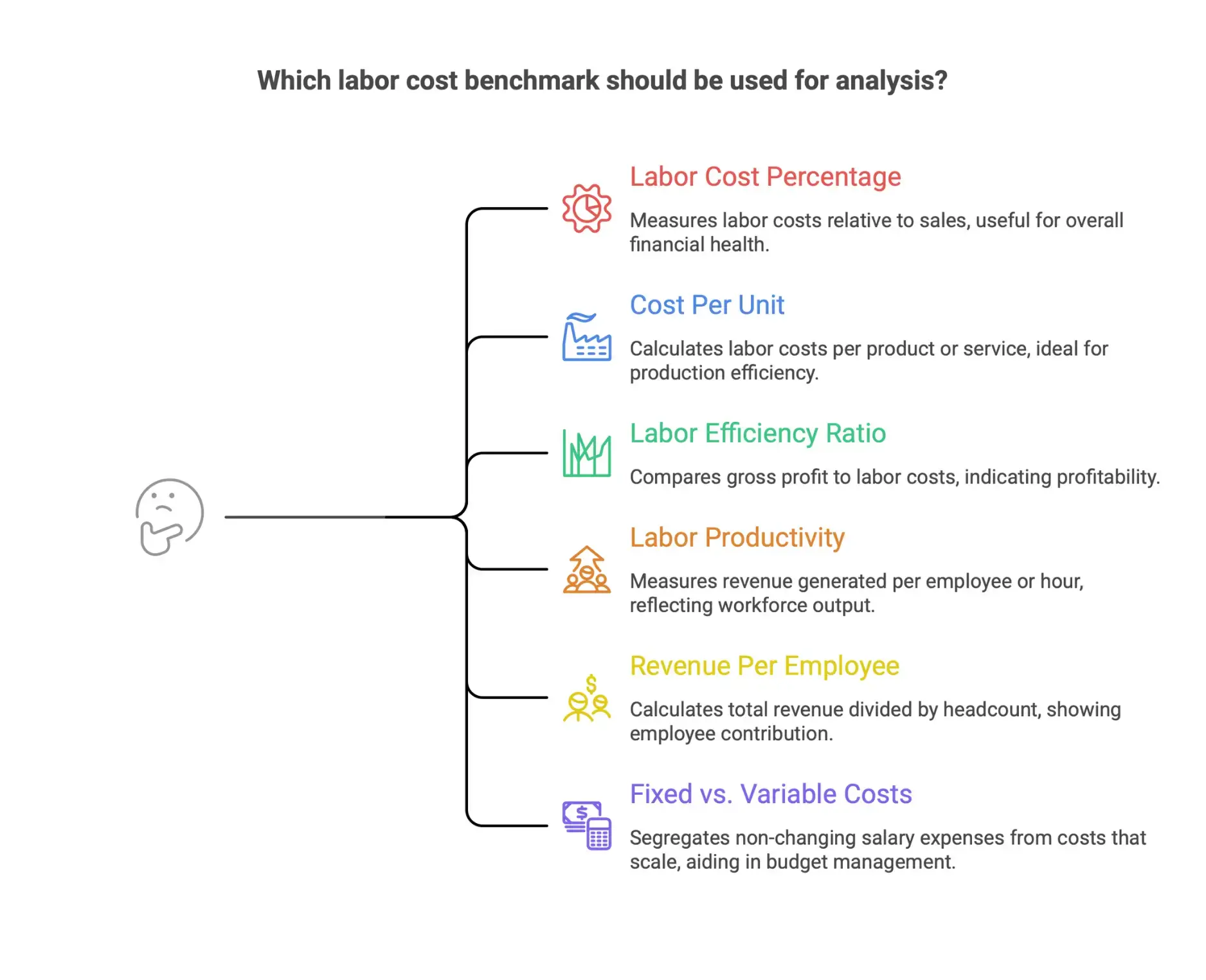
- Labor Cost Percentage: (Total Labor Costs ÷ Total Sales) x 100
- Cost Per Unit: Dividing total labor cost by number of products or service units delivered
- Labor Efficiency Ratio (LER): Gross Profit ÷ Labor Costs. A benchmark LER of 2.0x or higher is desirable.
- Labor Productivity: Gross revenue divided by number of employees or labor hours
- Revenue Per Employee: Total revenue divided by headcount
- Fixed vs. Variable Labor Costs: Segregating non-changing salary expenses from costs that scale with hours or production.
Many organizations leverage cost estimating software and analytics platforms to automate calculations, aggregate payroll data, and perform labor cost analysis, saving time and reducing errors.
Key Labor Cost KPIs and Benchmarks
Why Labor Cost Benchmarks Matter
Labor benchmarks are a key tool for decision-makers, offering measurable context for:
- Determining if compensation for roles (wages paid and benefits) is competitive
- Guiding hiring and workforce planning, including mix of full-time, seasonal, and family/operator labor
- Identifying potential inefficiencies or excess labor
- Budget planning and maintaining cost effectiveness
For instance, in higher education and healthcare, labor cost benchmarks allow budget managers to target areas for cutting unnecessary labor expenses without lowering service levels. By comparing internal labor costs with industry benchmarks, it becomes easy to spot where wage rates or benefits are above or below standards.
Typical benchmarks for labor cost percentage in various sectors:
- Restaurants: 25–35%
- Retail: Often under 25%, especially in smaller or automated stores
- Service businesses: 30–50%
- Manufacturing: Labor costs can account for up to 70% of total production cost
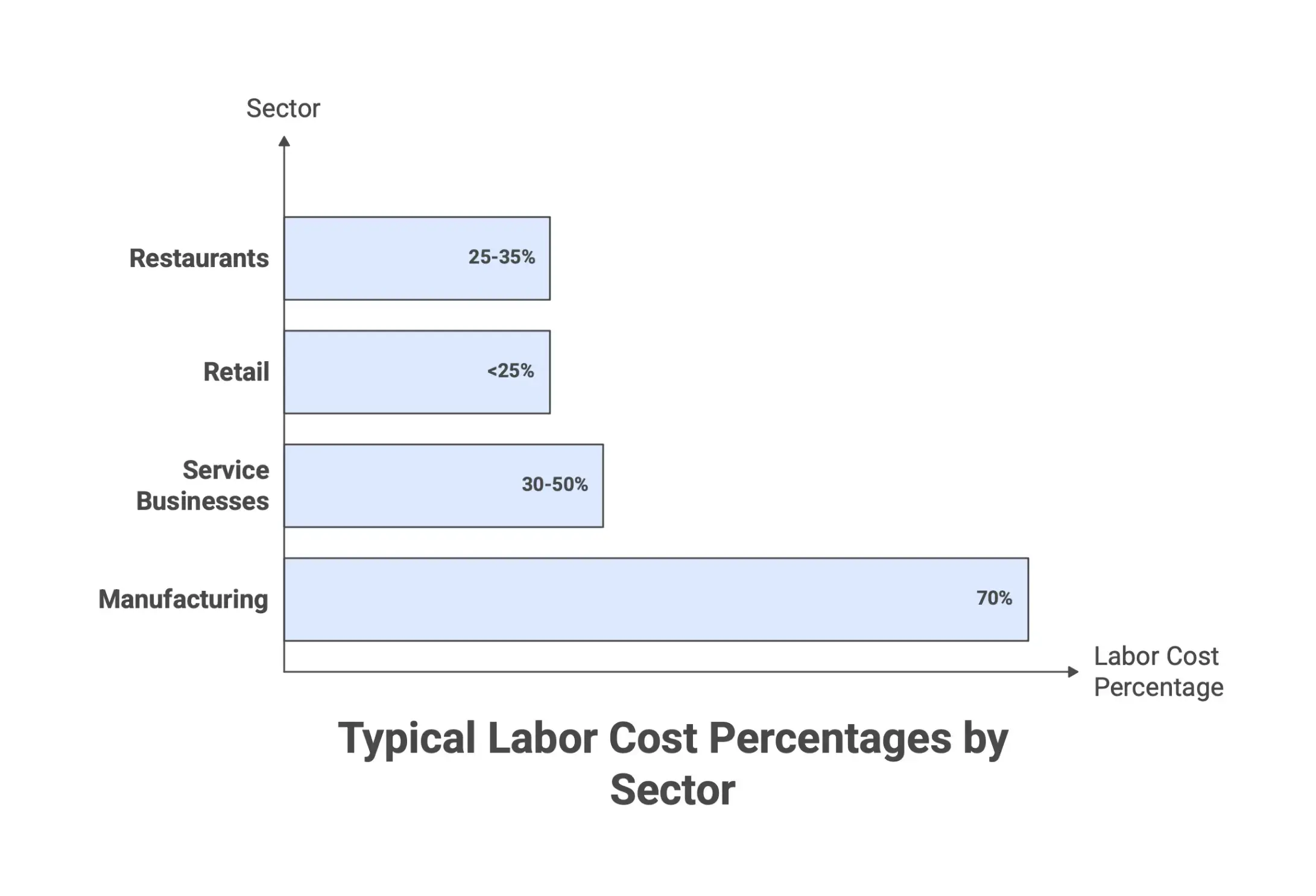
A labor cost percentage above these industry benchmarks may warn of hidden expenses, operational inefficiencies, or overstaffing. Regular review and adjustment are crucial for cost management.
Breaking Down Labor Costs and Calculating True Labor Expenses
Steps to Calculate Labor Costs
To calculate total annual labor cost, add together:
- Gross wages paid (including overtime pay)
- Payroll taxes (Social Security, Medicare, unemployment insurance)
- Health insurance and other benefits
- Paid time (such as vacation, sick leave)
- Workers compensation insurance and retirement contributions
- Any additional labor expenses (signing bonuses, stipends, etc.)

This sum gives your total labor cost. The fully burdened labor rate, total labor cost divided by total labor hours, shows the true cost per employee hour.
If you want to see labor costs as a share of business activity:
- Labor Cost Percentage: (Total Labor Costs ÷ Total Sales) x 100
- Cost Per Unit: Divide total labor cost by number of products or services delivered
- Dividing total labor cost by gross revenue: Reveals labor efficiency
Accurate estimation matters. Underestimating labor costs leads to profit erosion while overestimating can price your business out of bids.
Comparative Analysis: Full-Time vs. Contractor and Variable Labor Costs
Strategic Value of Labor Cost Benchmarks
In dynamic industries, knowing how much you spend on different employee types, full-time hires, seasonal employees, and contractors (hired labor), guides decisions around workforce expenses and flexibility. This split affects cost management, especially when labor markets shift.
- Direct labor costs are typically variable and scale with business volume
- Indirect labor costs (management, HR, maintenance) may remain steady regardless of output
- Tracking both helps benchmark cost per unit or service, showing where operational efficiency is high or where costs spiral
Modern tools and guides for estimating labor costs now cover both direct and indirect spend, highlight the distinctions between fixed and variable expenses, and account for total labor expenses across the production process.
Labor Cost Percentage and Financial Health
Labor cost percentage is a crucial indicator of a company’s financial health. Monitoring labor cost percentage highlights changes in the relationship between workforce expenses and total revenue, signaling performance risks or efficiency gains.
- A labor cost percentage consistently above industry benchmarks may indicate operational inefficiencies, overstaffing, or unnecessary labor expenses
- Keeping this ratio within standard ranges is critical for maintaining profit margins and competitive advantage
Companies should regularly benchmark their labor cost percentage using reliable data sources, including government and sectoral reports.
Industry Benchmarks: The Role of Data and Sector Analysis
How Industry Benchmarks Work
Industry benchmarks evaluate the efficiency and competitiveness of your workforce spending by comparing your labor costs (total, direct, and indirect) to external standards. These comparisons can span industries, geographies, or even specific job roles. Accessing the Bureau of Labor Statistics for regionally adjusted data is essential.
- Use wage rate analysis (comparing internal salaries and benefits with broad market surveys)
- Benchmarking should always include family and operator labor as well as hired and seasonal employees
- Tracking labor cost per unit helps tie labor investment directly to business output and profitability
Best Practices for Labor Cost Management and Optimization
Optimizing Labor Costs and Reducing Unnecessary Labor Expenses
Effective labor cost management has a direct impact on business performance, service quality, and employee satisfaction. Here are recommended strategies:
- Advanced Scheduling: Use technology or advanced scheduling software for efficient resource allocation, minimizing excess labor and costly overtime while maintaining service delivery.
- Data Review: Regularly analyze metrics related to labor costs to identify inefficiencies or unnecessary labor expenses.
- Cross-Training: Cross training employees for multiple roles can improve flexibility and reduce the need for extra staff during busy periods.
- Continuous Improvement: Cost control requires ongoing adjustment as conditions change; analyzing compensation structures and utilizing analytics help spot trends and improvement opportunities.
- Automation: Automating scheduling and time tracking can reduce labor cost per shift, optimize labor efficiency, and limit errors.
- Balancing Priorities: Maintain a focus on both cost effectiveness and employee experience to optimize labor costs without hurting morale.
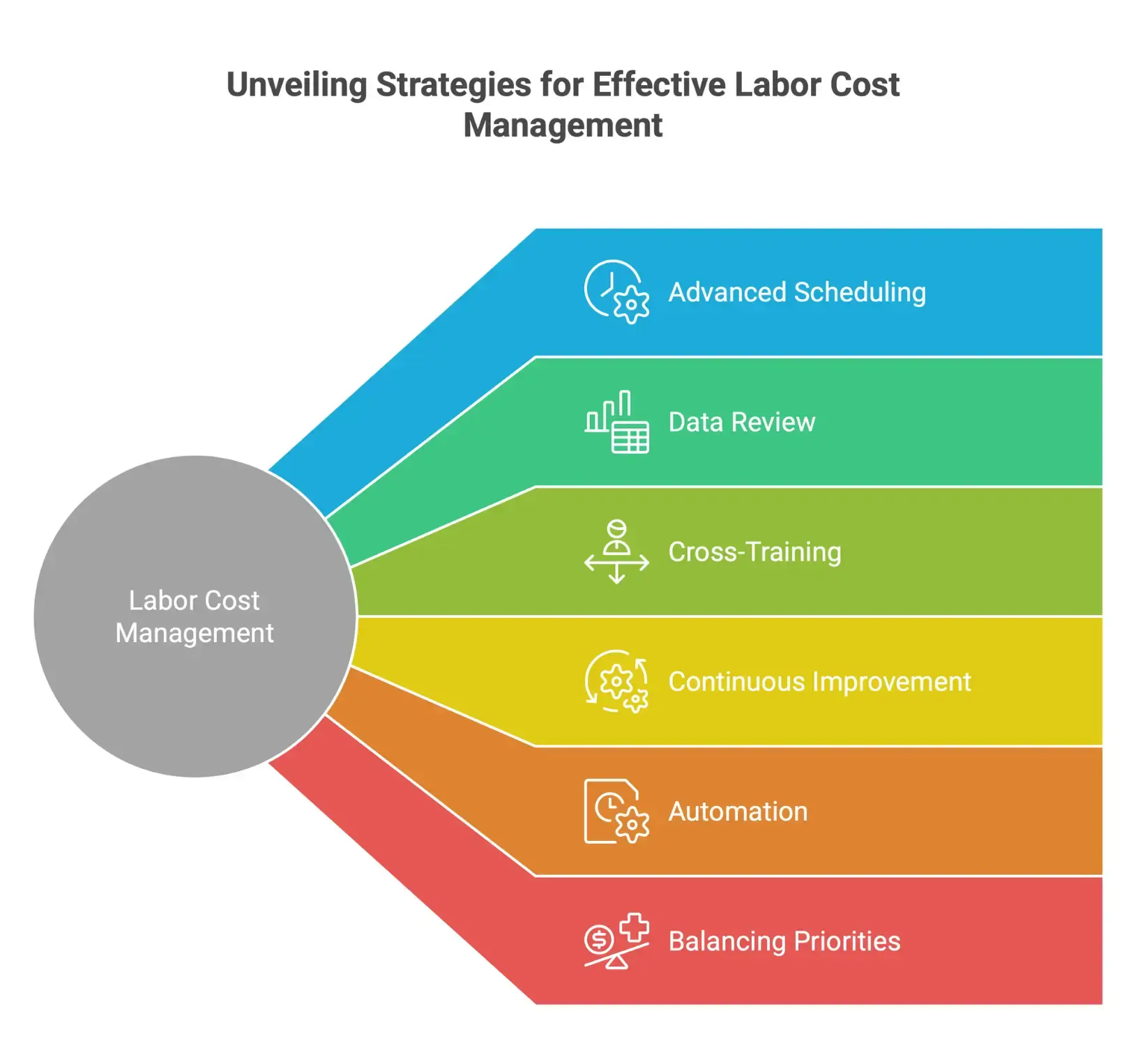
Tracking total labor expenses across direct and indirect labor, and using benchmarking to compare performance, enables cost savings while safeguarding operational and service quality.
Benchmarking Labor Costs for Competitive Pricing
Benchmarking to Improve Bids and Cost Per Unit
When government contracts or RFPs demand justified pricing, documenting labor costs with concrete benchmarks is non-negotiable. Labor benchmarking data provides hard numbers for each role and site, letting you:
- Pull market rates for specific roles or regions using tools like HigherGov
- Adjust proposals as labor markets or project types shift
- Show cost management and compliance with unique contract requirements
- Benchmark your own rates against those recently awarded, supporting smarter cost-per-unit calculations
Practical Estimating Techniques and Tools
Calculating and Controlling True Labor Costs
Core Techniques to Calculate Labor Costs
Several established estimating methods support strong labor cost management:
- Parametric Estimating: Links metrics (square footage, labor hours) to cost for repeatable jobs
- Analogous Estimating: Uses results from similar past work for new project planning
- Bottom-Up Estimating: Breaks projects into individual tasks, calculates labor cost per step
- Time and Motion Studies: Measures actual labor hour use and labor efficiency for real-time corrections
- Industry Benchmarks: Provides a reality check on both your labor costs and labor productivity relative to peers
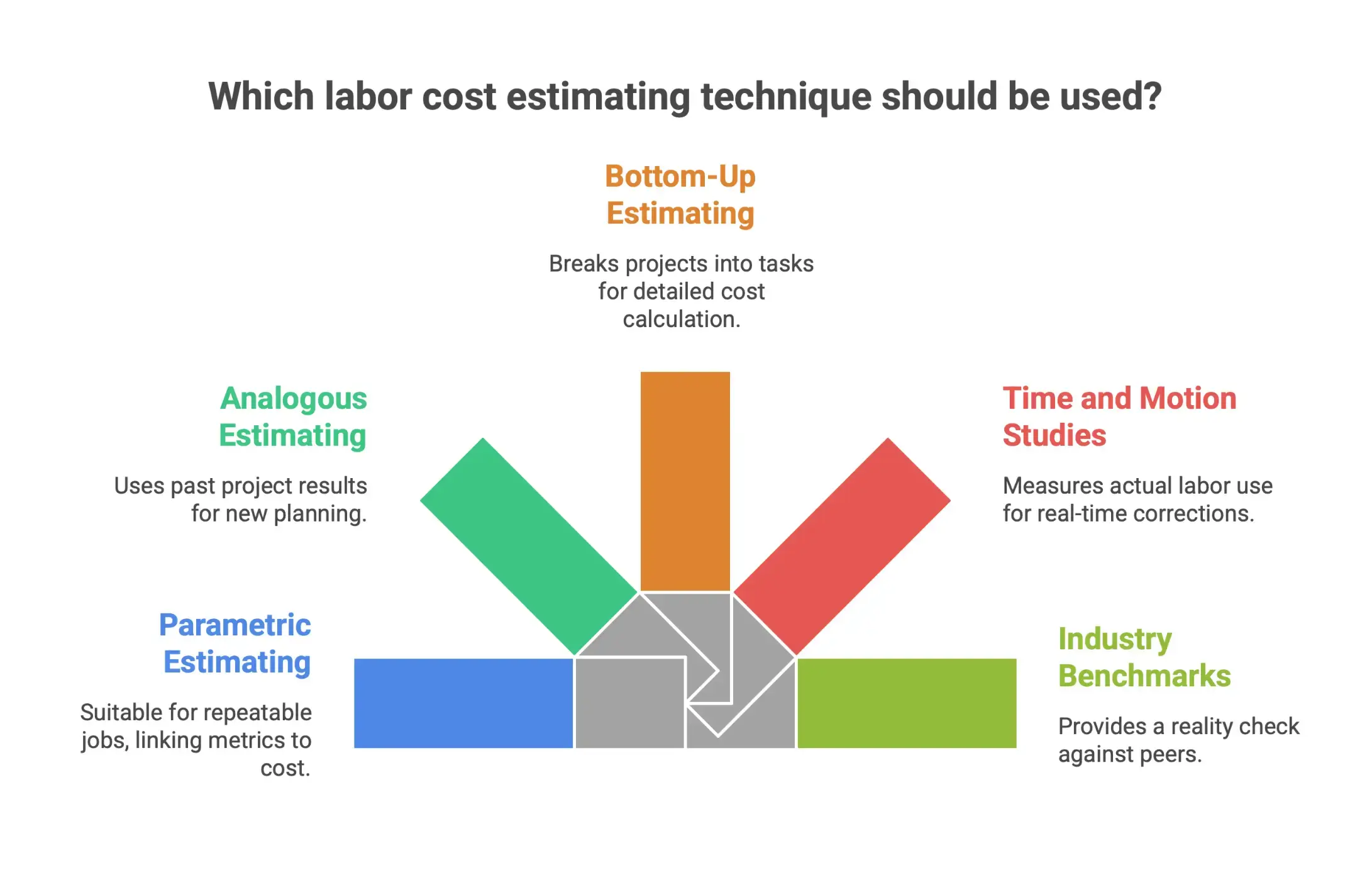
Tracking and comparing labor costs at each stage by project phase, job role, or service unit lets you avoid costly surprises. Include all labor expenses: direct, indirect, payroll taxes, overtime pay, and benefits.
Tracking, Monitoring, and Benchmarking Labor Costs
Ongoing Labor Cost Management
Effective labor cost benchmarking goes far beyond periodic reporting. Here’s how to implement best practices:
- Multi-level Benchmarking: Analyze labor costs by department, project, or job type
- Tie to Strategic Goals: Align labor benchmarks with business priorities from budgeting to staff optimization
- Standardized Data: Ensure all teams use consistent definitions and data sources to avoid apples-to-oranges comparisons
- Regular Reviews: Schedule check-ins to recalibrate labor cost benchmarks. Markets, hiring rates, and wage laws change
- Use Trusted Data: Rely on BLS ECEC reports and other respected sources
- Visualize Data: Present labor cost as dashboards or charts for fast, effective insights
- Integrate Tools: Make benchmarking visible in every project management and finance workflow, simplifying compliance and cost management
Frequently Asked Questions About Labor Cost Benchmarks
What is a labor cost benchmark, and why is it important?
A labor cost benchmark shows typical compensation levels including wages, payroll taxes, and benefits by industry or location. They are crucial for assessing profitability, cost efficiency, and making data-driven compensation plans.
How are labor cost benchmarks measured?
Labor cost benchmarks are measured by analyzing total labor expenditures (including direct and indirect labor, overtime pay, payroll taxes, and benefits) as a percentage of revenue or per unit of output. This often requires aggregating payroll data, normalizing for hours or headcount, and comparing with external sources like BLS reports.
Why monitor labor cost percentage?
Labor cost percentage reveals whether your labor expenses are in line with industry benchmarks. Tracking this metric helps understand the relationship between workforce costs and company revenues. Ratios consistently above benchmarks could indicate overstaffing or process inefficiencies.
What are direct and indirect labor costs?
Direct labor costs refer to wages and expenses for employees driving production or service delivery. Indirect labor costs cover support personnel such as managers, admin, and maintenance, whose roles aren’t tied to making a product or delivering a service but are essential for smooth business operations.
Which tools and best practices are most effective for labor cost management?
Adopt reliable data sources, regularly recalibrate metrics, and integrate advanced scheduling or estimation tools into routine financial processes. Set clear goals, automate wherever possible, and ensure all labor-related expenses are factored into every estimate and benchmark review.
Conclusion
Labor cost benchmarking gives you much more than raw numbers. It transforms decision-making. With reliable comparisons and actionable insights into labor cost percentage, cost per unit, and labor efficiency, you can control budgets, optimize pay, and craft competitive proposals while protecting profit margins and service quality. By combining smart measurement with continuous review and modern tools, labor costs shift from a black box to a strategic lever for operational efficiency and business growth.
Ready to Take the Next Step?
If you want to see what modern cost estimation tools can do, explore Nomitech’s full suite or contact their team to discuss how new solutions might fit with your workflows.





Stay Up to Date
Subscribe to our Newsletter today and receive the latest updates, trends, expert insights, and exclusive offers tailored to your specific industry.