
What Is Cost Management? Essential Guide for Businesses
TL;DR: Cost management is the process of planning, tracking, and controlling business costs to ensure projects and operations run efficiently, profits stay healthy, and resources are used wisely. This article covers cost management basics, best practices, software tools, and real-world strategies to help your organization maintain a competitive edge, prevent budget overruns, and achieve predictable financial outcomes.
Introduction to Cost Management
In today’s rapidly changing business environment, managing costs effectively is essential to maintain profits and support growth. Organizations face rising compliance demands, tighter profit margins, and more complex projects than ever before. Without a robust cost management plan, costs can spiral out of control, deadlines can slip, and your reputation may suffer. Inaccurate cost estimations, scattered data, and outdated processes make managing costs and keeping projects on track especially challenging.
A comprehensive cost management process isn’t just a nice-to-have; it’s critical. Modern cost management tools and platforms are replacing manual spreadsheets, giving teams better clarity. With real-time access to cost data, project managers can detect trouble early, optimize resource allocation, and safeguard profit margins. Effective cost management strategies lay the foundation for smarter business decisions and long-term success.
So, what is cost management, and why is it so important for your organization? Let’s break down the essentials.
What Is Cost Management?
Cost management is the process of planning and controlling a business budget. At its core, cost management is about forecasting predicted costs, setting clear financial goals, and closely tracking actual costs in projects and operations. A well-developed cost management plan helps organizations minimize costs, maximize value, and ensure every resource is used efficiently without compromising performance or quality.
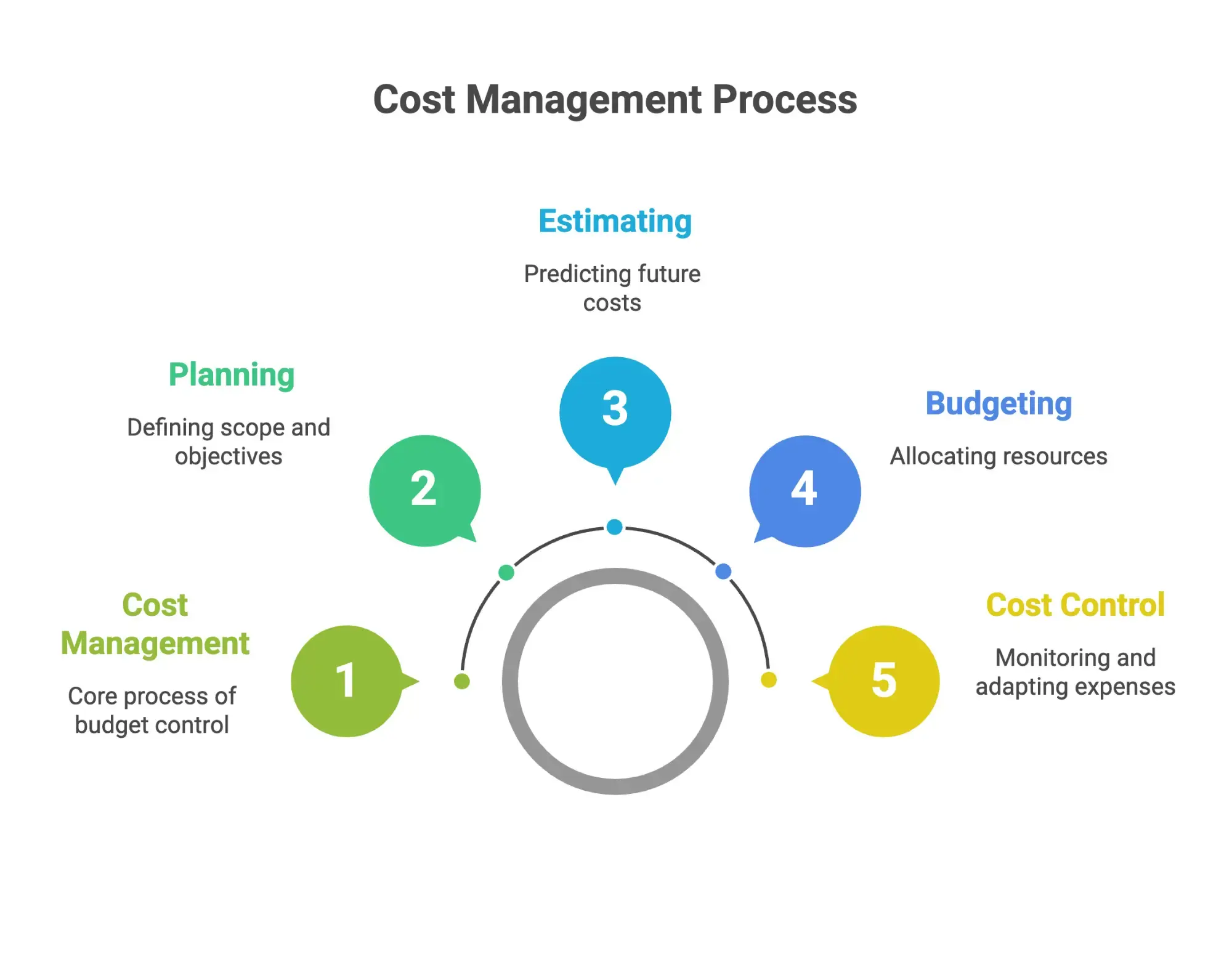
The cost management process typically involves five steps:
- Planning: Define project scope, objectives, and financial benchmarks. What do you need to achieve and at what cost?
- Estimating: Predict future costs by analyzing current needs, historical data, and market trends. Cost estimation covers materials, labor, overhead costs, and all other expenses.
- Budgeting: Allocate resources, set your project budget, and create a detailed budget breakdown to serve as your spending framework.
- Cost Control: Continuously monitor expenses, compare actual costs to estimates, and adapt as needed to stay within the cost management plan and avoid cost overruns.
- Cost Reporting: Analyze and communicate financial outcomes so leaders and project teams can make data-driven, informed decisions for current and future projects.
Management is the process of systematically applying these principles across all operations, from routine business costs to complex multi-phase projects, ensuring cost efficiency and financial discipline at every level.
Why Is Cost Management Important?
A tailored cost management plan is vital to an organization’s project planning process. Effective cost management ensures you can finish projects within the estimated budget, hit financial goals, and support business growth. Organizations that excel at managing costs become resilient, competitive, and attractive to stakeholders and clients alike.
Key benefits include:
- Predictable Financial Outcomes: Prevent budget overruns, minimize unnecessary expenses, and forecast future costs with confidence.
- More Accurate Budgets: Use cost management tools and software for better resource allocation and improved budget accuracy.
- Faster, Smarter Decision Making: Project managers get access to real-time cost data and cost reporting insights for faster response to changes.
- Competitive Edge: Robust cost management strategies help you win more bids, reduce waste, and direct resources to high-impact projects.
Organizations also see improved profitability as resources are allocated where they deliver the most value, helping sustain growth and innovation.
The Cost Management Lifecycle
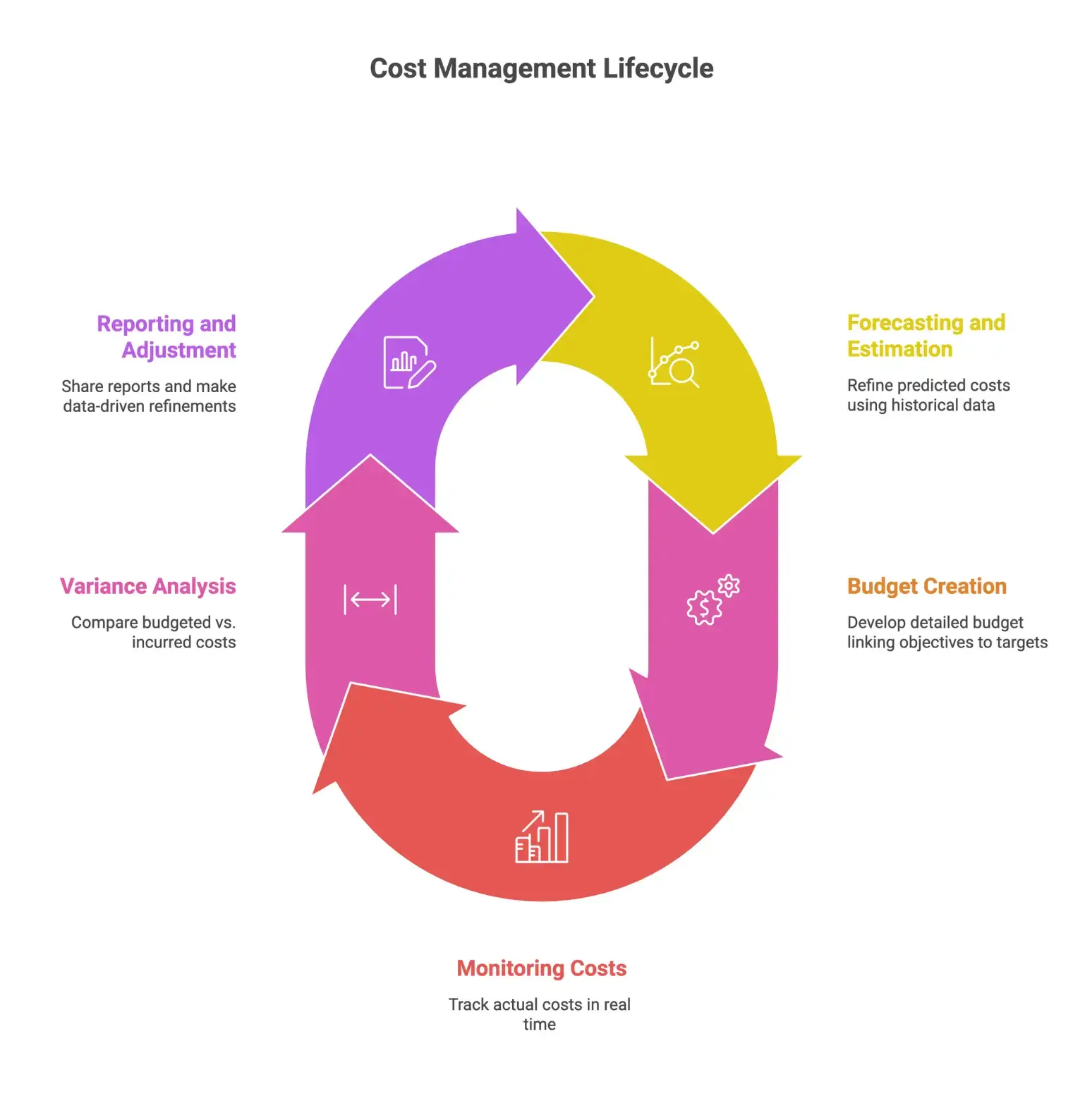
The cost management process is ongoing. It is a life cycle of planning, implementing, monitoring, and refining your approach to project costs and business costs.
Key Elements of the Cost Management Lifecycle:
- Forecasting and Estimation: Refine predicted costs and leverage historical data for more accurate budgets.
- Budget Creation: Develop a detailed budget, linking project objectives to financial targets.
- Monitoring Costs: Use cost management tools to track actual costs, overhead costs, and cloud costs in real time.
- Variance Analysis: Compare total cost budgeted to total cost incurred, identifying cost overruns and areas for improvement.
- Reporting and Adjustment: Share cost reporting with leadership, make data-driven refinements, and set new benchmarks for future cost management plans.
Continuous improvement and regular change management are necessary to adapt to fluctuating market prices and shifting project scopes.
Key Types of Cost Management
Cost Estimation
Cost estimation is the process of assembling and predicting costs of a project over its life cycle, including raw materials, labor, and indirect costs. Historical costs and data-driven estimates help establish an accurate project budget.
Cost Budgeting
Cost budgeting involves setting an allocated budget, establishing spending standards, and building a system for project budget tracking. This step defines financial boundaries for the full project duration.
Cost Control
Cost control means gathering, accumulating, monitoring, and managing costs as a project progresses. It also covers variance analysis to catch cost overruns early and implementing cost control processes, such as tracking actual costs versus estimated and predicted costs.
Zero-Based Budgeting (ZBB)
ZBB requires every expense to be justified each cycle, starting from a zero base rather than rolling over previous budgets. This approach helps eliminate unnecessary expenses and adapt spending to current needs.
Cost Management Plan: Building a Blueprint for Success
A cost management plan outlines how you will estimate, allocate, control, and report on costs throughout a project’s life cycle. Creating this plan is the first step toward cost discipline and a must for project managers who want to deliver projects on time and on budget.
Essential components of a cost management plan:
- Objective Setting: Define your project objectives and business goals.
- Scope Definition: Map out your project scope and team estimates.
- Cost Estimation: Use historical data and market analysis for more accurate budgets.
- Budget Development: Set a detailed budget, assigning resources based on likely needs.
- Cost Control Approach: Establish cost control processes and regular reporting milestones.
- Contingency Reserves: Account for unforeseen costs and change management scenarios.
- Reporting Structures: Plan regular cost reporting intervals to keep stakeholders informed.
A well-structured cost management plan ensures you minimize risks, control costs, and optimize project performance from day one.
Core Cost Management Tools and Technology
Cost Management Tools for Modern Teams
Cost management tools and software are essential for continuous cost control. They help project teams visualize spending, track actual costs in real time, and flag anomalies before they become issues.
Key features of cost management software include:
- Budgeting and Forecasting Tools: Create detailed budgets, project financial goals, and improve budget accuracy for future cost management predictions.
- Resource Planning and Allocation: Advanced resource planning tools streamline how you allocate resources, minimize project scope creep, and control costs.
- Automated Cost Control: Automated tools instantly flag irregularities, allowing project managers to proactively address cost overruns.
- Cost Reporting Dashboards: Real-time analytics deliver instant snapshots and cost reporting for project teams and leadership.
- Integration with Project Management: Many solutions combine project management, cost accounting, and cost estimation to centralize workflows.
Examples: Solutions from Nomitech’s cost management tools provide comprehensive functionality for managing costs at every project stage.
Earned Value Management (EVM)
EVM is a widely used method that ties cost, schedule, and scope data together. It allows project managers to measure project performance, compare planned versus actual costs, and forecast future expenditures. EVM uses detailed budget baselines, cost reporting, and variance analysis to support ongoing cost management.
Strategic Importance of Cost Management
Strengthening Enterprise Performance With Cost Management
The strategic value of cost management goes beyond cost cutting. It is about optimizing operations for lasting results. Effective cost management empowers business leaders to make informed decisions, direct resources to high-impact projects, and deliver consistent financial outcomes.
By reducing unnecessary expenses and operational complexity, organizations can:
- Significantly reduce total cost structures with next-generation cost management tools
- Optimize costs without harming quality or capability
- Channel funds into innovation, growth, and capability development

Embedding cost management strategies into everyday business processes ensures improved profitability and agility in changing markets.
The Cost Management Process in Practice
Planning Phase
Projected costs are calculated during planning and must be approved before executing the project plan. The planning step includes defining project scope, goals, and constraints and using historical data for budget accuracy.
Execution and Monitoring
Expenses are tracked as the project plan unfolds. Using centralized cost management tools, project teams monitor costs against the cost management plan, adjust for scope changes, and use cost data for continual reporting.
Completion and Analysis
Upon project completion, compare predicted costs to actual costs. This analysis informs future cost management plans and helps improve estimating methodologies, budget accuracy, and financial discipline.
Best Practices for Effective Cost Management
Optimize Project Costs With Smart Technology
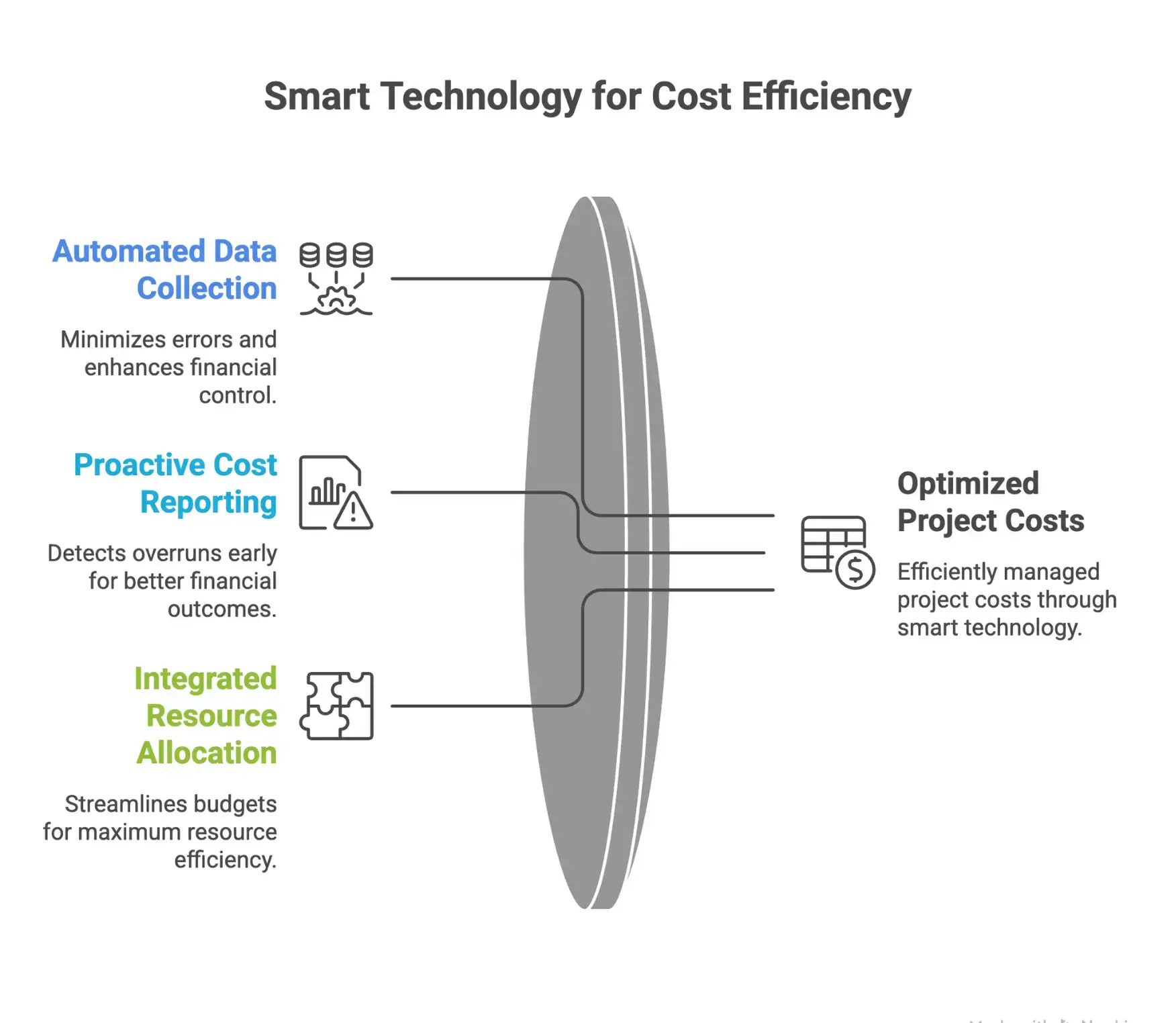
Smart technology is integral to effective cost management. Platforms offering real-time tracking, IoT data collection, and automated analytics provide instant insights and enable data-driven decisions.
Best practices include:
- Automated Data Collection: Minimizes manual errors and offers better financial control.
- Proactive Cost Reporting: Enables early detection of cost overruns and better financial outcomes.
- Integrated Resource Allocation: Streamlines staffing, equipment, and material budgets for maximum efficiency.
Embedding a Cost-Conscious Culture
A culture of cost awareness starts with leadership. Leaders should connect cost control to broader mission objectives, showcase smart spending, reward cost-saving innovations, and foster open cost reporting throughout the organization.
Vendor Management and Unnecessary Expenses
Improved vendor management, such as consolidating suppliers and negotiating long-term agreements, can unlock volume discounts and minimize costs. By routinely identifying and cutting unnecessary expenses, companies can significantly reduce overhead and operational costs.
Continuous Improvement
Regularly review and refine the cost management process. Monitoring costs throughout the project duration, adjusting strategies, and training teams ensures that cost management remains a continuous, effective practice.
Controlling Project Costs and Handling Unforeseen Costs
Managing Project Budget & Contingency Allowances
Every project faces budget uncertainty. Build flexibility into your cost management plan by including contingency reserves. Use historical data and cost benchmarking tools to determine how much to reserve, document reserves alongside main budgets, and adjust based on project complexity and scope.
This approach lets you handle unforeseen costs, adapt to project changes, and stay within your allocated budget. You can turn uncertainty into manageable minor course corrections instead of budget disasters.
Challenges in Cost Management
Organizations encounter multiple challenges, including:
- Inaccurate Cost Estimations: Leading to budget overruns and missed deadlines.
- Market Fluctuations: Adding unpredictability and impacting predicted costs.
- Resistance to Change: Making it harder to implement efficient new cost management methods.
- Multiple Data Sources: Disconnected tools and spreadsheets hinder integrated cost management.
- Training and Culture Barriers: Overcoming inertia requires ongoing training and leadership modeling.

Robust planning, integrated cost management tools, and continuous improvement are critical for addressing these challenges.
Frequently Asked Questions About Cost Management
What is cost management in project management?
Cost management in project management is the process of planning, controlling, and optimizing project costs to deliver outcomes within an allocated budget. It involves a structured approach to cost estimation, budgeting, monitoring, and cost reporting. Projects meet financial and business goals through this process.
Why do you need a cost management plan?
A comprehensive cost management plan helps organizations plan spending, allocate resources, monitor actual costs, and reduce risks of exceeding budgets. It tackles cost overruns by tracking cost performance and supporting timely, informed decisions.
What are the most effective cost management strategies?
Standout cost management strategies include Activity-Based Costing for granular tracking, Zero-Based Budgeting to question all expenditures, leveraging advanced cost management tools for automated reporting, and embedding cost-conscious thinking into team culture.
How does technology improve cost control and reporting?
Technology centralizes cost management, enabling automated collection and analysis of cost data, real-time monitoring costs, enhanced cost reporting, and faster decision making. Automated alerts flag potential issues so project managers can take proactive measures before costs get out of hand.
What is the difference between actual costs and estimated budget?
The estimated budget provides forecasts of what costs should be. Actual costs are what you really spend as the project progresses. Comparing these through cost reporting and variance analysis helps teams refine future budgets and improve project performance.
What are common types of business costs in cost management?
Business costs in cost management include direct costs like materials and labor, indirect costs such as overhead costs and cloud costs, and fixed costs that remain constant over the project duration.
Why is cost management important for decision making?
Effective cost management is important for decision making because it supplies financial insights, identifies performance gaps, and helps leaders allocate resources efficiently. This drives better returns, supports business growth, and ensures projects achieve their objectives.
Conclusion: Future-Proofing Your Organization With Robust Cost Management
Cost management is not a one-time task. It is a continuous process and an organizational mindset. When structured cost management is part of daily business processes and project management, it delivers powerful results: minimized costs, improved profitability, and better alignment with strategic goals.
Sustaining Competitive Edge Through Effective Cost Management Strategies
Organizations that prioritize cost management strategies, invest in modern cost management tools, and create strong cost management plans consistently outperform their peers. This focus allows teams to:
- Catch and correct cost overruns before they threaten profit margins
- Align project objectives with resource allocation for maximum value
- Improve cost performance and create more accurate budgets for future projects
- Enable faster innovation by minimizing unnecessary expenses and reallocating funds to impactful initiatives
Future cost management predictions point toward deeper integration of AI analytics, smarter automation, and real-time dashboards. This will further accelerate the ability to monitor costs, support change management, and make informed data-driven decisions.
Mastering cost management is about much more than cutting costs; it’s about optimizing business processes and building resilient, sustainable organizations equipped for whatever comes next.
Ready to Take the Next Step?
Curious about upgrading your cost estimation game? Explore Nomitech’s full suite or contact our team to see what fits best with your workflows.




Stay Up to Date
Subscribe to our Newsletter today and receive the latest updates, trends, expert insights, and exclusive offers tailored to your specific industry.