

Cost Benchmarking vs Budgeting: Keys to Accurate Project Financials
TL;DR: Cost benchmarking and budgeting are different, but they work best as a team. Benchmarking lets you measure how you’re doing against industry standards, while budgeting turns that context into practical spending plans. Use both, and you’ll make sharper decisions, control project costs with more confidence, and set your projects up for steady improvement.
Introduction: Understanding Cost Benchmarking vs Budgeting
Attention: Every project manager knows costs can spin out of control faster than expected, especially in project management. Between scattered cost data sources, shifting goals, and sudden market changes, sticking to your financial plan can feel like trying to catch smoke. Many project teams aren’t just battling overruns. They’re flying blind, unsure how their project costs stack up or where spending is drifting off track.
Interest: As competition heats up, leaders need sharper bidding, streamlined resource allocation, and the discipline of cost benchmarking vs budgeting. Just looking at your own numbers isn’t enough anymore. Without a way to check your actual costs against industry standards or use those benchmarks to improve cost budgeting, it’s easy to miss important signals or risk compliance headaches.
Desire: The good news? Tools like CostOS make it easier than ever to support the budgeting process with benchmarking, structured financial planning, and actionable cost data. With the right approach, you can turn heaps of raw project data into reliable cost estimates. You’ll see trouble coming and fix it before it becomes a problem.
Action: In this article, you’ll learn the essentials of cost benchmarking vs budgeting, why understanding the distinction matters for decision making, and how a robust budgeting process powered by benchmarks ensures accurate project financials and improved outcomes for project managers.
What is Cost Benchmarking vs Budgeting?
Cost benchmarking vs budgeting answers related, but fundamentally different, questions central to decision making in financial planning:
- Cost benchmarking is your measuring stick. It compares your results to external industry standards, competitors, or best practices, often using multiple cost data sources, including public filings and industry reports. This structured benchmarking process helps companies evaluate performance, identify areas for improvement, and ensure project costs are competitive.
- Budgeting is where you define a concrete budget plan for how resources and funds will be allocated within a defined time. This internal roadmap sets spending limits, aligns operations with objectives, and forms the backbone of project cost control and resource planning.

As City of Redmond outlines, benchmarking provides external context while budgeting sets internal targets.
Here’s the key: these aren’t standalone exercises. As the Consonance Group clarifies, effective budgeting uses benchmarking data so budget templates become more realistic, actionable, and competitive. Systematically comparing project data against industry benchmarks allows organizations to objectively evaluate cost estimates, validate decisions, and determine if their budgets and expenditures align with both the market and company’s strategic ambitions.
For a deeper comparison of estimating and budgeting, check out cost estimating vs budgeting.
Why the Distinction Between Cost Benchmarking and Budgeting Matters for Decision Makers
Understanding the line between cost benchmarking vs budgeting isn’t a minor academic detail. For anyone tasked with project management or financial planning, clarity here is central to strong decision making, successful investment, risk reduction, and efficient resource allocation.
Cost benchmarking gives companies the context they need. You’re measuring your spending and performance not just against historical data or past performance, but against industry standards, which helps flag inefficiencies and estimate accuracy.
Budgeting turns these insights into an internal, actionable plan, ensuring resource allocation matches the real world, not just internal optimism. Incorporating benchmarking into the budgeting process gives your budget plans external guide rails, making them both realistic and competitive.
Key benefits when you combine both:
- Budgets anchored to proven benchmarks, not just past performance
- Targets that are challenging but achievable, based on the latest market conditions
- Forecasts and cost estimates that are validated by third-party context
- Metrics that go beyond your own company, creating confidence for stakeholders and management
Ultimately, using both benchmarking and budgeting together lets you identify areas to optimize, achieve your financial goals, and support continuous improvement throughout the project lifecycle.
The Role of Benchmarking: Structured Insight Through Peer Comparisons
Cost Benchmarking Enhances Predictability and Cost Control
Benchmarking isn’t only about looking outward at competitors. It’s about building a structured way to evaluate project costs and compare them to relevant industry standards. High-quality benchmarking uses data from a variety of sources: industry reports, public filings, historical data, and even SaaS peer metrics. This approach, known as external and internal benchmarking, provides a comprehensive view of performance and supports decision making.
By evaluating project costs, resource allocation, and indirect costs against neutral third-party benchmarks, companies can:
- Spot potential risks, reduce risks, and identify opportunities to improve
- Increase estimate accuracy and refine the cost budgeting process
- Objectively validate decisions and ensure they’re aligned with corporate strategy

A structured benchmarking process strengthens predictability in project management by improving cost data for estimating and helping teams assess performance, achieving efficiency and competitiveness.
Leveraging Peer Benchmarks in IT, Logistics, and Agriculture
Benchmarking IT Spend and Performance
In IT, benchmarking systems like IBM enable project managers to compare project costs, cost budgeting outcomes, and actual costs over time. By benchmarking IT costs and outcomes against similar companies, you can:
- Identify areas of inefficiency or overinvestment
- See where investment lags or leads compared to industry standards
- Adjust project budgets to remain competitive
Sector-specific cost benchmarking tools offer analysis powered by AI and normalized industry data.
Applying Benchmarking to Transportation and Logistics
Logistics present unique cost challenges. Benchmarking using IntelliTrans or advanced tools produces actionable cost estimates and keeps budget plans relevant. By comparing project costs like transportation rates at the lane level:
- You align bids and annual budgeting with current market conditions
- Gain negotiation power using real-world actual costs
- Prevent outdated cost data from steering budgets off course
Maximizing Farm Efficiency with Benchmarking
In agriculture, E4 Crop Intelligence offers benchmarking of planned and actual costs, equipment use, and yields. Comparing cost data and project performance with similar projects leads to:
- Smarter budgeting and better allocation of funds
- Efficiency gains in resource planning, not just spending cuts
Benchmarking yields save project teams both actual costs and resource waste.
Core Elements of the Budgeting Process: Planning and Resource Allocation
Building a Financial Roadmap
Budgeting is the backbone of financial planning in project management. It turns strategy into a budget plan for clear spending, defined targets, and aligned operations. It’s all based on structured cost data, estimate accuracy, and best practices for project cost control.
A practical budgeting process does more than set spending boundaries:
- Converts cost estimates into actionable budget templates for every department
- Supports clear communication and manages expectations across project teams, finance, and stakeholders
- Encourages alignment around shared financial goals
For essential budgeting tools, see the cost estimating software guide.
Operation, Capital, and Cash Flow Budgets
Effective budgeting incorporates multiple layers:
- Operation budgets lay out spending for daily business
- Capital budgets address large investments like new systems or construction projects
- Cash flow budgets ensure liquidity for ongoing project management

All three contribute to a detailed, internal roadmap for achieving objectives and controlling actual costs over the budgeting period, usually a fiscal year.
Zero-Based Budgeting and Beyond
Zero-based budgeting resets assumptions. Every indirect cost and direct cost is justified from scratch, not just rolled over. As Wikipedia explains, this shakes up resource allocation, exposes broken processes, and prompts a fresh look at every budget line item. It clears out inefficiencies and makes sure budgets truly serve project goals.
ZBB requires more effort but is a proven strategy for preventing unnecessary expenses, scope creep, and aligning budget plans with what matters today for project management.
Data-Driven Methods: Cost Estimation, Cost Budgeting, and Optimization
Cost Estimation and Cost Accounting
In project management, cost estimation and cost budgeting are interlocked. Cost estimation is the first step, forecasting project costs and creating a foundation for budgeting. As Vintti notes, strong cost accounting allows for:
- Effective evaluation of how resources are used by teams and departments
- Pinpointing what causes actual costs to diverge from estimates or budgets
- Precise assignment of both direct costs and indirect costs
For project cost control, cost estimation informs budgeting, which in turn keeps actual spending within plan and financial goals on track. See cost estimating vs cost control.
Using Reliable Cost Data and Historical Benchmarks
The foundation of solid cost budgeting is access to actionable cost data, including past performance and industry benchmarks. Modern solutions aggregate cost data from completed and live projects to:
- Track cost trends and estimate accuracy
- Build historical data sets for new project estimates
- Compare actual costs to forecasted budgets and identify risks
Well-structured data ensures every budget plan is grounded in reality and supports the planning process, reducing the risk of overruns.
Advanced Cost Budgeting and Cost Optimization Tools
Especially for construction projects and cloud environments, managing project costs goes beyond spreadsheets. nOps and other modern tools deliver live, granular breakdowns of expenses, helping project managers and teams:
- Monitor real-time resource allocation and project costs
- Uncover overlooked savings
- Benchmark cloud costs with actionable insights
A good cost estimating software supports scenario analysis, benchmarking, and live updating of budget templates.
Integrating Benchmarking Into the Budgeting Process
Using Cost Benchmarking to Validate Budgeting Decisions
The budgeting process depends on many assumptions about both internal and market conditions. External benchmarking tests these assumptions, ensuring project costs, cost estimates, and budget plans reflect what’s actually happening in the market.
Tools like Costmine allow teams to compare internal estimates and expenditures to neutral, third-party standards, providing objective validation and supporting better decision making.
Implementing a structured benchmarking approach, integrated directly with the cost budgeting process, supports:
- Early detection of risky estimates
- Meaningful adjustments of budget plans before they’re finalized
- Stronger resource allocation aligned with best practices
For practical guidance, see integrating estimating and cost control.
Ongoing Benchmarking for Adaptive Budgeting
Markets shift. Both project costs and actual costs rarely follow the script. Ongoing benchmarking keeps your budgeting process agile, using fresh cost data to guide mid-cycle adjustments.
IBM highlights how regular benchmarking prevents surprises that static budget plans cannot. Incorporating benchmarking into monthly or quarterly reviews gives:
- Current views of company performance versus industry standards
- Early warning when budgets need to be revised
- A structured basis for evidence-backed pivots by project managers
Tying benchmarking to periodic planning processes turns budgeting into a living document, not a set-it-and-forget-it plan.
Best Practices for Cost Benchmarking and Budgeting in Project Management
Scenario Analysis and Real-Time Adjustments
Project teams rely on adaptive processes. Best practices call for regular review of budget plans, evaluating actual costs against both internal targets and external benchmarks. Steps to keep your budgeting process responsive include:
- Set a review cadence to compare estimated and actual costs with benchmarks
- Update project budgets in response to market conditions or project changes
- Develop alternative scenarios so financial planning is robust
- Use tools that support live benchmarking and scenario planning, such as cost estimating software
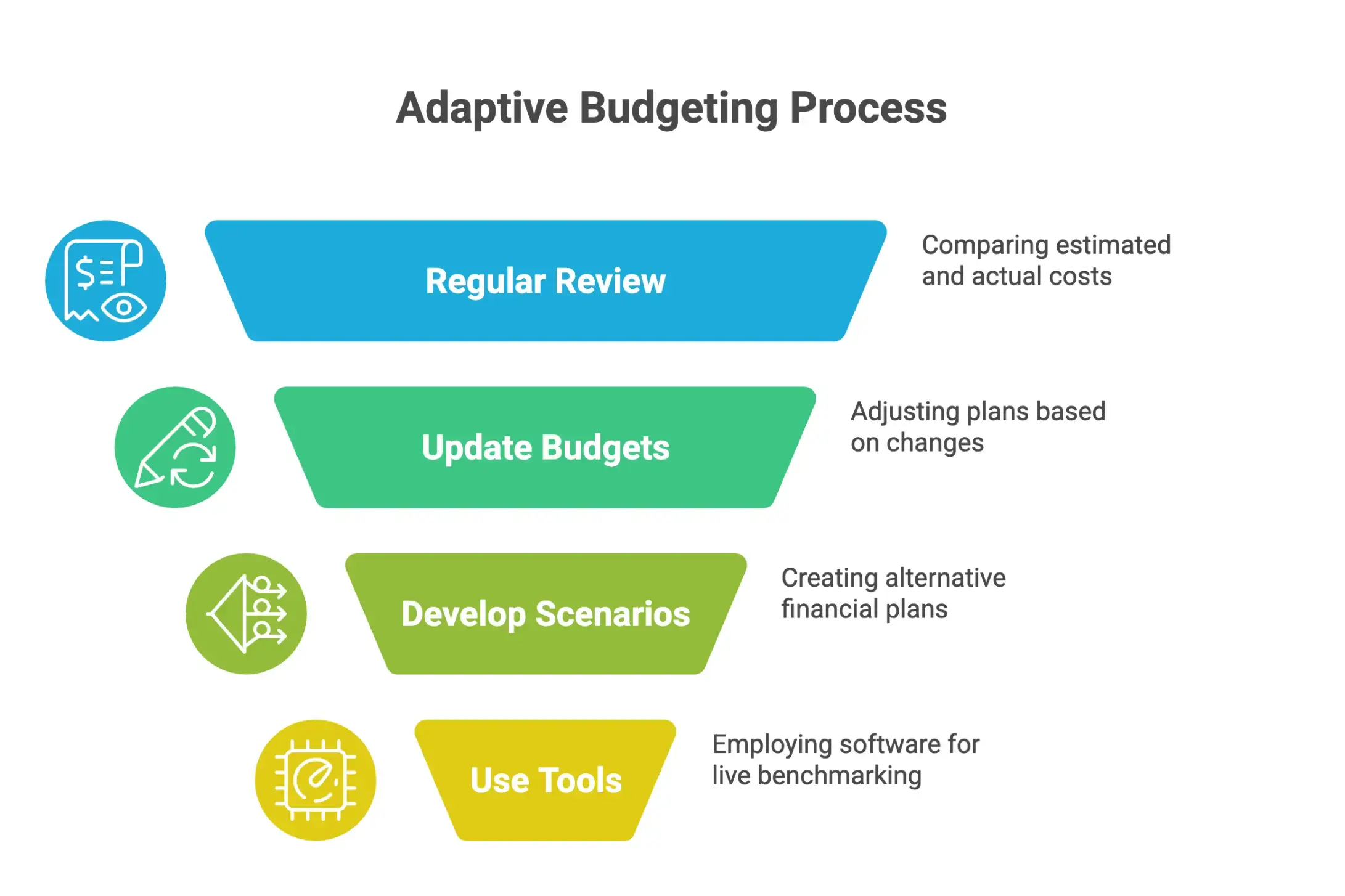
This approach identifies areas of overspending, highlights where investment is most effective, and enables timely decision making.
Learning from Peer and Cross-Industry Benchmarks
Internal benchmarking is valuable, but external perspectives unlock new ideas. E4 Crop Intelligence advises comparing not just costs but process performance with both direct competitors and similar organizations in new markets or other sectors. This can reveal best practices, process improvements, and higher-impact investments.
Effective benchmarking means:
- Targeting organizations or construction projects with similar scale and challenges
- Focusing on best practices that improve both cost efficiency and resource allocation
- Drawing on anonymous industry data to avoid bias

For more, see cost estimation best practices.
Labor Cost Benchmarking
Labor often makes up a significant share of project costs. Labor cost benchmarking enables companies to:
- Compare labor spending patterns with similar institutions
- Uncover indirect costs, direct costs, and inefficiencies
- Make sound decisions about project management and resource allocation
Careful analysis of labor benchmarks can reveal new opportunities to improve both project outcomes and financial health.
Frequently Asked Questions
What is the main difference between cost benchmarking and budgeting?
Cost benchmarking measures your project costs against external industry standards or peers to determine competitiveness and identify areas for improvement. Budgeting, by contrast, defines how financial resources, funds, and project team efforts will be allocated. Benchmarking provides context; budgeting sets the detailed, actionable internal roadmap.
How does cost benchmarking improve the budgeting process?
Benchmarking provides external, objective data that grounds your budget templates and plans in reality. It validates assumptions, ensures cost estimates and expenditures are competitive, and guides decision making on investment and resource planning.
Why use cost benchmarking and budgeting together?
Combining both approaches ensures budgets are challenged and refined by the latest industry standards, not just past performance. This enables continuous improvement, better cost control, and aligns financial goals with what’s happening beyond your four walls.
What are the key parts of a budgeting process?
The budgeting process typically includes creating operation budgets, capital budgets, and cash flow budgets. It turns cost estimates into a working budget plan and is reviewed during each fiscal year to identify opportunities, reduce risks, and keep financial planning on track.
How do modern tools support the cost benchmarking and budgeting process?
Platforms like CostOS streamline the budgeting process by pulling data from diverse sources, supporting benchmarking across metrics, and enabling real-time, collaborative updates to cost budgeting. This supports better project management and improves estimate accuracy and outcomes.
Conclusion: Building Robust Project Financials with Benchmarking and Budgeting
Both cost benchmarking and budgeting are essential for achieving accurate project costs, reliable forecasts, and strong financial planning. Cost benchmarking gives you third-party metrics and structured methods to validate performance and spot gaps. Cost budgeting creates actionable plans from these insights and keeps actual costs within target.
A best-in-class budgeting process links both. Actual, relevant cost data guides every step from estimate to final expenditure. This approach builds stronger management, ongoing improvement, and clear value for every dollar spent.
Building a Culture of Continuous Improvement
Integrating benchmarking into your routine project management cycles ensures your team always maintains an up-to-date understanding of cost data, actual costs, and industry trends. Ongoing benchmarking helps improve estimate accuracy and supports stronger planning processes across successive projects.
Key actions:
- Collect project cost data and past performance for every project
- Commit to regular, transparent reviews incorporating benchmarking and budgeting outcomes
- Foster open dialogue between estimating, budgeting, and management teams
- Use modern software to keep your data, estimates, and results visible and actionable
Done right, cost benchmarking vs budgeting isn’t a debate. It’s a partnership that makes every cost estimate, every project, and every budget plan more reliable and competitive.
Ready to Take the Next Step?
Looking to modernize your budgeting process or project management toolkit? Explore the full Nomitech suite or connect with our team to identify opportunities, reduce risks, and choose solutions that fit your project costs and needs.





Stay Up to Date
Subscribe to our Newsletter today and receive the latest updates, trends, expert insights, and exclusive offers tailored to your specific industry.