

What Is a Pricing Index in Cost Estimating? Complete Guide
TL;DR: A pricing index is a statistical measure that allows you to translate yesterday’s costs into today’s market, enabling more accurate project budgets, informed pricing decisions, and a data-driven understanding of how your prices compare to the market average. This guide covers what price indices are, how they’re calculated and used, including the Consumer Price Index (CPI) and Producer Price Index (PPI), how to perform an index calculation for actual estimating, and why using a price index helps safeguard your profits and competitive position.
What Is a Pricing Index in Cost Estimating?
A pricing index is a statistical measure that tracks how the prices of a specified basket of goods or services change over time, usually compared to a base period. In cost estimating, a price index serves as a benchmark that helps you adjust historical price data to reflect current or future price levels. Price indices give estimators, managers, and business owners a systematic approach for monitoring price changes and making informed pricing decisions rooted in data rather than gut feeling.
Why Use Price Indices?
- They enable you to compare prices over different periods or markets.
- Offer valuable insights when comparing costs between competitors or regions.
- Provide a data-backed way to monitor price trends and inflation rates.
- Help you identify price adjustments needed to preserve profit margins.
In short, a price index helps transform your estimates and pricing from subjective guesswork to objective, trackable projections.
The Significance of Price Indices in Cost Estimation
Users searching for price indices in cost estimating are typically seeking a clear explanation of what they are, how they function, and their impact on both everyday economics and project budgets. Pricing indices are crucial because they:
- Act as a normalized average of price relatives for a class of products or services in a defined market over a defined time period.
- Serve as an anchor for tracking overall price changes. This can be inflation or deflation.
- Allow comparisons not just across time, but between regions and different market positions.
- Help businesses and project teams build data-driven forecasts and scenario plans to maximize revenue and stay competitive.
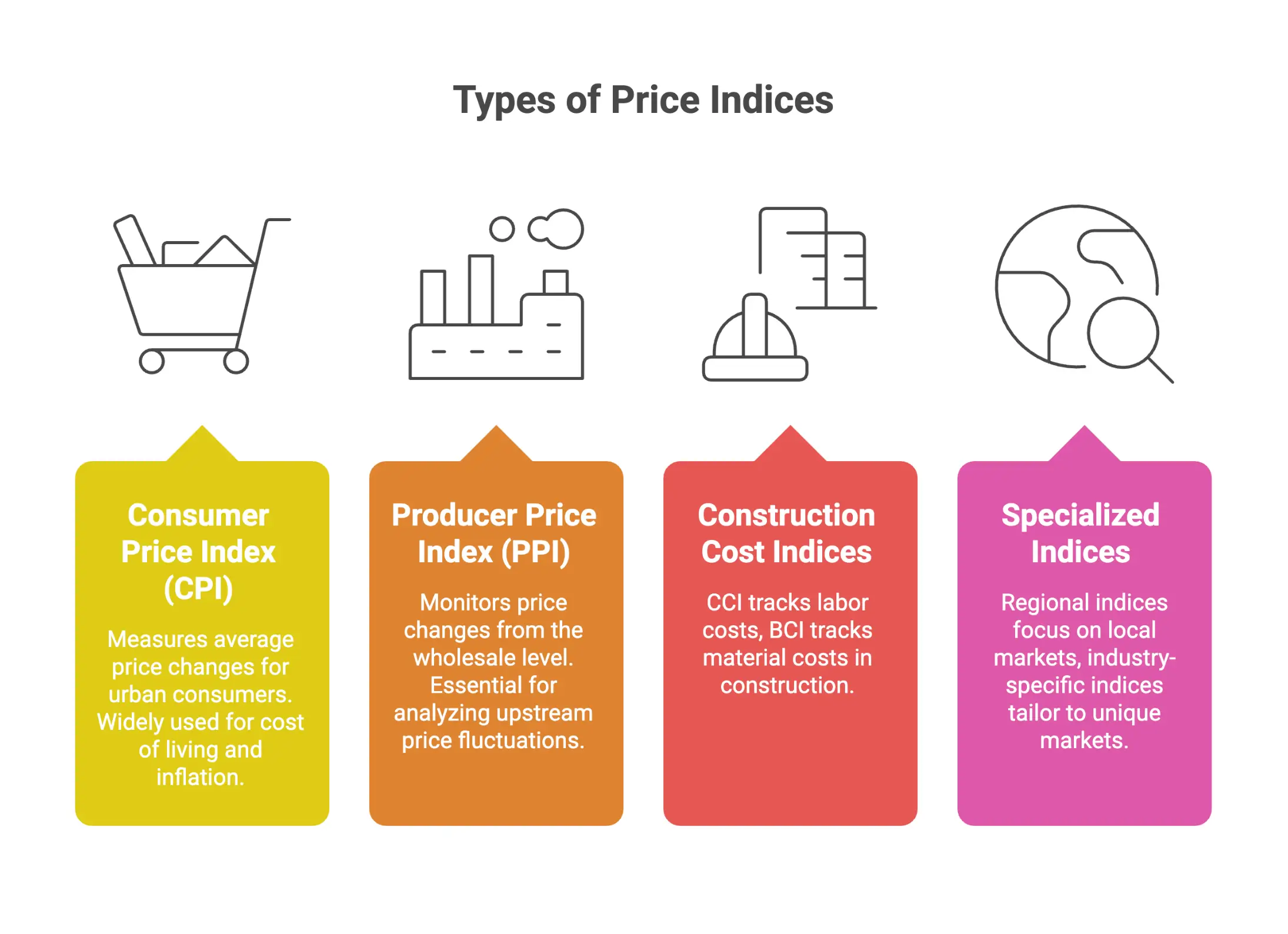
Types of Price Indices: CPI, PPI, and More
Consumer Price Index (CPI)
The Consumer Price Index (CPI) measures the average change over time in the prices paid by urban consumers for a basket of consumer goods and services. It's the most widely recognized index for tracking cost of living changes and inflation rates. Organizations often refer to CPI for wage adjustments, cost-of-living comparisons, and general economic planning.
Producer Price Index (PPI)
The Producer Price Index (PPI), as published by the U.S. Bureau of Labor Statistics, monitors price changes from the wholesale level, tracking the average change over time in selling prices received by domestic producers for their output. It's an essential tool for analyzing how upstream price fluctuations impact contracts, especially in long-term deals.
Construction Cost Indices (CCI, BCI)
- Construction Cost Index (CCI) tracks price changes in construction primarily focused on labor costs.
- Building Cost Index (BCI) tracks price levels with an emphasis on materials.
Specialized Indices
- Regional Cost Indices focus on local markets, accounting for region-specific price trends, labor rates, or tariffs.
- Industry-Specific Indices may be tailored to unique markets. For example, the COST INDEX PR in Puerto Rico is customized for regional conditions.
Data Collection for Calculating Price Indices
Successful calculating price indices starts with robust data collection. This involves:
- Gathering historical price data for each product or service in your index “basket.”
- Collecting expenditure data to assign correct expenditure weights based on actual spending.
- Recording price quotes at consistent intervals for reliable comparison.
Modern estimating platforms integrate data collection tools, letting you update cost indices automatically.
Calculating Price Indices: Methods and Example Calculation
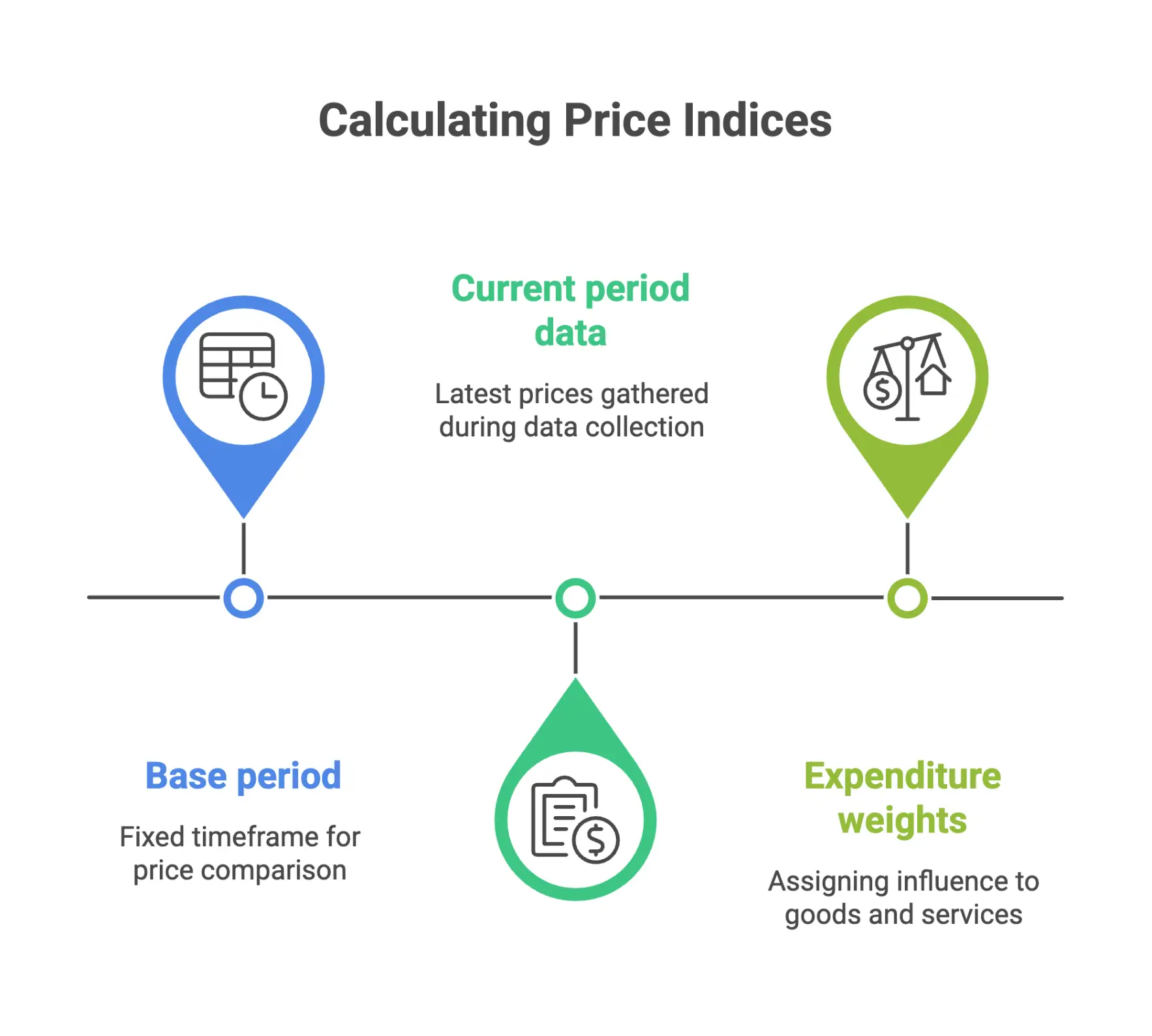
To calculate the price index, you need:
- A base period: The fixed timeframe against which other prices are compared.
- Current period data: Latest prices gathered during ongoing data collection.
- Expenditure weights: Assigning more influence to goods and services representing larger shares of consumption or project cost.
Example Calculation
Suppose you're using the Laspeyres index, a common method due to its simple use of base period quantities.
Laspeyres Price Index formula:
PI = (Sum of (Current Period Price × Base Period Quantity)) / (Sum of (Base Period Price × Base Period Quantity)) × 100
Where:
- PI = Price Index
- Current Period Price = Price in year t (p_t)
- Base Period Quantity = Quantity in the base period
Step-by-Step Example
- Suppose in the base period (2020), a contractor bought 100 units of steel at $50 each, and in the current period (2024) the price is $60.
- Laspeyres index calculation:
PI = (100 units × $60) / (100 units × $50) × 100 = ($6,000 / $5,000) × 100 = 120
- The index value (P_I) of 120 means prices are now 20% higher than the base period.
Other formulas, such as geometric mean or the modified Laspeyres, can adjust for different weighting schemes or price movements.
Base Period, Expenditure Data, and Weighted Averages
What’s a Base Period?
The base period is a fixed reference point in time for the index, typically set when the index is launched or rebased. All subsequent prices are compared to this period. Selecting a recent, relevant base period helps ensure the index calculation reflects current market conditions.
Weighted Averages and Expenditure Weights
Price indices use expenditure weights to reflect the relative importance of different goods or services in the basket. For example, if concrete costs make up a larger share of construction budgets than paint, concrete prices carry greater weight in the index. Weighted averages thus offer a comprehensive measure of overall price changes.
How a Price Index Helps with Pricing Adjustments and Market Analysis
A price index helps you monitor price changes over time, enabling accurate price adjustments in long-term contracts and proactive pricing strategies. Index-based pricing strategies are common for goods or services with volatile costs, linking contract prices to a relevant market index to reduce risk and protect profit margins.
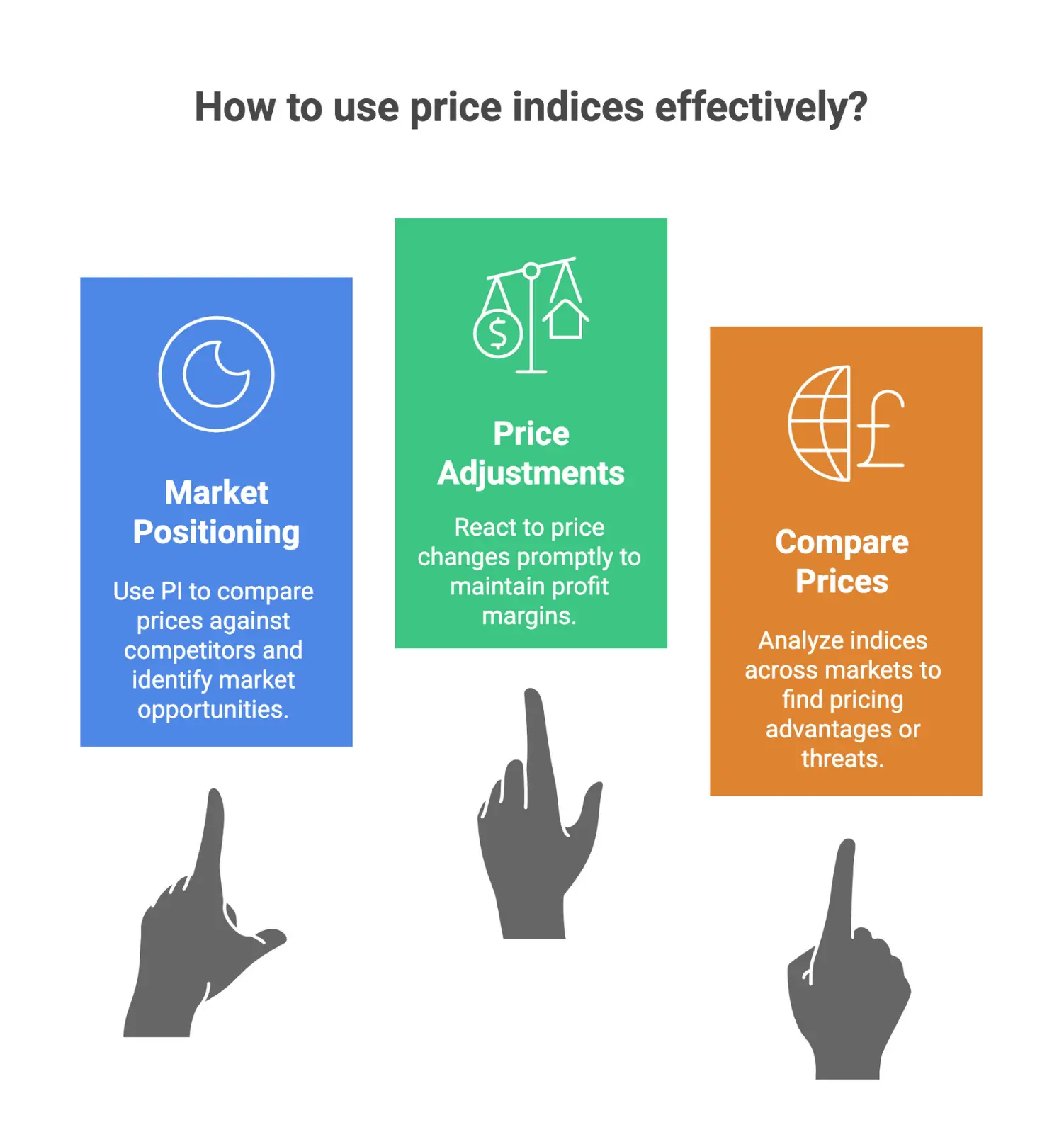
Use Cases:
- Market Positioning: Your Price Index (PI) indicates how your product or project prices stack up against competitors.
- Price Adjustments: Regularly using a price index lets you react to rising or falling prices before profit margins suffer.
- Compare Prices: Comparing price indices across markets helps identify pricing opportunities or threats.
Applying Index Calculations: Example Calculation
Let’s say you’re adjusting an old cost estimate from 2020 using current index values for 2024. The 2020 CCI is 200; in 2024, it’s 250.
- Calculate the Price Adjustment Ratio:
Index Ratio = 250 / 200 = 1.25- Apply to Historical Estimate:
- If the historical cost was $2,000,000, your updated estimate is:
$2,000,000 × 1.25 = $2,500,000
This adjustment ensures your project budget is aligned with the latest market average, reducing risk of budget overruns.
Consumer Price Index (CPI) and Producer Price Index (PPI)
Consumer Price Index (CPI)
The CPI offers a statistical measure for changes in the prices paid by consumers for goods and services, focusing on urban consumers. It tracks overall inflation and helps businesses, policymakers, and individuals adjust prices, wages, and benefits to maintain purchasing power.
Producer Price Index (PPI)
The PPI measures the average change over time in selling prices received by domestic producers for their output. It monitors price movements at the wholesale level, helping organizations understand upstream cost drivers and make informed pricing decisions.
For e-commerce and consumer electronics businesses, referencing the CPI or PPI can guide price adjustments and help maintain market position in a competitive landscape.
Index-Based Pricing: Protection Against Market Volatility
In volatile markets, index-based pricing provides a contract mechanism for automatic price adjustments based on the movements of a selected index, such as the CPI, PPI, or a construction-specific index. This approach protects vendors and clients from unexpected cost escalations or drops, creates transparency, and allows for fairer negotiations.
Common applications:
- Construction projects with long lead times.
- Goods or services with fluctuating input prices.
- Index-linked contracts in government or large infrastructure work.
Regional, National & Specialized Indices: When to Use Each
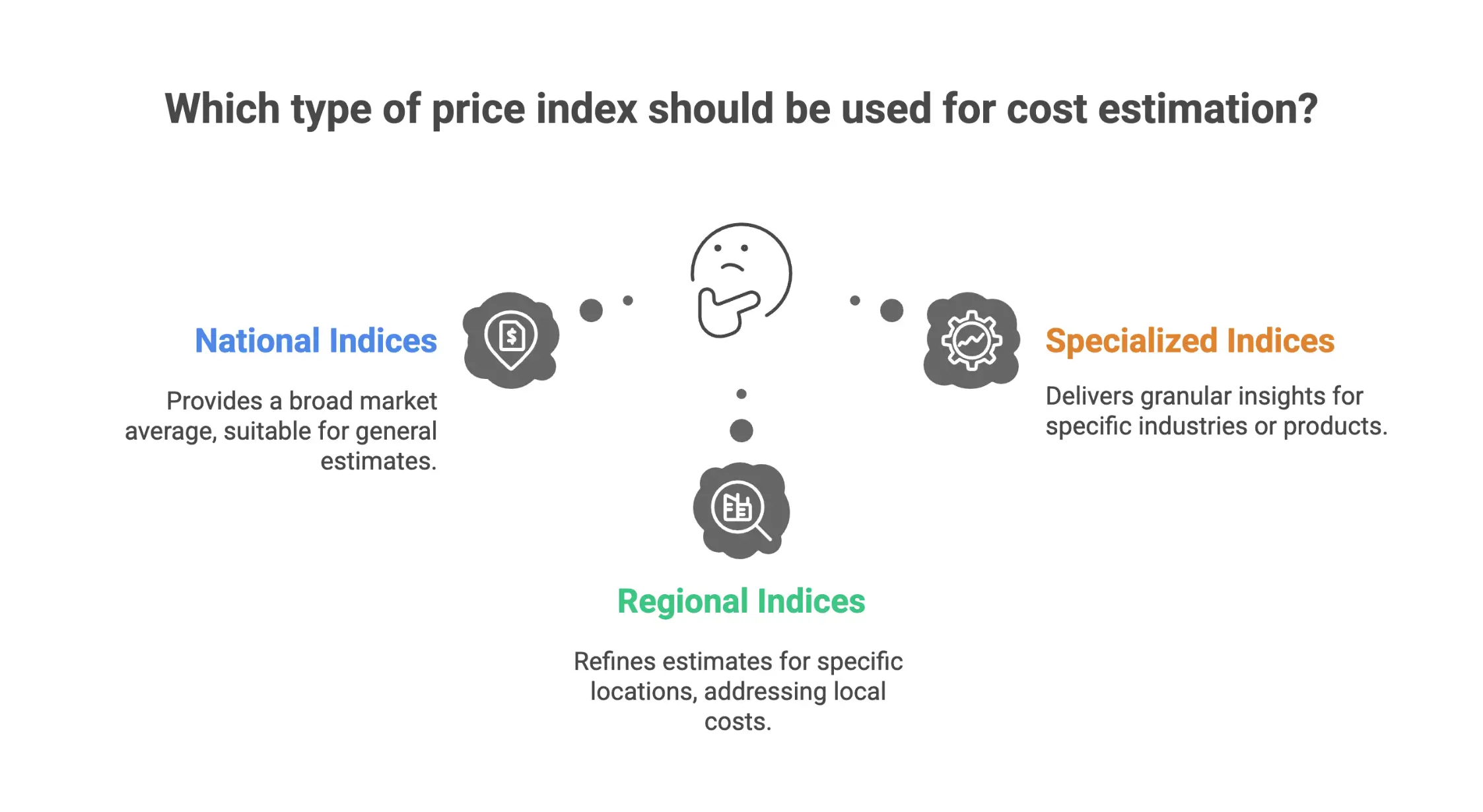
Choosing the right index is critical:
- National Indices (like CPI, national CCI) give a broad market average.
- Regional Indices refine cost estimates for specific locations, addressing local labor costs, tariffs, supply chain issues, or currency effects.
- Specialized Indices (e.g., COST INDEX PR, industry product lines) deliver granular insights where market average doesn’t suffice.
Always clarify the scope (region, sector, time period) your index is designed for.
Historical Price Data: Using Price Indices for Retrospective Analysis
Analyzing historical price data with indices lets you uncover price trends, perform retrospective analysis, and make long-term strategic decisions.
For example, a builder reviewing bids from several years ago can use a historical price index to determine if competitor prices were aggressive or reflected actual market conditions at the time.
Regular retrospective analysis helps refine future bidding strategies, spot cyclical trends, and maximize revenue over the long term.
Using Pricing Indices in Project Management: Cost Performance Index (CPI)
In project management, the Cost Performance Index (also abbreviated as CPI, but distinct from Consumer Price Index) measures a project's cost efficiency by comparing the value of completed work to its actual cost.
CPI = Earned Value / Actual Cost
While the Cost Performance Index is not a price index per se, it demonstrates how index-based thinking translates into performance measurement. Using CPI alongside price indices enhances cost control, risk mitigation, and overall project success.
E-Commerce: Price Indices for Staying Competitive Online
In e-commerce, a price index helps you compare your product prices to competitor prices in real-time. For example, online retailers routinely create and monitor price indices for the in house speaker category or consumer electronics.
Key uses for e-commerce price indices:
- Monitoring market position to stay competitive.
- Rapid price adjustments as the market shifts.
- Identifying opportunities for cost optimization and profit margin improvements.
Example Calculation for E-Commerce If your product sells for $90 and the market average competitor price is $100, your price index is:
PI = (100 / 90) × 100 = 111.1
A result above 100 means your price is lower than the average market price, making you more competitive.
How Often Should You Update Price Indices for Estimation?
Update your cost estimates using pricing indices at least quarterly. In fast-moving or volatile markets, switch to monthly updates. Real-time data collection tools, automated feeds in estimating software, and regular team check-ins all help your price indices stay current. Keeping your indices current is essential for making informed pricing decisions and preserving market advantage.
Common Challenges: Quality Change, Data Collection, and Class Mean Imputation
Quality Change: When products improve or specs change, adjust your index for like-to-like comparison. Use standardized definitions and monitor for product specifications updates.
Data Collection: Reliable indices use consistent, regular data collection and valid price quotes. Gaps or inconsistent updates can skew results.
Class Mean Imputation: In cases of missing data, class mean imputation involves estimating missing prices based on averages from similar products or services in the same class, maintaining the integrity of your index calculation.
Best Practices for Index Selection
When selecting or building a price index:
- Ensure it reflects current market conditions and is updated regularly.
- The basket of goods or services must be representative, capturing all relevant price movements.
- Use appropriate expenditure or quantity weights to accurately reflect relative importance in your estimate.
- Document your base period clearly.
- Choose reputable sources (e.g., government statistical agencies or respected industry consortia).
Pricing Indices for Informed Pricing Decisions
A price index is vital in making informed pricing decisions. By tracking market average costs and competitor prices over time, you can:
- Adjust prices strategically to maintain or improve market position.
- Maximize revenue by identifying when to increase or decrease your own prices.
- Use price relatives and index values to monitor your standing in competitive markets.
- Conduct retrospective analysis to inform long term strategy and robust scenario planning.
Using pricing indices transforms how businesses operate, shifting from reactive to proactive pricing management and supporting data-driven leadership.
Price Indices and Inflation Rates: Measuring the Cost of Living
Price indices, especially the Consumer Price Index, are central tools for measuring inflation rates. By tracking price levels for a basket of consumer goods and services, they provide insights into changes in the cost of living, inform wage negotiations, support economic policy debates, and enable cross-regional living standard comparisons.
Profit Margins and Price Positioning: Strategic Uses of Price Indices
Integrating pricing indices into your strategy enhances your ability to:
- Maintain healthy profit margins by responding to rising or falling input or competitor prices.
- Identify shifts in market position, leveraging price index data for both tactical and long-term pricing adjustments.
- Use the price index to monitor price adjustments, defend budget requests, and maximize competitive advantage.
Case Studies: Price Indices in Action
1. Using Construction Price Indices (CCI/BCI) in Long-Term Projects
Long construction projects often see dramatic price movements. Utilizing a construction cost index or building cost index allows you to:
- Compare prices and bids against historical index movements.
- Identify potential price adjustments and scrutinize change order requests using independent index numbers.
- Update cost forecasts in line with current period index values to maintain accurate, competitive bids.
2. Regional Index for Puerto Rico Construction
The COST INDEX PR, developed for Puerto Rico’s construction sector, accounts for regional product lines, wage rates, and supply chain constraints. Local estimators can use this index to:
- Compare local supplier prices with the market average.
- Adjust historical price data using the latest index calculation.
- Enhance profit margins and maintain competitiveness in a specific market.
For more, see Nomitech case studies.
Frequently Asked Questions
How often should you update your estimates using pricing indices?
Update at least quarterly, or monthly in rapidly changing markets. Use real-time data collection feeds where possible for the most accurate index calculation.
What’s the risk if you skip pricing indices in your cost estimates?
Ignoring pricing indices exposes you to budget overruns, shrinking profit margins, unreliable forecasts, and weaker market position. Regular monitoring with a price index helps mitigate these risks.
What is the difference between national, regional, and specialized pricing indices?
- National: Provides the overall market average for a country or industry.
- Regional: Reflects prices, cost trends, and market conditions at a local level.
- Specialized: Targets a unique sector or market (e.g., consumer electronics or in house speaker category), offering the most tailored insights.
How do modern estimating tools use pricing indices to improve accuracy?
Modern platforms like CostOS and BuildOps integrate systematic data collection and live index feeds into your workflow, enabling more agile scenario planning and faster, more accurate price adjustments.
How do I choose the right index type for my project?
Consider your sector, geographic region, time frame, and the actual cost drivers for your project. Choose a reputable, up-to-date index that matches these parameters for the most robust estimate.
Ready to Take the Next Step?
Curious about building faster, more dependable cost estimates or making more informed pricing decisions in your sector? Explore Nomitech’s full suite or reach out for a conversation about the right tools and systematic approaches to keep your prices aligned with the market average. This will help keep your projects ahead of the curve.





Stay Up to Date
Subscribe to our Newsletter today and receive the latest updates, trends, expert insights, and exclusive offers tailored to your specific industry.