

EHV Transmission Line Cost Estimation with CostOS
TL;DR:
Get rapid, reliable EHV transmission line cost estimates with CostOS. This parametric model, shaped by real project data, delivers detailed BOQs and scenario analysis within minutes for utility and power transmission projects.
Introduction to EHV Transmission Line Cost Estimation
Drawing on extensive US and Middle East experience in the field of EHV and substations estimating the knowledgebase utilises solid algorithms and engineering knowledge to drive Class 4 & 3 estimates. The parametric model delivers quick, accurate estimates for everything from rights-of-way, civil works, and foundation work, to structures, conductors, and crews. With CostOS, you can pull together a full BOQ and proposal in minutes, making it easier to keep transmission line projects on track. It eliminates unknowns and wasted time commonly faced in the power industry.
If you’re planning extra-high-voltage (EHV) or high-voltage (HV) transmission lines, you know how much depends on accurate estimation.
There’s pressure at every step of major infrastructure projects. If you resort to guesswork in a feasibility study or regulatory filing, you invite budget headaches or missed approvals. Overruns during construction aren’t just frustrating. They drive major costs and project delays. The EHV Transmission Lines Cost Model from CostOS is designed to close these gaps, using proven data, industry practices, and reliable estimation tools that address the challenges utilities and engineers face today.
What Sets CostOS Apart for EHV Transmission Lines?
CostOS did not create this solution in isolation. Developed in close coordination with APStamp, a leading US consultancy behind large-scale EHV megaprojects in Texas and the Middle East, the model relies on real project records including unit rates, productivity, terrain variations, and structure logic. By incorporating data-driven insights, CostOS mirrors what actually happens on the ground. The result is accurate estimates that project teams and engineers can trust, whether for early planning or finalizing budgets.
GIS-Driven Takeoff Meets Parametric Estimating
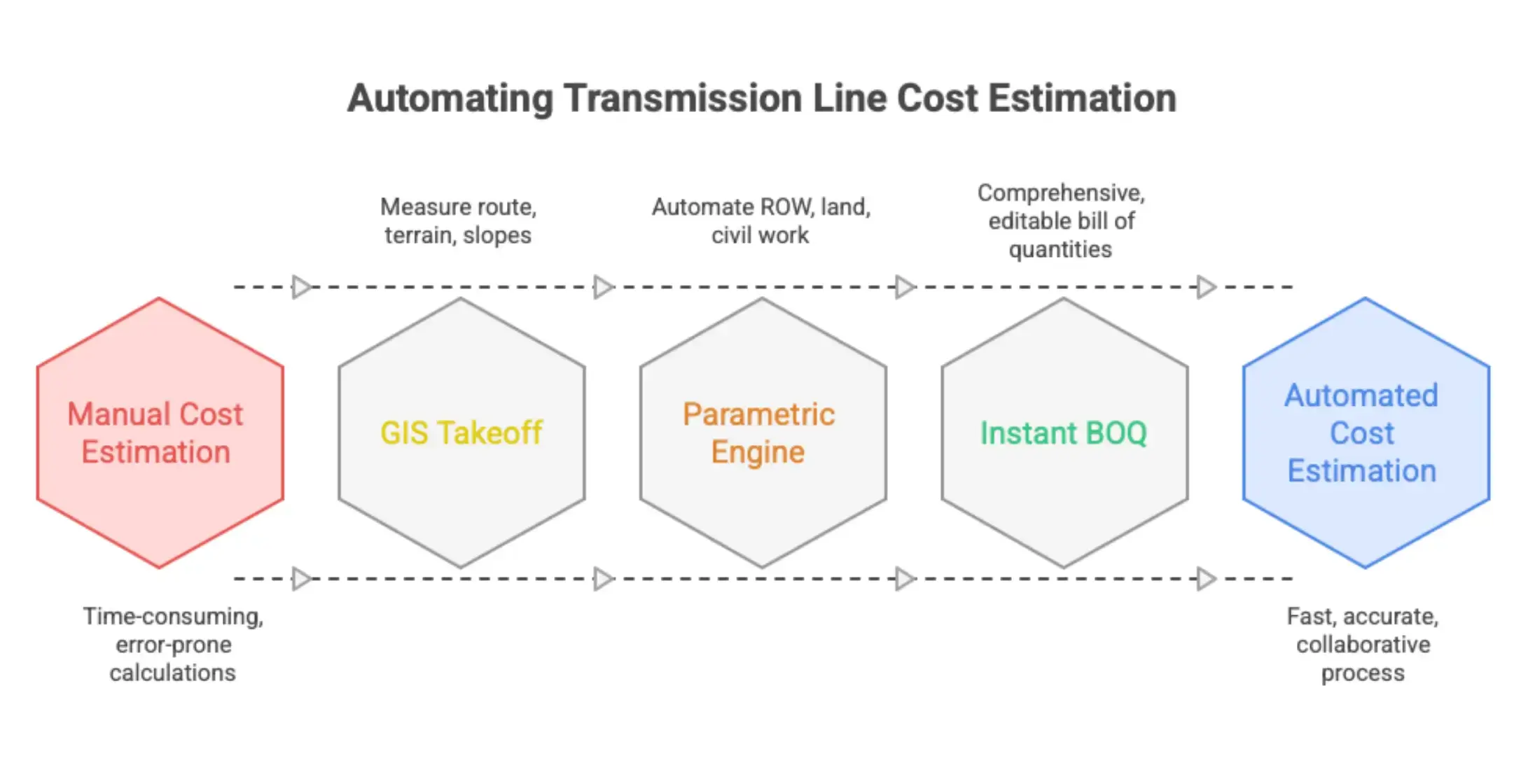
The power of CostOS starts right on the map. Using the GIS takeoff engine, estimators can trace a transmission corridor, measuring route length, terrain types, slopes, and more, whether the line covers forests, wetlands, bush, mountains, or standard ground. All of these details, vital for transmission line cost estimation, flow directly into the parametric engine. This automates the breakdown of ROW needs, land acquisition costs, environmental restoration, and civil work volumes. That means no more manual calculations or risky copy-paste mistakes.
Once the transmission line route is outlined, CostOS delivers a comprehensive BOQ instantly, fully editable for further review or team collaboration, enabling utility coordination and straightforward proposal or contract preparation.
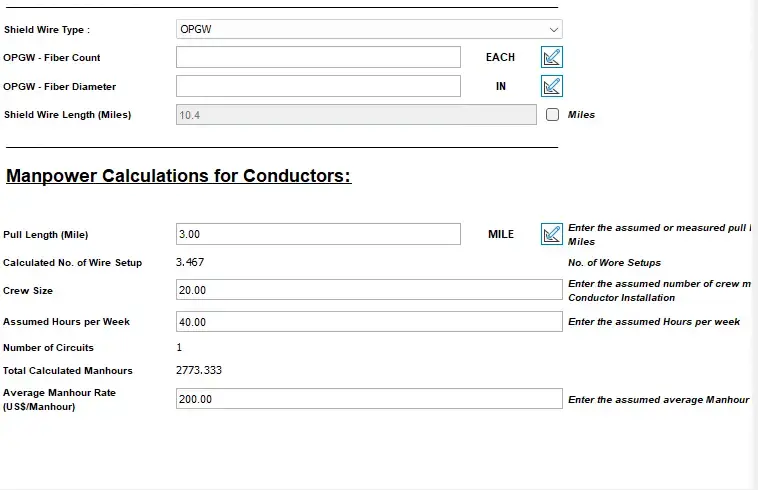
Defining terrain classes, right-of-way requirements, and civil work parameters for transmission line cost estimation in CostOS.
Key Inputs the Model Handles
- Tower structures: Choose between steel monopole or lattice towers for overhead transmission lines, with tailored manpower, equipment, and foundation specifics
- Foundations: Calculate costs for direct embed or poured concrete, using updated market rates per cubic yard to ensure prices reflect current conditions
- Terrain & right-of-way: Accurately detail land use, mix and match up to five terrain types, adjust ROW widths, and input region-specific real estate costs and permitting considerations
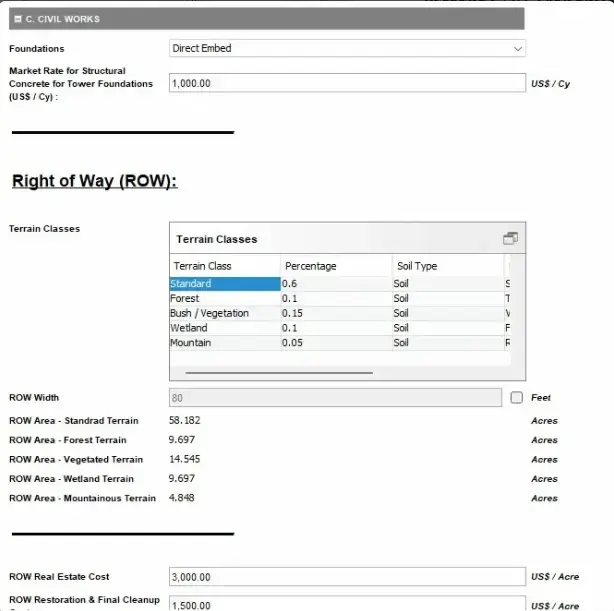
- Conductors & shield wire: Specify OPGW or standard conductors, adjust pull lengths, pick crew types, and factor in labor and man hours for stringing
- Manpower and labor: Assign detailed crews and production rates for each step, capturing true work complexities in transmission line projects
- Location factors: Built-in regional adjustments allow for market cost variations, utility requirements, and unique project specifics
Parametric manpower calculation for conductor installation based on crew size, pull length, and productivity rates in CostOS.
Fast Scenario Analysis for Utility & Power Transmission Projects
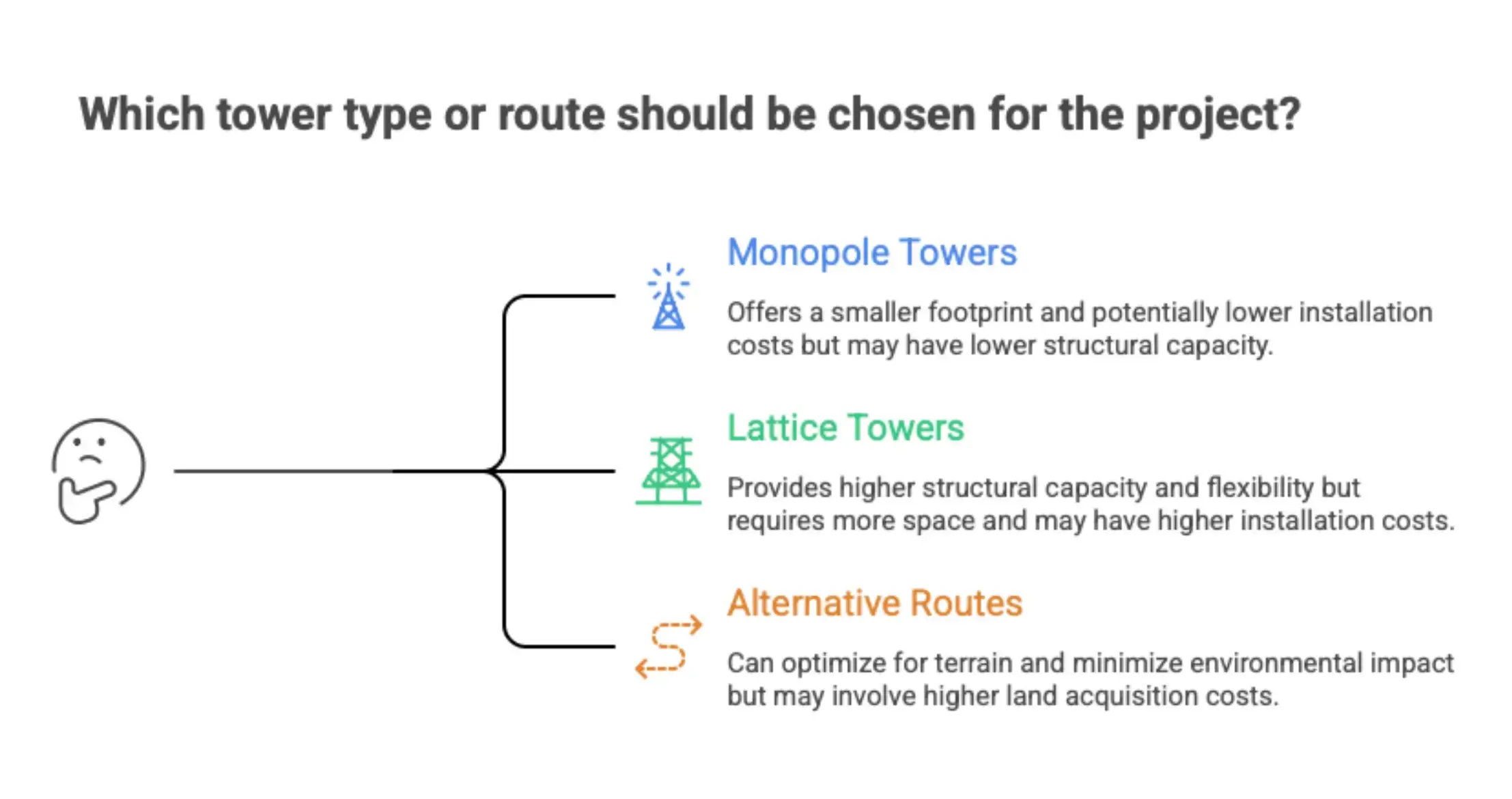
Need to compare monopole versus lattice towers, or test alternative routes that cross different terrains? With CostOS you can swap any model input, and the full BOQ recalculates in seconds, right down to every rate, quantity, and material needed. This efficiency supports engineers and estimators in the planning stages, from “what if” questions to establishing solid, defensible budgets for utility transmission line projects.
Outputs That Teams Can Rely On
After each run, CostOS provides a detailed and transparent BOQ that shows every quantity, rate, and critical cost breakdown. These outputs are easy to check against benchmarks, adjust for particular projects, or export back into your CostOS database for further project development, bid preparation, or ongoing tracking.
Model at a Glance
Parameter
Coverage
Voltage class supported
HV and EHV transmission lines
Structure types
Steel monopole, steel lattice tower
Terrain classes
Standard, Forest, Bush/Vegetation, Wetland, Mountain
Takeoff method
GIS-based route plus parametric estimating
Output
Editable BOQ with all quantities and unit rates
Integration
Native to CostOS for project management, reporting, and seamless export
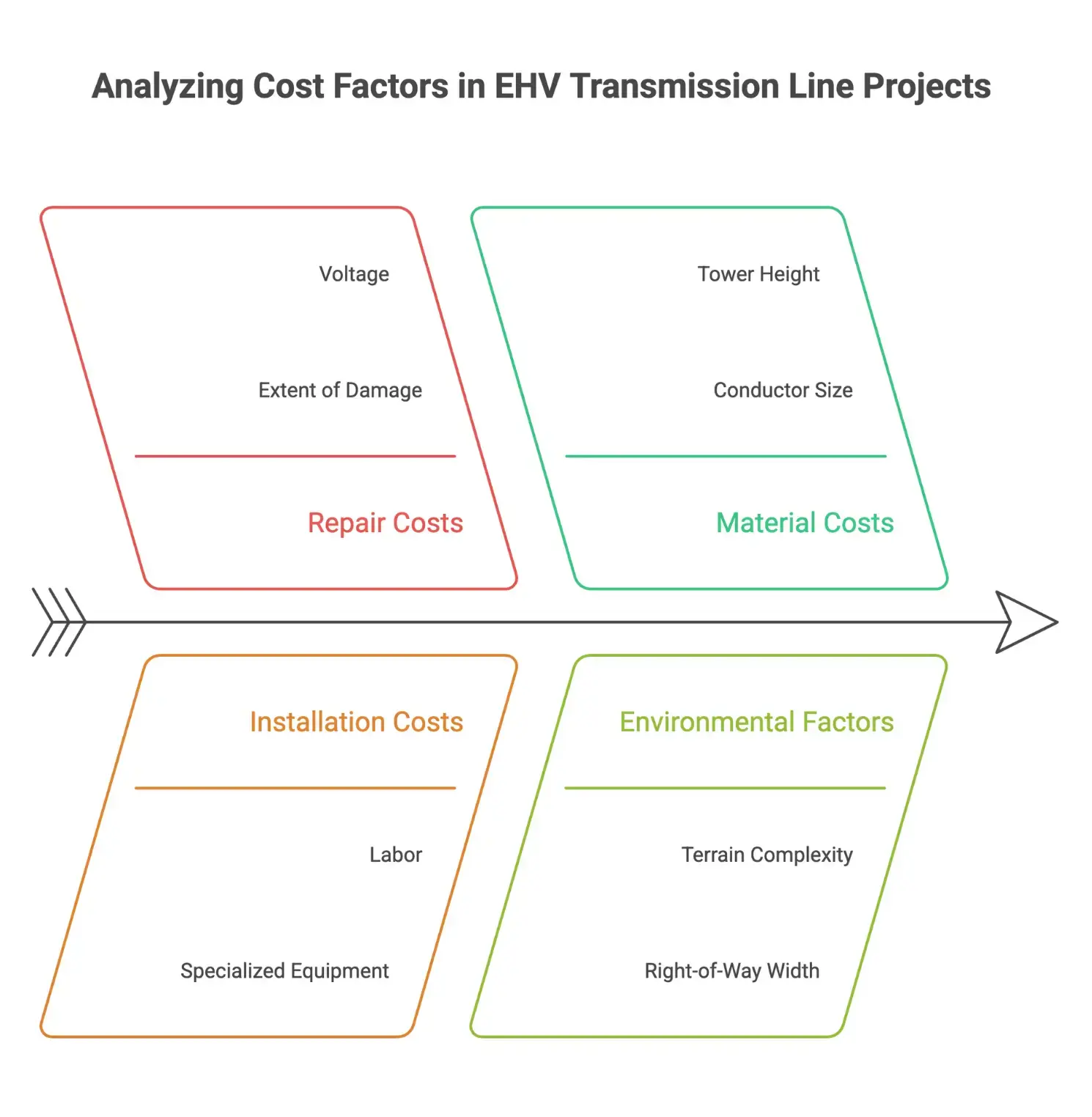
Key Cost Factors in EHV Transmission Line Projects
- Transmission line repair costs vary by extent of damage, voltage, site complexity, and environmental conditions. Minor repairs may cost $5,000–$20,000 per structure while full replacement after severe damage can exceed $1 million per mile.
- Higher-voltage lines from 230kV to 500kV require advanced engineering and specialized materials, significantly raising overall project costs.
- Installation, covering labor and specialized equipment, is usually the largest project expense.
- Estimators and engineers use a phased approach. Cost estimates become more accurate as projects move through planning, scoping, and detailed design.
- Terrain multipliers can substantially increase costs in hilly or forested regions due to challenging access.
- Maintenance costs for EHV transmission lines are estimated at about 1.5 percent of the initial capital investment per year.
- Project costs generally fall into main categories: land and right-of-way acquisition, structures, conductors, and professional services.
- Key cost components include material expenses, foundation work, substation equipment, labor, and project contingencies.
- Higher voltages demand larger conductors, taller towers, and wider rights-of-way. All of these increase material and labor costs.
- EHV lines often require wide corridors for safety, up to 200 to 225 feet for a 765-kV line.
- Conductors may account for up to 40 percent of total capital costs.
- Economic transmission voltage is the intersection where conductor costs balance the rising costs of high-voltage insulators and terminal equipment.
- Route length, terrain, tower design, conductor specifications, right-of-way, labor, and inflation all influence estimating for EHV transmission lines.
- HVDC transmission requires converter stations that may represent up to 60 percent of fixed costs.
- Utility transmission and substation projects involve high capital investment and face complex regulatory and permitting constraints. Mismanagement can cause overruns and delays.
- Best estimation practices include interactive review of planning, site development, and construction. This helps engineers and utilities understand risks and optimize project accuracy.
FAQ
How fast can I generate a cost estimate using CostOS for EHV transmission lines?
With CostOS and its specialized tools, you can build a detailed estimate and editable BOQ for transmission lines within minutes of mapping your corridor using the GIS tool.
Can I adjust model parameters for specific project requirements?
Yes. Every core parameter, such as terrain, structure, materials, crew rates, and more, can be tailored for instant scenario comparisons and accurate estimates.
Are the outputs exportable for team review or tender proposals?
Absolutely. The detailed BOQ is ready for review, further editing, and can be exported to support proposal, utility coordination, and contract needs.
Does CostOS only cover overhead transmission lines?
While overhead lines are the primary focus, CostOS can support projects that involve both overhead and underground transmission elements, ensuring costs are reliably captured for integrated transmission line projects.
Ready to deliver instant, trusted EHV transmission line cost estimates? Discover CostOS for utility transmission and streamline your estimating process today.





Stay Up to Date
Subscribe to our Newsletter today and receive the latest updates, trends, expert insights, and exclusive offers tailored to your specific industry.