

Cost Estimating in Mining: Strategies, Tools & Best Practices
TL;DR: Accurate cost estimation is essential for mining project success. This article breaks down modern methodologies, software tools, and best practices to help mining teams improve estimate reliability, manage risks, and keep projects on track.
Why Cost Estimating in Mining Is Vital
Accurate cost estimating in mining forms the financial backbone of every successful mining project. Even a minor miscalculation can send a project sideways, delaying feasibility studies, upsetting budgets, and putting returns at risk. Cost estimation is not a one-time exercise but an iterative process vital for viability assessment and securing financing. It evolves through phases. Conceptual/Scoping, Pre-Feasibility, and Feasibility Studies bring increasing accuracy as engineering detail advances. Cost estimating in mining covers expenses from exploration through closure and is essential for assessing the financial viability of any project.
As mining projects become more complex and capital intensive, cost estimating plays a crucial role. Stakeholders demand precise figures, and fluctuating resource prices regularly threaten to push estimates off track. Strong and timely cost estimates build confidence for both engineers and investors. This lays a foundation for strategic decisions and steady outcomes.
Understanding Key Principles and Phases in Mining Cost Estimation
Mining cost estimates are not just numbers. They represent a detailed understanding of project risks, uncertainties, and operational realities unique to the mining industry. The process begins with rough conceptual numbers and, through several iterations, builds toward more reliable detail as each phase progresses:
- Conceptual/Scoping Study: The earliest phase, providing preliminary capital and operating costs based on limited data. Intended to determine whether further work is justified.
- Pre-Feasibility Study: Adds more engineering detail, outlines equipment, infrastructure, and addresses processing alternatives. Estimates at this stage are more refined, but still broad.
- Feasibility Study: The final engineering phase, leveraging site-specific data and engineered designs to produce highly accurate cost estimates for decision making and financing.
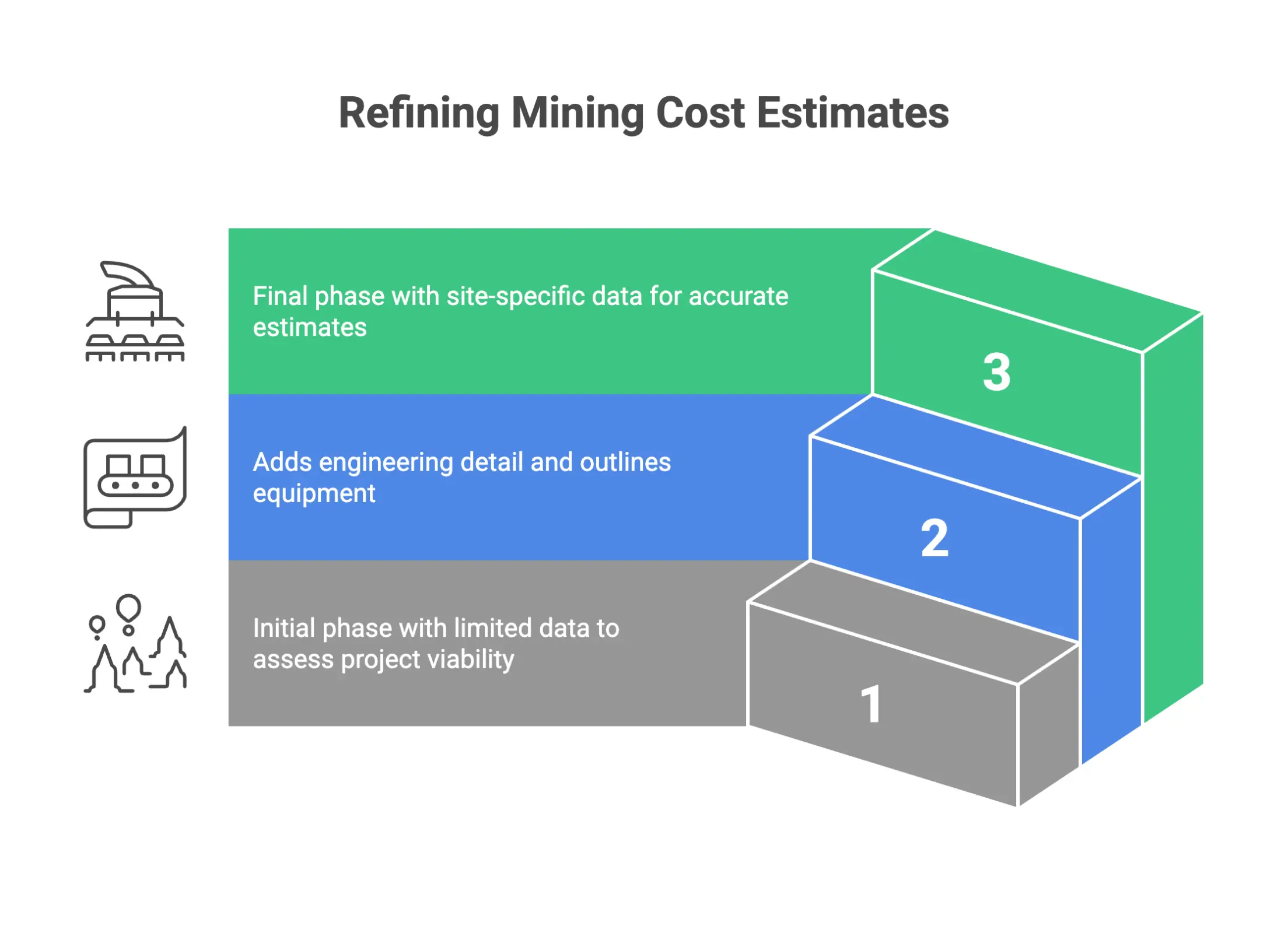
Each step improves estimate accuracy, helping mining companies secure funding and plan projects with greater confidence.
Capital and Operating Cost Fundamentals in the Mining Industry
Core costs in mining project estimation consist of Capital Expenditures (CAPEX) and Operating Expenditures (OPEX), essential categories for every cost estimate:
- Capital Costs (CAPEX): Cover upfront investments such as mine development, site infrastructure, equipment purchases or leases (trucks, drills, crushers, processing plants), and technology upgrades.
- Operating Costs (OPEX): Include daily expenses required to keep the mine running, such as labor, energy, consumables (like explosives, chemicals, lubricants, and spare parts), ongoing maintenance, and compliance costs.
Creating a mining cost estimate requires careful analysis of capital costs, operating costs, and closure or reclamation costs. These figures are influenced by geology, location, mining method, regulatory environment, and market prices.
Major Cost Drivers in Mining Projects
Numerous factors drive costs in mining, and understanding their impact is crucial for efficient and reliable estimating:
- Geological Characteristics: Ore grade, depth, mineralogy (which affects refining), and rock strength directly determine equipment needs, drilling/blasting requirements, and processing complexity.
- Mining Method: Open pit versus underground mines come with distinct costs linked to machinery fleets, labor, waste handling, and specialized infrastructure.
- Project Scale and Development: Larger projects benefit from economies of scale, but development includes site preparation, road construction, shaft or decline creation, and plant setup. All of these significantly influence costs.
- Location and Remoteness: Remote sites incur higher transportation, labor, and infrastructure costs due to logistical challenges.
- Compliance and Permitting: Regulatory requirements drive costs for environmental studies, impact assessments, permitting, and ongoing compliance.
- Labor and Energy Costs: Wages, benefits, and the high energy demands of mining directly impact the operating cost structure.
- Consumables and Supplies: Operating daily requires a steady supply of reagents, explosives, maintenance materials, and spare parts.
- Infrastructure: Access to power, water, administrative buildings, and tailings storage forms a significant portion of initial investment.
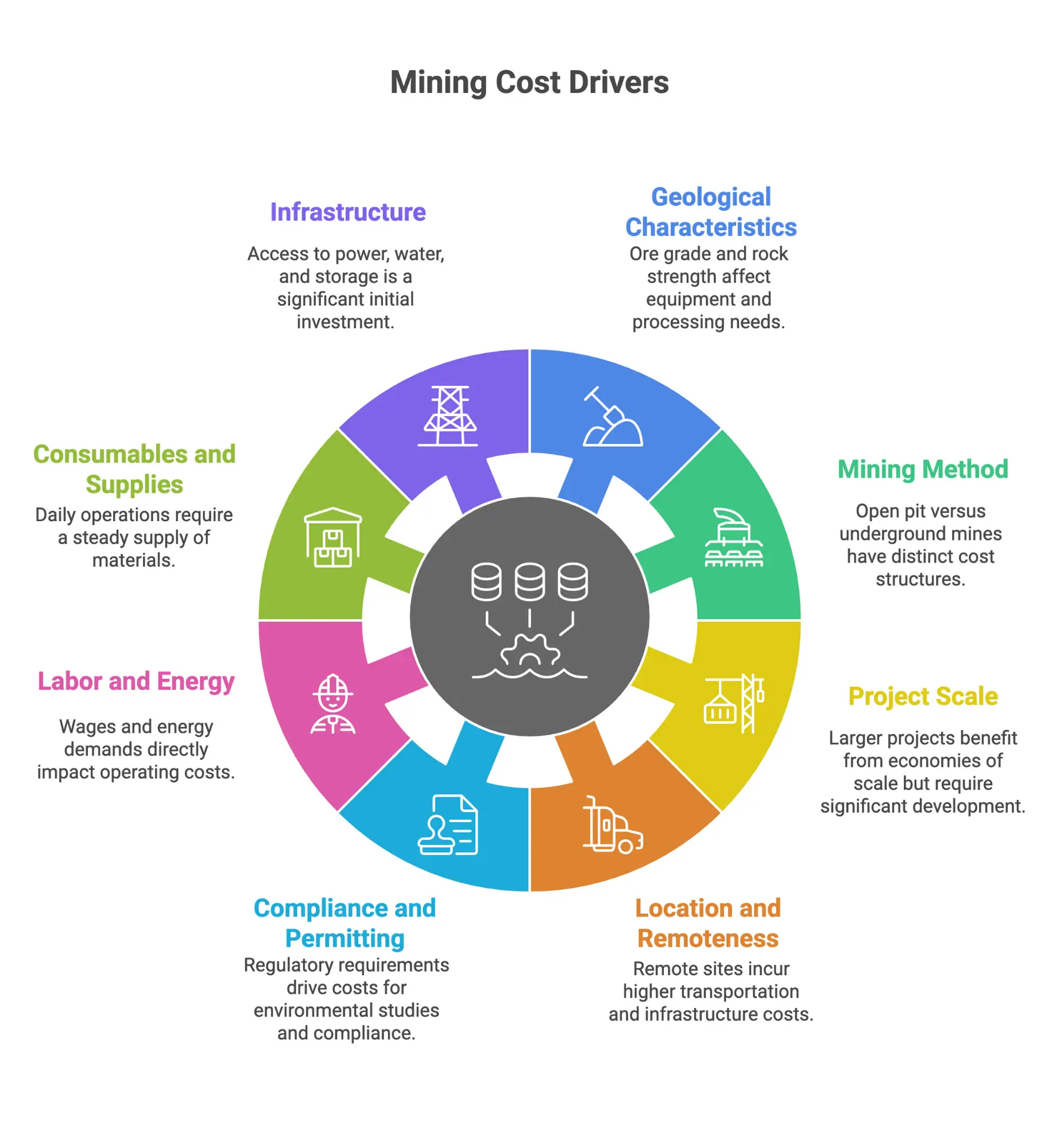
Each mining project is unique, with cost drivers interacting in complex ways. Cost models for various types of mines, especially underground mines, must account for differences in geology, extraction method, and project scope.
Methodologies: Benchmarking, Comparative Analysis, and Cost Indexes
Benchmarking for Accurate Cost Estimates
Benchmarking is central to reliable mining cost estimation. By comparing projected costs to similar past projects or well-established industry averages, estimators can spot anomalies and gain real-world insight. High-quality benchmarking, supported by digital cost indexes and analysis tools, brings consistent and defendable cost estimates to feasibility studies. It ensures that estimates reflect up-to-date costs and industry standards, minimizing the chance of budget surprises.
Cost Indexes and Data Sources
Reliable datasets, such as those provided by Mining Cost Service, include current capital costs and operating cost data, regularly updated using annual labor surveys and current prices for equipment, utilities, and supplies. Historical inflation data and cost indexes for major mining categories help bring past data up to current dollars, making cost estimates more precise.
Empirical and Statistical Methods
Industry-standard handbooks and tools (like the Bureau of Mines Cost Estimating System and its successors) provide equations for modeling capital and operating costs in various mining scenarios. Simplified cost models, especially for underground mining methods, use regression analysis to generate equations, helping estimators rapidly build prefeasibility cost estimates. These handbooks also include cost indexes for annual updates.
Modern Tools and Technologies for Efficient Mining Project Cost Estimating
Spreadsheets may have worked in the past, but cost estimating for mining projects now relies on specialized software that centralizes all cost data and facilitates scenario modeling.
Integrated Cost Estimating Software
Software such as Costmine Intelligence SHERPA and Nomitech CostOS provides platforms for managing all aspects of mining cost estimation. These tools integrate capital and operating cost data, allow for rapid updates, and generate detailed breakdowns covering equipment, labor, fuel, and site-specific factors.
Centralizing cost data leads to:
- Consistent and accurate estimates across projects
- Faster scenario testing
- Efficient updates as assumptions or market prices change
- Immediate benchmarking against standards
Scenario-Based Estimating: Parametric and Monte Carlo Simulation
Mining is subject to unpredictable changes. Commodity prices, regulations, and geology can all shift quickly. Scenario-based estimating in mining project estimation, supported by parametric tools, lets teams adjust key variables and forecast the impact of changes in real time.
Monte Carlo simulation is increasingly used to determine contingency in cost estimates, improving risk awareness and encouraging mining companies to prepare for a range of possible outcomes rather than a single point estimate. Parametric modeling and Monte Carlo add value in feasibility studies and capital planning for both open pit and underground mines.
The Cost Estimation Process in Mining: From Start to Finish
Estimating mining project costs is not a linear task. Instead, it's an iterative and evolving process that grows more meticulous over time. The process starts with broad conceptual estimates used for initial viability screening, then transitions to pre-feasibility studies that refine the scope, equipment lists, and infrastructure requirements. Finally, full feasibility studies involve the most rigorous engineering, resulting in highly detailed and accurate cost estimates. These are essential for financing and final investment decisions.
Key phases and their focuses:
- Conceptual/Scoping Phase: Examines the project's overall potential, involving rough cost estimates based on high-level data.
- Pre-Feasibility Phase: Evaluates possible designs, mining methods, and processing routes with medium-detail estimates.
- Feasibility Phase: Delivers comprehensive plans and costings, ready for lenders and investors to review.
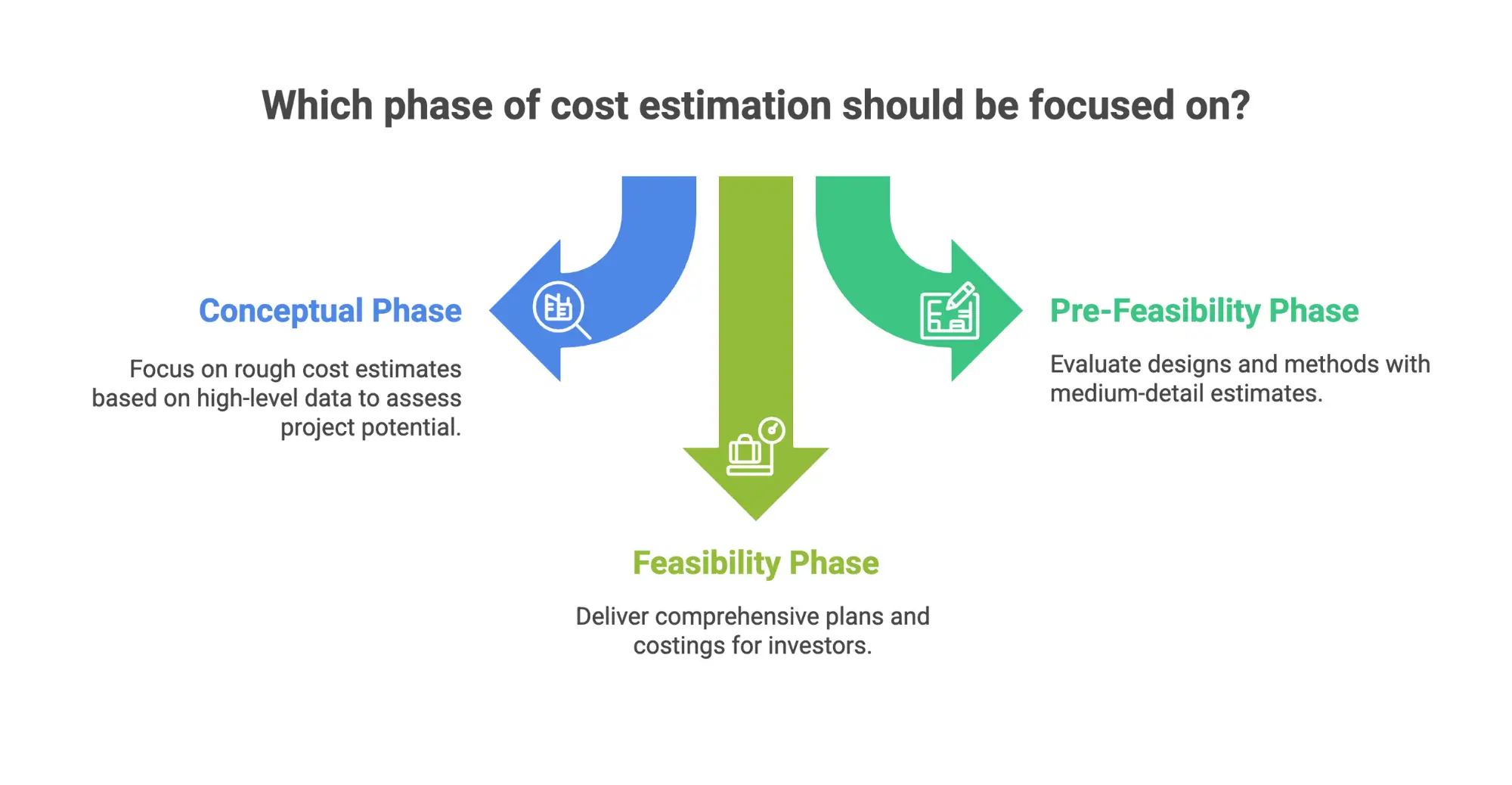
As the estimation process progresses through each phase, the degree of confidence in capital and operating costs increases, supporting better decision-making.
Best Practices in Cost Estimating for the Mining Industry
Standardized Inputs and Data Integrity
Ensuring inputs are standardized is vital for cost accuracy. Databases that are built specifically for the mining industry and updated annually (like Mining Cost Service) provide the best results. These platforms offer detailed, standardized numbers for equipment, labor, operating supplies, utilities, and taxes.
Continuous Training and Proficiency
Even the best software cannot replace skilled professionals. The most accurate mining cost estimates come from teams continuously updating their skills in both technical and industry best practices. Formal courses, such as those offered by the Australasian Institute of Mining and Metallurgy (AusIMM), ensure that estimators can adapt to new tools and regulations, efficiently address the scope of any mining project, and learn from real-world case studies.
Risk Management, Contingency, and Strategic Value
Cost contingency is crucial and should be incorporated into every mining cost estimate. It is typically calculated either as a percentage of projected costs or via robust methods like Monte Carlo simulation. Accounting for uncertainty is especially important in feasibility studies, as geological gaps or limited drilling data can lead to unpredictable cost swings. Integrating risk management into each estimation phase and updating estimates as new information arises helps projects avoid strategic setbacks and financial losses.
Addressing Specific Mining Project Challenges
Underground Mines
Estimating for underground mines poses unique challenges due to variable geology, mining method selection, and the need for specialized equipment. Simplified cost models in industry handbooks offer equations specifically tailored to underground methods, often covering eight or more variants, factoring in equipment operation, hourly labor, administration, sundries, and supplies. These handbooks generally include sections on updating equations for inflation via cost indexes.
Equipment and Infrastructure
Choosing between purchasing or leasing essential mining equipment impacts both capital and operating cost structures. Key machinery ranges from trucks, drills, and shovels to processing and crushing plants. Infrastructure must also address power, water, tailings storage, and support facilities. All are major influences on up-front and long-term costs.
Common Pitfalls and How to Avoid Them
Data Gaps, Scope Changes, and Project Delays
Two-thirds of mining project delays and overruns stem from unreliable starting estimates or project scope changes, often due to incomplete data. Common pitfalls include underestimating geological complexity, neglecting to factor in remote site infrastructure needs, or missing regulatory compliance costs. A staged approach, updating feasibility studies as more information becomes available, can minimize surprises and reduce the risk of cost overruns.
By using standardized methods, robust benchmarking, up-to-date data, and skilled estimators, mining companies can sidestep many of these pitfalls.
The Role of Cost Data Sources and Handbooks
Modern cost estimating draws heavily from specialized datasets and handbooks, which are continually refined:
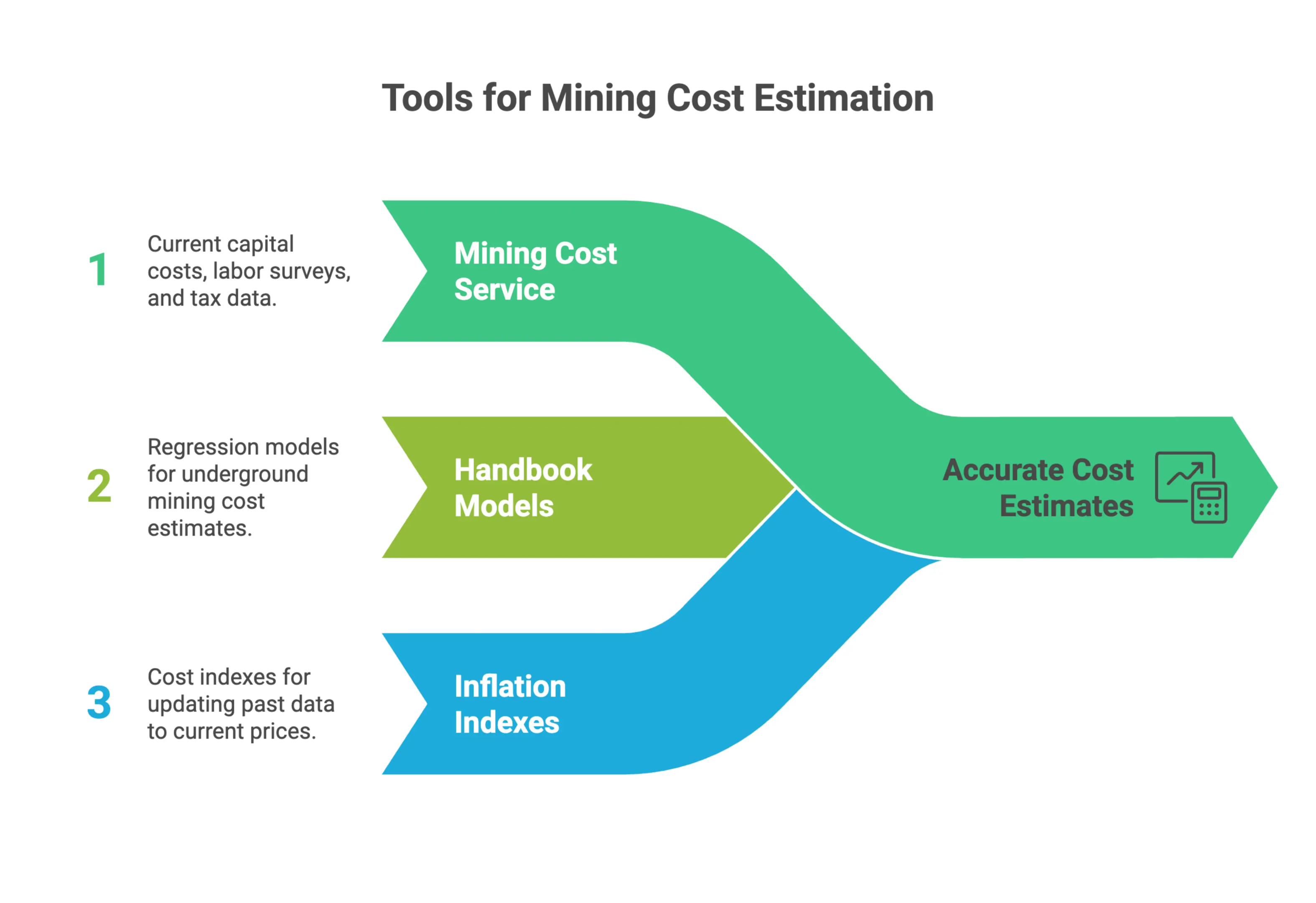
- Mining Cost Service: Updated annually, this resource provides current capital costs for thousands of equipment items and includes annual labor surveys (for Canada and the U.S.), supply item prices, and comprehensive coverage of taxes.
- Handbook Models and Equations: The principal resource for regression-based models, particularly in underground mining. They guide development and updating of capital and operating cost estimates.
- Inflation Indexes: Sections on cost indexes enable updating past cost data to reflect current pricing, ensuring cost estimates remain relevant year-to-year.
The Impact of Technology, Efficiency, and Strategic Planning
Investing in technology can boost efficiency and safety on site, but such moves tend to increase initial capital costs. Modern mining cost estimation processes now incorporate factors like automation, data analytics, and digital twin simulations. These provide better visibility and controls throughout the project lifecycle.
The Future of Mining Cost Estimation
Cost estimation in the mining industry is becoming more predictive and data-driven. With the growing use of artificial intelligence, machine learning, and cloud-based cost estimating software, mining professionals are now equipped to provide more accurate and efficient estimates. Real-time analytics, statistical models, and the ability to quickly update for commodity price shifts will continue to reshape best practices. Robust, risk-aware estimating grounded in empirical data and powered by modern tools will lead mining companies to more reliable budgets and successful projects.
Frequently Asked Questions about Mining Project Cost Estimating
What is the main reason mining projects run over budget or behind schedule?
Unreliable or rushed initial cost estimates often lead to budget overruns. Missing key data or shortcuts during feasibility studies and planning are the top culprits.
How does benchmarking improve cost estimating in mining?
Benchmarking compares your cost estimate with historic projects or current industry standards. This process helps detect errors, provides context, and ensures your budget stands up to scrutiny.
Why should mining companies use specialized cost estimating software instead of spreadsheets?
These programs combine all project variables, including equipment, infrastructure, labor, and compliance costs. They give more accurate, updatable, and scenario-friendly estimates than manual spreadsheets.
What practices help reduce uncertainty in mining cost estimates?
Rely on standardized industry data, provide regular estimator training, and use scenario modeling and robust benchmarking to identify risks and blind spots early in the mining project lifecycle.
How are statistical models and Monte Carlo simulation changing mining cost estimation?
Statistical models (using factors like tonnage, grade, and rock strength) and Monte Carlo simulation add measurable accuracy and risk awareness, strengthening cost estimating especially for complex underground mining projects.
Ready to Optimize Your Cost Estimates?
If you’re exploring modern mining cost estimation platforms, check out Nomitech’s full suite or get in touch with our team to find the right fit for your project needs. Accurate, data-driven cost estimating gives mining companies the edge in today's competitive industry.





Stay Up to Date
Subscribe to our Newsletter today and receive the latest updates, trends, expert insights, and exclusive offers tailored to your specific industry.