
Cost Estimating Nuclear Energy: Best Practices and Key Insights
TL;DR: Accurate cost estimating in nuclear energy is the linchpin for reliable planning and project execution. Nuclear power projects demand massive capital costs, grapple with unique regulatory and industry challenges, and run for decades, making robust cost estimates critical. This guide demystifies leading estimation techniques, tools, and real-world case studies so you can understand the drivers, risks, and value of effective nuclear energy cost estimation.
Cost Estimating for Nuclear Energy: Why It’s Crucial
Imagine managing the construction of a nuclear power plant, a project with capital costs exceeding several billion dollars and a construction timeline that often spans more than five years. On such a scale, even small cost overruns can jeopardize financial viability. In nuclear construction, getting cost estimation right determines success or failure.
Nuclear power plants are expensive to build but relatively cheap to run, making them competitive with fossil-fuel electricity generation in many regions. The capital outlay is daunting, often representing at least 60% of the plant’s levelized cost of electricity (LCOE), as reported by major agencies like the International Energy Agency and the OECD Nuclear Energy Agency. But, once built, operating costs stay low and stable, a key reason why stakeholders and policymakers look to nuclear for affordable, low-carbon power generation. Accounting for carbon emissions is crucial in economic assessments, as it directly influences the competitiveness of nuclear energy compared to fossil fuels.
Every stage, from early studies to regulatory review, construction, operation, and eventual decommissioning, brings new cost drivers. Fuzzy cost assumptions cause budgets to balloon, spark cost escalation, and undermine investor confidence. In deregulated markets, economic justification for major capital investment in nuclear has decreased, raising concerns about energy security and market risk. Within the broader power sector, these challenges highlight the need to balance economic, environmental, and societal objectives.
Nuclear's role in mitigating climate change is increasingly recognized, as it supports decarbonization efforts in the power sector by providing reliable, low-carbon electricity.
Factors Shaping Capital Costs in Nuclear Projects
High Capital Costs and Financing Realities
The most significant cost driver in new builds is the massive upfront investment. The overnight capital cost covers land, construction, equipment, and licensing before a single watt is generated. Financing costs are further magnified by long construction times (often exceeding five years), high interest rates, and lengthy non-revenue-generating phases. In fact, high interest rates and extended construction periods can escalate overall capital costs, as funds are tied up long before plants begin operation.
A recent Reuters report noted the EU’s plan to invest €241 billion to achieve 109 GW of nuclear capacity by 2050: €205 billion for new builds and €36 billion for updates at existing sites. Cost estimation at this scale demands meticulous risk analysis and financial modeling. Cost estimates for new nuclear projects are often higher for first-of-a-kind reactors due to developmental uncertainties, while subsequent units may benefit from cost reductions as experience is gained.
Government support, such as loan guarantees or power purchase agreements, is often necessary to make these investments bankable, especially amidst policy uncertainty. The financing of nuclear projects frequently requires a blend of public incentives and private equity, given the market’s inability to fully absorb such risks unaided.
Understanding the Cost Structure: What Makes Up Nuclear Costs?
Capital, Operating, and Decommissioning Costs
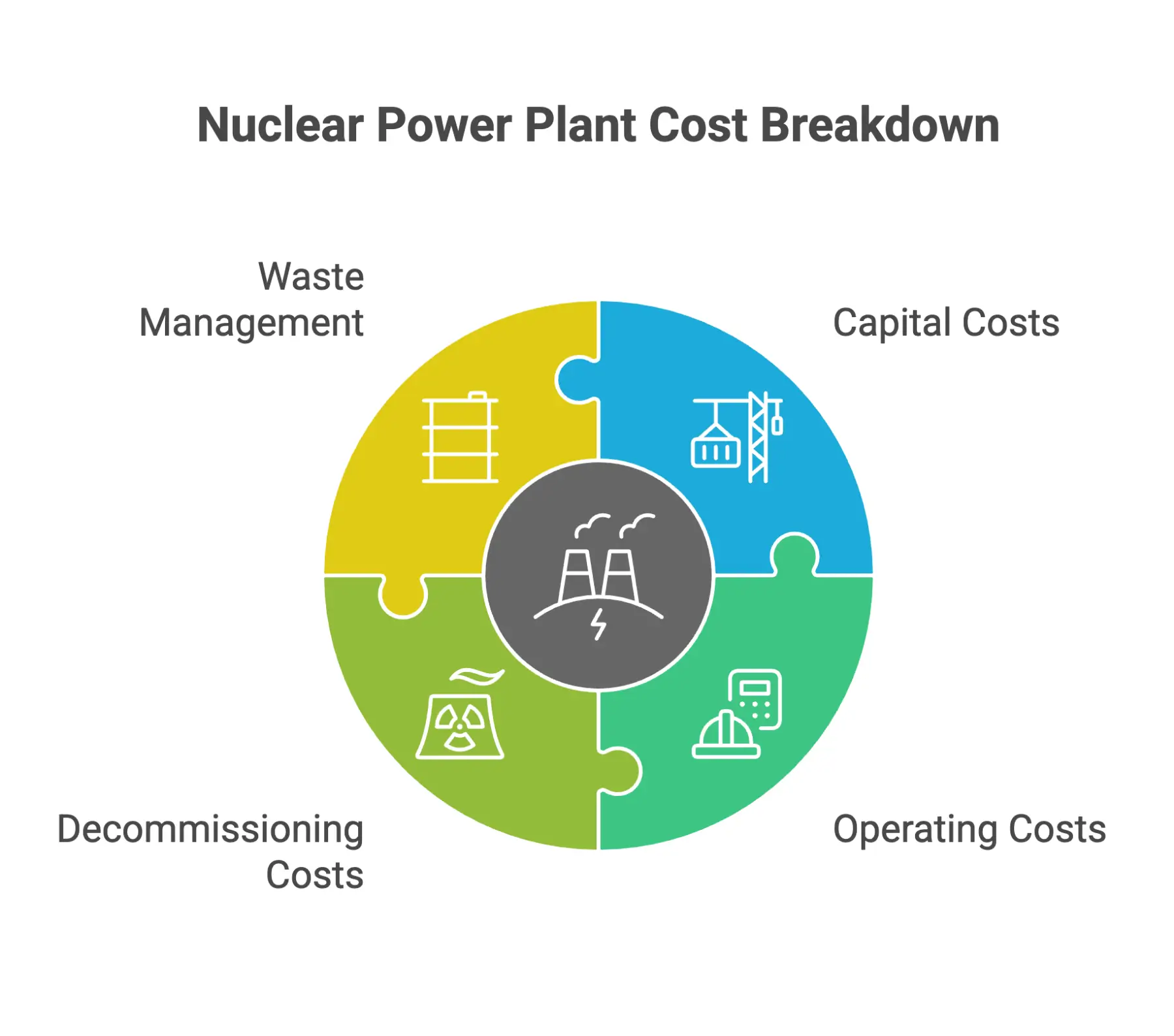
A breakdown of total nuclear power plant costs typically falls into:
- Capital costs: The bulk of expenses arise upfront, from civil works, reactor components, grid connection, and regulatory compliance.
- Operating costs: Once operational, nuclear plants incur relatively modest expenses, which include staff wages, fuel costs (about one-third to half that of coal-fired power plants), and ongoing maintenance costs (O&M).
- Decommissioning costs: End-of-life expenses, billed at about 9-15% of initial capital costs, cover dismantlement and safe closure.
- Waste management: Unique to nuclear energy, this is factored directly into the LCOE, preventing externalization of costs.
The levelized cost of electricity (LCOE) is calculated by dividing the plant’s total lifetime costs by all electricity dispatched, making cost transparency essential for investors and public trust.
Evolution of Cost Estimates Through Project Phases
Cost estimation in nuclear projects evolves from broad early approximations to detailed bottom up estimates as engineering, siting, and supply decisions become final. As designs are finalized and actual supply contracts are signed, projected costs become more precise, narrowing risks for sponsors and regulators. However, there remains a high degree of uncertainty in nuclear cost estimates due to historical variability and ongoing technological advancements.
Plant Operations and Maintenance: Ongoing Costs and Optimization
Efficient operations and maintenance (O&M) are the backbone of successful nuclear power plants, directly influencing their safety, reliability, and long-term economic performance. While the initial capital investment in nuclear power is substantial, it’s the ongoing O&M costs that determine how cost-effective and competitive a plant remains throughout its operational life.
O&M costs in nuclear power plants encompass a wide range of activities, including routine inspections, equipment servicing, replacement of parts, and the management of highly skilled personnel. These costs also cover periodic upgrades and refurbishments that keep the plant running at peak efficiency and in compliance with evolving regulatory standards. Labor remains a significant portion of O&M expenses, given the need for specialized training and expertise unique to the nuclear sector.
Optimizing O&M is essential for minimizing unplanned outages and maximizing capacity factors—key drivers of low nuclear energy costs. Modern nuclear plants increasingly leverage digital tools, predictive analytics, and condition-based monitoring to anticipate maintenance needs and reduce downtime. These innovations not only help control maintenance costs but also enhance plant safety and extend operational lifespans, sometimes by decades beyond the original design.
Industry benchmarks, such as those published by the Nuclear Energy Institute, show that U.S. nuclear plants have achieved some of the lowest O&M costs globally, thanks to continuous improvement, workforce development, and the adoption of best practices. As nuclear power plants age, proactive maintenance and timely upgrades become even more critical to sustaining high performance and cost competitiveness.
Ultimately, effective O&M strategies are central to delivering the stable, low-carbon electricity that makes nuclear power a cornerstone of reliable power generation. By focusing on operational excellence and cost optimization, plant operators can ensure that nuclear remains a vital part of the energy mix for decades to come.
Cost Estimation Methodologies: Tools, Models, and Data
Key Methodologies for Cost Estimation in Nuclear Projects
Tool-Based Approaches
Market leaders increasingly use advanced cost estimating software to produce accurate, data-driven cost estimates. For example, the open-source Nuclear Cost Estimation Tool (NCET), developed by Fortum and MIT, standardizes estimating practices and helps teams benchmark costs across plant types and designs. These platforms harness parametric modeling, BIM integration, scenario planning, and real-time team collaboration. These features are essential for navigating nuclear’s complexity.
Multi-Tiered Modeling and Flexibility
Modern estimation leans on multi-tiered, flexible frameworks that break down direct costs at the project, system, and component levels. This granular approach is used for various reactor technologies, including sodium-cooled fast reactors, and can adapt to advanced nuclear, small modular reactors, or large plants alike. Flexibility is crucial for comparing new nuclear reactors, adapting to regulatory changes, and tracking cost escalation risks.
Detailed modeling also accounts for:
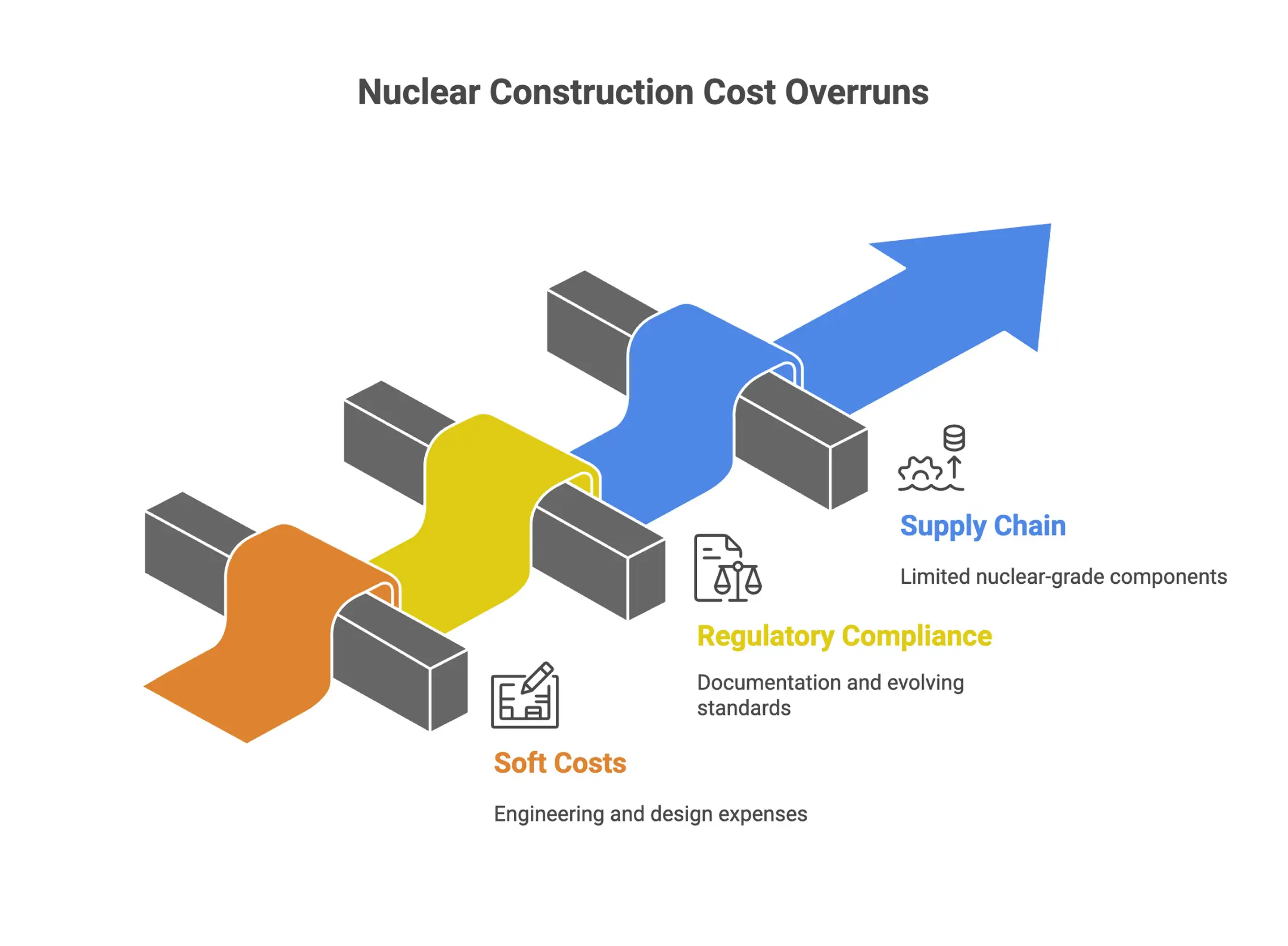
- Soft costs: Engineering, design, and project management, which often fuel cost increases.
- Regulatory compliance: The need for extensive documentation, evolving standards, and inspection can indirectly raise total costs and lengthen the construction schedule.
- Supply chain challenges: Specialized nuclear-grade components are in limited global supply, raising lead times and prices.
Data and Benchmarking
Cost estimation depends on robust, up-to-date data points. Platforms like CostOS and case studies enable benchmarking against prior projects, which is vital for calibrating estimates across geographies and reactor designs. It’s common practice to draw from the annual energy outlook and energy information administration projections for future planning.
Cost Reduction and Addressing Escalation in Nuclear Construction
Cost Reduction Strategies
Efforts to reduce costs focus on:
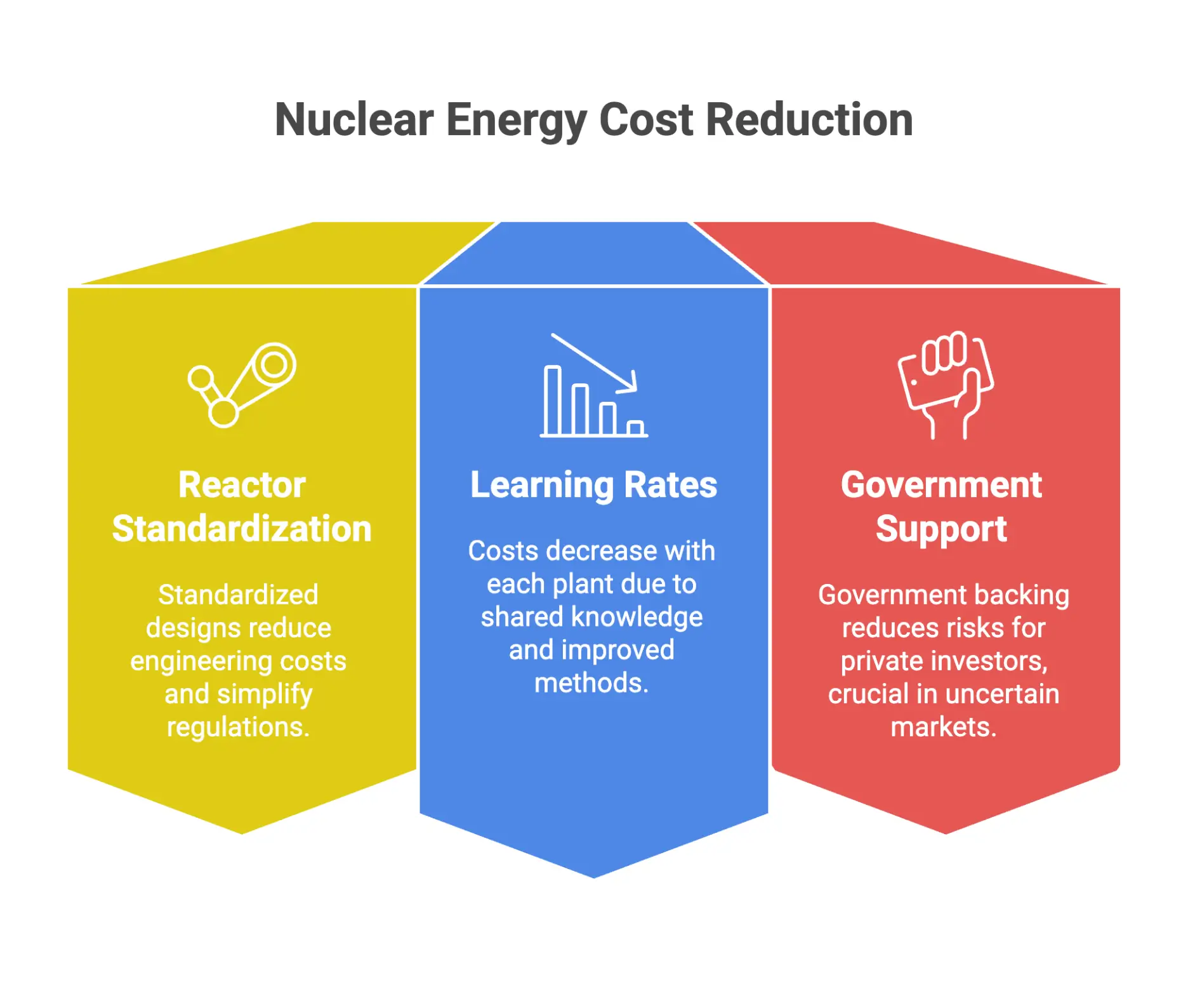
- Standardization of reactor designs: Drives down engineering expenses and streamlines regulatory processes.
- Learning rates: With each completed plant, new projects become less costly due to shared expertise and refined processes. This is a concept seen with learning rates of 8% for large reactors and 9.5% for SMRs.
- Government support: Mitigates risks that private financiers are unwilling to absorb. This is vital under market uncertainty and changing policy environments.
Constructing multiple units on a single site can also lead to significant cost reductions per kilowatt, as economies of scale and shared infrastructure lower overall project costs.
The Inflation Reduction Act in the United States is a prime example of federal support that can shift project economics, making advanced nuclear projects feasible.
Dealing with Construction Delays and Cost Escalation
Construction delays, sometimes resulting from design changes or regulatory shifts, often trigger significant cost overruns and cost escalation. Delays also mean higher financing costs, as funds are invested in a project that is not yet generating revenue. This makes the accurate forecasting of the construction duration and schedule essential for controlling project risks.
Soft costs, such as project management and engineering design, are major contributors to budget increases during nuclear construction. Regulatory instability and public opposition inject further uncertainty, sometimes deterring investment altogether.
Comparative Analysis: Nuclear vs. Other Electricity Generation Technologies
Levelized Cost of Electricity and Relative Costs
Nuclear energy’s LCOE is competitive with dispatchable sources like coal and natural gas, particularly when social, health, and environmental externalities are included. Nuclear also provides for long-term waste management, disposal, and decommissioning from the outset, minimizing hidden external costs common in other power generation technologies.
According to the Nuclear Energy Agency, new nuclear plants average an LCOE of $69/MWh. This compares favorably to other firm generation sources. Microreactors, which are compact, flexible advanced reactors, are projected, with tax credits like those in the Inflation Reduction Act, to reach LCOEs between $48.21 and $78.32/MWh (arXiv).
Cost Competitiveness and System Costs
The cost competitiveness of nuclear improves significantly when accounting for system integration impacts. Adding large volumes of intermittent renewables leads to higher system balancing and backup costs, which nuclear’s predictable output helps avoid.
Fluctuations in gas prices can significantly affect the levelized cost of electricity for gas-fired plants, making nuclear energy's costs more stable by comparison.
Unlike coal plants and wind power, nuclear energy delivers predictable, firm, low-carbon electricity, enhancing economic competitiveness, especially as international carbon regulations and climate targets sharpen.
Impact of Capacity Factors
Capacity factors, a measure of how often a power plant runs, are higher for nuclear (often over 90%) than for renewables. This makes long-term cost estimates and system planning more robust. This reliability underpins nuclear’s reputation as a base-load source. Nuclear energy's consistent output also helps meet fluctuating power demand in modern energy systems, providing stability when electricity needs vary.
Advanced Nuclear, Small Modular Reactors, and Future Trends
Evolution of Advanced Reactor Costs
Advanced nuclear technologies like SMRs and next-generation designs are expected to drive cost reduction through:
- Standardized designs, repeatable construction, and improved project execution.
- Declining costs as more units are deployed and economies of scale take effect.
- Enhanced safety and operational features, potentially simplifying regulatory pathways and reducing some capital costs.
Projected costs for advanced reactors start from 2030 onward and are based on compilations of historical and recent cost data, according to the Nuclear Energy Institute and other industry authorities. As more experience is gained from actual deployments, cost models will be updated for greater accuracy. Policies and incentives, such as zero-emission credits, are also expected to evolve in subsequent years, further influencing the economic viability of nuclear projects.
Future Economic Competitiveness
Small modular reactors and microreactors are poised to capture substantial market share, especially in regions with demanding reliability or space-constrained sites. Their short construction duration, potential for mass production, and lower single-unit capital costs make them especially appealing. With the right mix of government incentives and private investment, advanced nuclear is positioned to see meaningful cost reduction and increased deployment.
Cost Estimation and Project Execution: What the Process Looks Like
Steps in Developing Cost Estimates
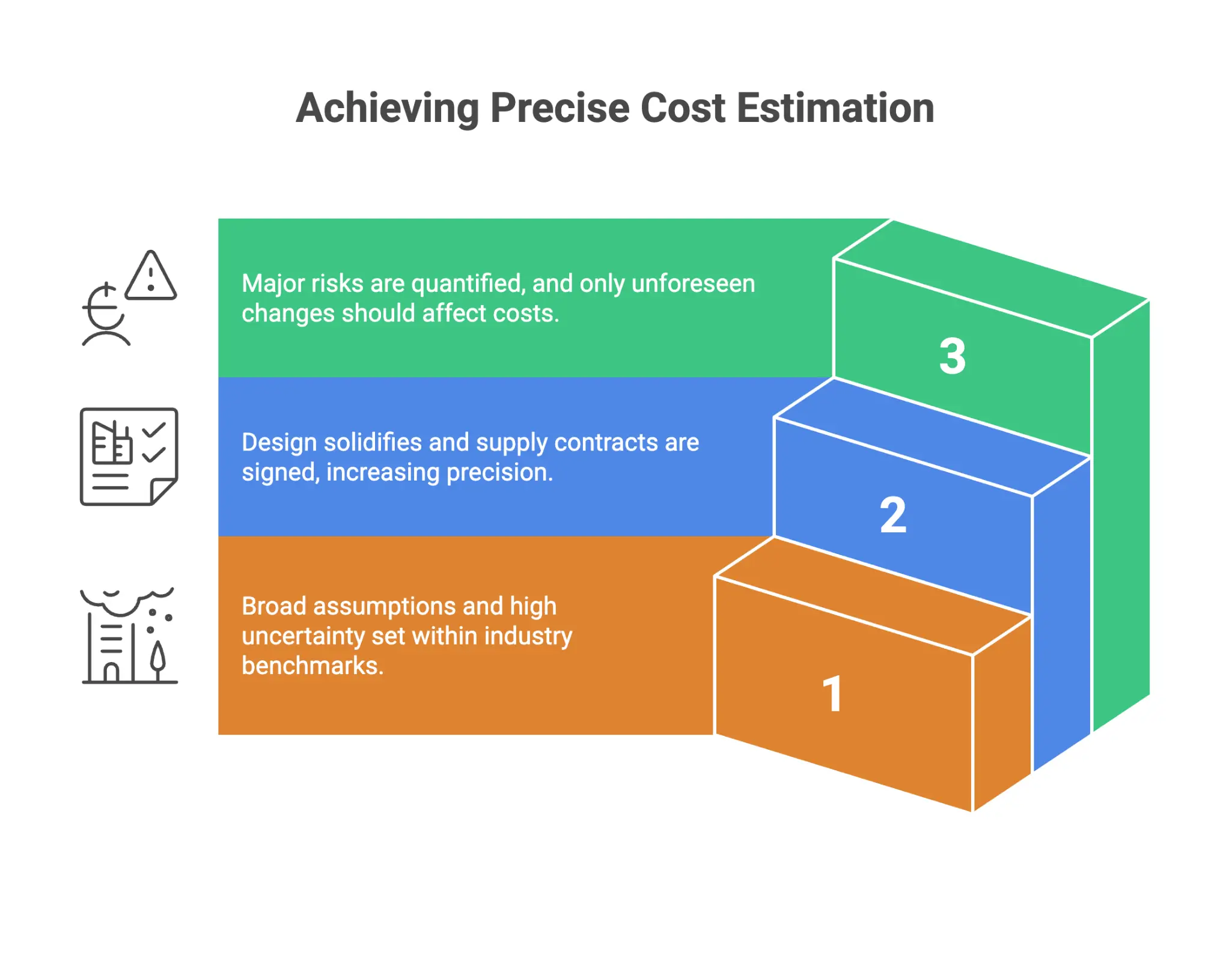
- Initial Estimates: Early project phases begin with broad assumptions and high uncertainty, set within industry benchmarks.
- Refined Estimates: As design solidifies and real supply contracts are signed, cost estimation becomes increasingly precise, allowing for realistic budgeting and project planning.
- Final Estimates: Major risks are quantified, and only unforeseen design or market changes (such as shifts in discount rates, commodity prices, or regulatory requirements) should materially change forecasted costs.
Cost models must account for:
- Sourcing challenges, including limited supplier pools for specialized components.
- Documentation and compliance, which are required for licensing and financing.
- Changing regulations, which can necessitate costly late-stage design modifications.
Key Influences on Cost Structure
- Upfront capital costs dominate total outlay.
- Long construction time increases interest and impacts overall cost.
- Soft costs: Design, project management, and regulatory compliance.
- Risk management: Systems must cover possible construction delays and cost drivers like quality control and supply disruptions. Additionally, the fabrication and management of fuel elements—such as processing uranium, enrichment, and assembling fuel elements for reactors—significantly contribute to overall fuel cycle costs.
- Decommissioning and waste: Compare favorably to fossil fuels which externalize many costs.
Case Studies in Nuclear Energy Cost Estimation
Rooppur Nuclear Power Plant: Financing and Cost Realities
The 2,400 MW Rooppur Nuclear Power Plant in Bangladesh brings to life the complexity of financing and cost estimation for new builds. With a total price tag of $12.65 billion and nearly $11.4 billion secured via a Russian export credit facility, Rooppur highlights how large, upfront capital costs require innovative financing (Wikipedia).
The LCOE at Rooppur ranges from $43.8 to $82.5/MWh, a huge spread rooted in projected costs, interest rates, and design assumptions. Export credits, government support, and global partnerships are not just helpful. They’re often essential to moving such projects forward.
Big lessons from Rooppur:
- Financing terms are often decisive.
- Export credits are a lifeline for upfront capital costs.
- Cost estimates must consider future market and policy changes.
- International partnerships pave the way for newcomers in nuclear energy.
For further examples, Nomitech’s case studies span a range of global nuclear and infrastructure giants.
Challenges and Solutions: Project Management, Labor, and Supply Chain
Key Execution Risks
- Lack of experienced project management and skilled labor can limit productivity and cause errors, as seen in markets with limited recent nuclear builds.
- Design changes during construction often lead to expensive rework and construction delays.
- Limited suppliers for high-quality nuclear components reduce competition and hike prices.
- Public opposition, changing government policy, and nuclear-specific taxes generate additional investment risk and may reduce the economic competitiveness of new plants.
Effective risk management and early investment in talent development are central to cost control and successful outcomes.
Frequently Asked Questions
Why is accurate cost estimation so important in nuclear energy projects?
Because capital costs and timelines are enormous, risks are everywhere, and nuclear projects have long non-revenue-generating construction phases. Good cost estimates keep budgets realistic, timelines on track, and give investors and stakeholders the confidence to stay engaged.
What tools are commonly used for nuclear cost estimation?
Teams use software like the Nuclear Cost Estimation Tool (NCET) and CostOS. These platforms provide standardized estimating, early risk and cost driver assessments, flexible modeling, and support for collaborative decision-making.
How do small modular reactors and microreactors compare with traditional nuclear in terms of cost?
Small modular reactors and microreactors can reach lower LCOEs, sometimes between $48 and $78 per MWh with tax credits, which is competitive with other low-carbon sources. Their shorter construction duration and modularity reduce some financing risk.
What role does financing play in nuclear power plant costs?
An outsized one. Extended construction schedules, high capital costs, and high interest rates raise total project costs. Structures like export credits, PPAs, and international loans often determine whether a project gets built.
What are the main benefits of using multi-tiered cost modeling in nuclear projects?
Multi-tiered models break costs out by systems, anticipate risks, and allow for apples-to-apples comparisons across diverse reactor designs and technologies, improving transparency and project control.
Economic Competitiveness: External Costs and Policy Impacts
Accounting for the Whole Economic Picture
When the health, safety, and environmental costs of fossil fuels are compared to nuclear, the competitiveness of nuclear improves sharply. Nuclear power plants price in waste management, decommissioning, and low-carbon credentials from the outset, unlike some renewables or fossil generation.
As grids add more intermittent renewable sources, system costs increase due to the need for backup and balancing. Nuclear energy’s steady output is a hedge, offering predictable, reliable supply and shoring up grid reliability.
Policy instruments and market designs that recognize these attributes, such as capacity payments or carbon pricing, can shift the investment calculus in favor of nuclear energy and advanced technologies.
Conclusion
Cost estimating for nuclear power is a world apart. It requires specialized tools, multi-tiered modeling, and an understanding of wide-ranging risks. By harnessing experienced project management, advanced digital solutions, and supportive market structures, the industry can control capital costs, ensure economic competitiveness, and deliver clean, reliable power generation.
Ready to Take the Next Step?
Looking to sharpen your cost estimation? Explore Nomitech’s full suite or contact the team for the approach best suited to your nuclear energy project.





Stay Up to Date
Subscribe to our Newsletter today and receive the latest updates, trends, expert insights, and exclusive offers tailored to your specific industry.