

Cost Estimating in Infrastructure and Civil Works: Best Practices
TL;DR: Reliable cost estimation is the linchpin for successful infrastructure and civil works projects. This comprehensive guide explores the principles of cost estimating in infrastructure and civil works, essential methods and types, technology’s role, and actionable strategies. You’ll learn how construction cost estimates, documentation, and collaboration help keep construction costs on track, reduce budget overruns, and ensure project success.
Introduction: Why Cost Estimating in Infrastructure and Civil Works Matters
Every construction project in infrastructure or civil works begins with a critical question: Are our cost estimates accurate? Project leads juggle fluctuating budgets, incomplete construction documents, and fragmented data. Misjudging construction costs can erode trust. Worse, it can endanger project feasibility before construction starts.
With complex project scopes, evolving regulations, and increased demand for transparency, traditional cost estimating approaches often struggle to keep up. Manual construction estimating processes increase the risk of missing indirect costs, material price fluctuations, and budget overruns. Modern projects require not only up-to-date unit costs and detailed construction drawings, but also agile project management and robust collaboration tools.
Cost estimating in infrastructure and civil works is no longer about just tallying receipts. Specialized construction estimating software and digital solutions such as BIM (Building Information Modeling) now underpin the entire estimating process, enabling teams to create precise construction cost estimates, manage construction documents, and streamline communication among stakeholders.
This guide dives deep into best practices, relevant estimating methods, software impacts, and real-world strategies for successful project delivery. You’ll learn how advanced cost estimating helps you determine project feasibility, maintain healthy profit margins, and minimize unexpected costs.
What is Construction Cost Estimation?
Construction cost estimation is the systematic process of forecasting all the expenses, direct and indirect, that go into successfully delivering a construction project. It informs every project decision, from initial conceptualization to project closeout. According to The Constructor, this process does far more than simply total up the expected materials, labor costs, and equipment costs. It involves careful review of construction drawings, construction documents, unit cost estimating, and integration of current cost data from supplier databases and historical benchmarks.
In the civil engineering field, construction cost estimation is indispensable. As Smartsheet explains, estimates start generalized, providing a preliminary estimate based on order-of-magnitude data, then become more detailed as project plans and specifications mature. Determining whether a project is viable often hinges on these early estimates, supporting decisions ranging from funding to resource allocation.
For a thorough overview, visit What is cost estimating.
The Role of Accurate Construction Cost Estimates in Project Success
Accurate construction cost estimating underpins every phase of a successful construction project. Good construction cost estimates allow project owners, contractors, architects, and project managers to evaluate project feasibility, assess project budget, and set expectations with all project stakeholders. Reliable estimates also help secure funding and guide contract negotiations.
As Smartsheet points out, construction estimates evolve across the project lifecycle, from conceptual numbers for early project scope discussions, to bid estimates and construction document estimates used to manage costs in the field. The accuracy of these estimates directly affects the risk of cost overruns and scope creep.
Inaccurate cost estimating can quickly result in budget overruns, strained client relationships, and negative impacts on profit margin. Conversely, accurate cost estimating supports successful project delivery by aligning all the expenses, supporting risk management, and anticipating potential change orders.
Explore a complete guide to cost estimating software to see how top solutions centralize data and streamline collaboration for effective project management.
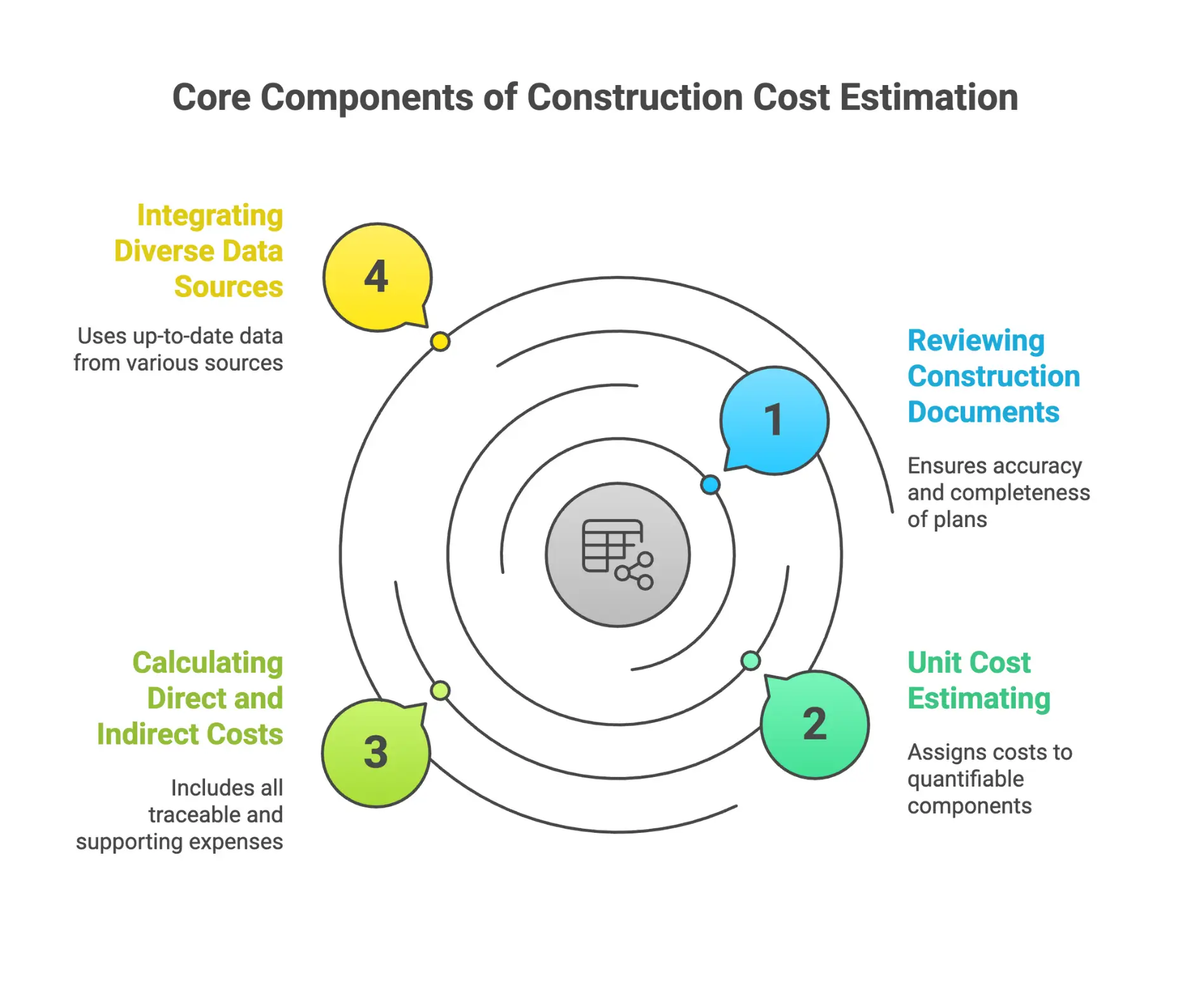
Core Components of a Construction Cost Estimate
Getting a construction cost estimate right is crucial for avoiding costly mistakes. The following elements combine to form the backbone of well-prepared construction cost estimation in civil works:
1. Reviewing Construction Documents and Drawings
The process starts by thoroughly reviewing construction drawings, construction documents, specifications, and project plans. A meticulous document review ensures that takeoffs, required materials, and quantities are complete and accurate. Missing or outdated construction documents can cause major estimation errors.
2. Unit Cost Estimating and Quantity Takeoff
Unit cost estimating involves breaking the project down into quantifiable components (concrete per cubic yard, steel per ton, labor hours per trade, etc.) and assigning current unit costs to each. Quantity takeoff depends on up-to-date construction drawings and project documents to determine exactly what’s needed on the job site.
Typical workflow:
- Extract itemized quantities from construction drawings and specifications
- Match each with regional, current material costs and labor costs
- Include market-appropriate equipment costs and rental rates
- Adjust for site-specific factors or material price fluctuations
- Compare against similar past projects for context and validation
Integrating unit cost estimating within the construction estimating process ensures the resulting project estimate reflects realistic market data, not just theoretical numbers.
3. Calculating Direct and Indirect Costs
- Direct costs include construction materials, labor costs, and equipment costs that can be traced directly to the physical construction of the project.
- Indirect costs cover all supporting expenses not linked to specific tasks: temporary offices, permits, insurance (including general liability insurance), administrative salaries, and project management fees.
A robust construction cost estimate accounts for both. Indirect costs may also include bonding costs, legal expenses, escalation factors, and contingency allowances designed to mitigate unforeseen expenses and manage project risk.
4. Integrating Diverse Data Sources
Incorporating up-to-date cost data from suppliers, labor wage indexes, equipment rental firms, and current cost databases like Richardson or RSMeans is essential for accuracy.
Modern estimating software helps tie these data sources together, improving the quality and transparency of construction cost estimates.
Types and Categories of Construction Cost Estimates
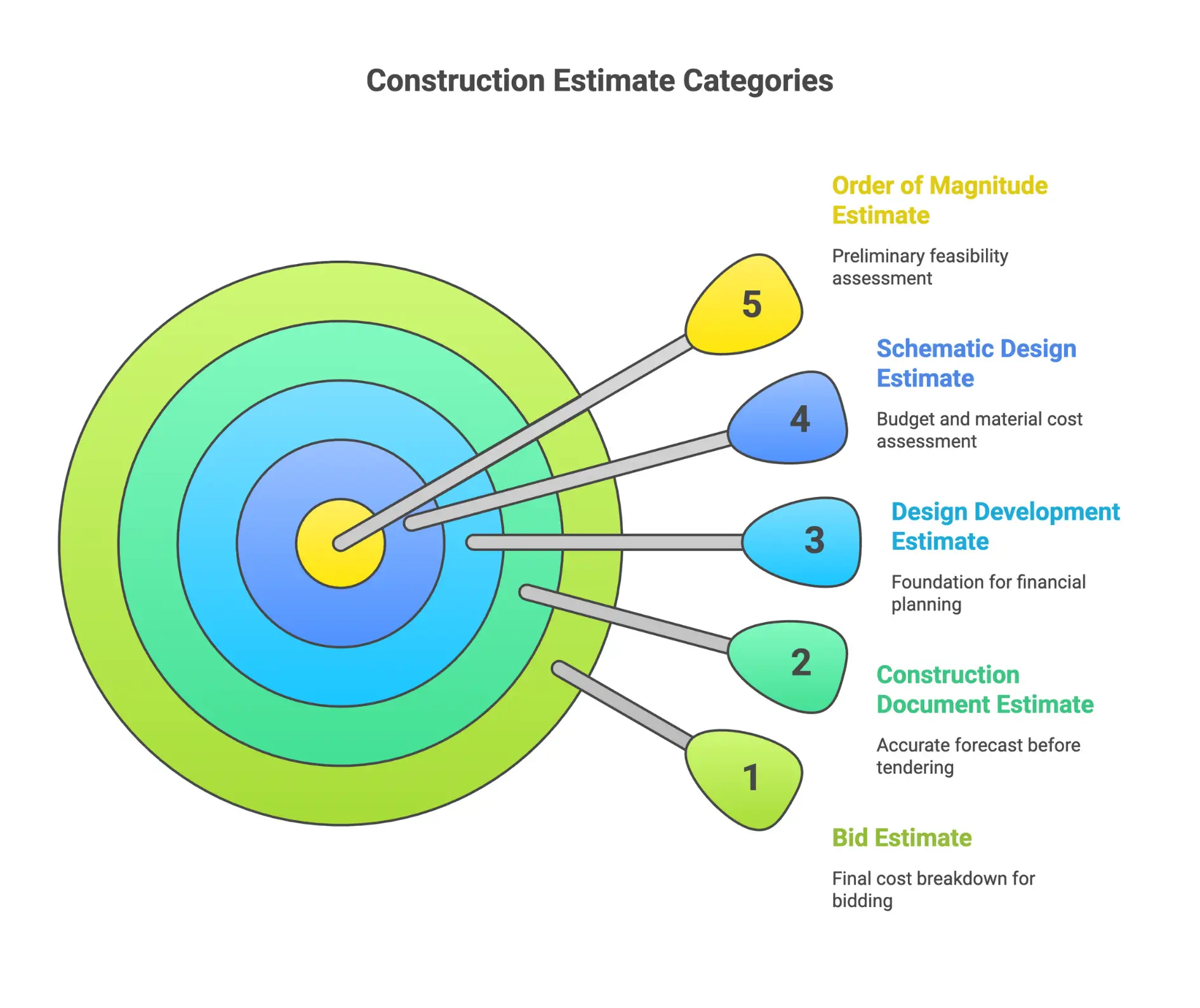
Construction cost estimation evolves as the project lifecycle moves forward. The type of estimate you use depends on the level of project detail and phase:
Overview of Construction Estimate Categories
- Order of Magnitude Estimate
When only minimal information is available (no drawings), this preliminary estimate helps roughly estimate project feasibility and high-level project scope. - Schematic Design Estimate
Based on preliminary design and schematic drawings. Provides more detail for assessing budget and material and labor costs as the project develops. - Design Development Estimate
Uses developed design, including detailed information about construction materials, labor, and equipment costs. Provides a sound foundation for financial planning and further project risk analysis. - Construction Document Estimate
Leveraged when final construction drawings and construction documents are complete. Offers the most accurate cost forecast before a project is tendered to contractors. - Bid Estimate
The last estimate before the bidding process. Offers a comprehensive breakdown of estimated costs required to complete the job. A high-quality bid estimate not only sets contractors up for fair competition but also helps manage unexpected costs and improve profit margin.
Common Construction Estimating Methods
- Analogous (Top-Down) Estimating: Uses historical data from similar past projects for rapid, early-stage assessment.
- Parametric Estimating: Involves applying statistical relationships between project variables (such as cost per square foot) to project scope and size.
- Bottom-Up (Detailed) Estimating: Involves a granular breakdown of project components, providing the most accurate project cost forecast.
- Three-Point Estimating: Accounts for uncertainty by averaging optimistic, pessimistic, and most likely estimates.
BIM (Building Information Modeling) also plays a role by linking cost data with digital 3D models, ensuring quantity takeoff and cost estimating reflect all details in real time.
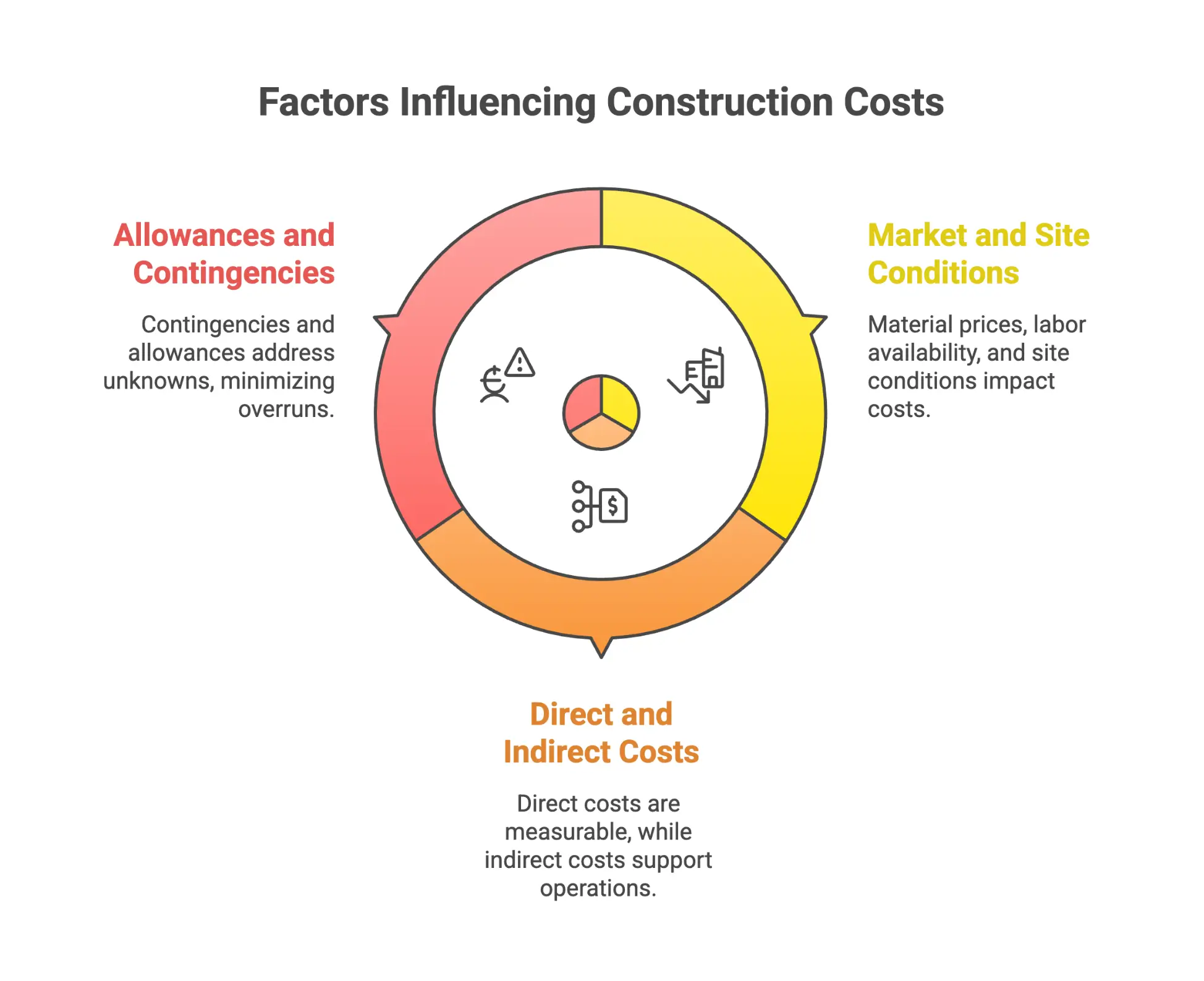
Key Factors Influencing Construction Costs
Understanding what drives construction costs helps you anticipate, avoid, and manage project risk more effectively:
Market and Site Conditions
- Material price fluctuations: Construction materials and material prices may change rapidly, directly impacting the overall construction cost.
- Labor availability and local wage rates: Labor markets shift with regional demand, union agreements, and seasonality. Labor costs can make up 30% to 50% of a project’s total cost.
- Project complexity and site conditions: Soil quality, access, and topography all shape the estimating process and can increase direct or indirect costs.
Direct and Indirect Costs Breakdown
- Direct and indirect costs must be separated clearly within every construction cost estimate. Direct costs include physically measurable items or tasks (excavation, concrete, mechanical systems), while indirect costs (insurance, overhead, project management) are essential for supporting the entire construction business and site operations.
Allowances, Contingencies, and Escalation
- Contingencies and allowances should always be incorporated within the construction estimation document to address unknowns and minimize budget overruns.
- Escalation refers to anticipated increases in project cost due to inflation or economic shifts.
- Cost overruns and scope creep could result from underestimated labor, material price fluctuations, or overlooked requirements in project documents.
Leveraging Technology: Construction Estimating Software and Digital Tools
How Construction Estimating Software Revolutionizes the Estimating Process
In today’s complex construction industry, modern estimating software is crucial for speed, transparency, and accuracy. Digital tools and specialized construction estimating software, like CostOS®, ProEst, or BIM-integrated solutions, allow cost estimators to:
- Integrate construction drawings and design data for real-time quantity takeoff
- Streamline collaboration, enabling project teams, subcontractors, and suppliers to work from shared project documents
- Access current cost data and automate repetitive calculations to minimize human error
- Test scenarios and respond to changes instantly, reducing reliance on manual spreadsheets
As BIM adoption grows, project teams can link cost data with 3D models, giving everyone a three-dimensional, real-time snapshot of construction costs and resource requirements.
Fact: Modern construction cost estimating increasingly relies on specialized software and digital tools to improve speed, accuracy, and consistency. Using software not only increases accuracy but also improves transparency and efficiency across the project management workflow.
Key Benefits of Construction Estimating Software
- Minimizes human error: Automated tools cross-check quantities, unit cost estimating, and even indirect costs, reducing costly omissions.
- Improves transparency: Cloud-based platforms facilitate clear communication with all project stakeholders, speeding up approvals and document reviews.
- Accelerates estimating process: Functionality and accessibility provided by cloud-based software solutions help cost estimators handle large, complex projects with greater efficiency.
- Supports experienced estimation: Even the most advanced estimating software cannot replace the expertise of professional estimators, but it does make their work much more efficient.
AI and Machine Learning in Construction Cost Estimation
AI-driven platforms now analyze thousands of completed construction projects to reveal patterns and improve prediction of construction costs, labor productivity, and material usage. These innovations further narrow the gap between estimated cost and actual outcomes, resulting in more accurate cost estimates for current and future estimates.
Learn more about AI estimating solutions and how machine learning is shaping the future of construction estimating software.
Construction Cost Estimating Process: Best Practices in Infrastructure and Civil Works
1. Involve Construction Cost Estimators Early
Cost estimators should be involved from the outset, working closely with project teams to define project scope, ensure accurate project budgets, and align construction estimates with business goals.
2. Maintain Ongoing Review and Updates
The estimating process is not a one-time event. It is ongoing: estimates should be continuously updated as construction documents, bid estimates, and site conditions evolve.
3. Thoroughly Review Project Documents and Specifications
- Use project plans and construction drawings to accurately quantify all required materials and expected materials.
- Consult multiple suppliers to gather current pricing for each material and ensure accurate cost data.
- Account for both direct and indirect costs, including overhead, insurance, and bonding costs.
4. Leverage Standardized Formats
- Use standardized systems like the Construction Specifier Institute’s MasterFormat to organize all parts of the project and reduce missed scope items.
- Validate every estimate with professional experience and common sense before submission.
5. Build Risk Management into the Estimate
- Include contingencies and allowances for unforeseen expenses.
- Document assumptions related to transportation costs, material prices, subcontractor fees, and escalation.
- Benchmark against similar past projects and track key lessons learned for future estimates.
Phases of Construction Estimates Within the Project Lifecycle
Construction cost estimates shift as the project moves from early planning to completion. Understanding these phases improves project management and helps project managers maintain cost control:
1. Conceptual (Order of Magnitude) Estimates – Planning Phase
Based on high-level data or square foot costs from previous, similar past projects. Used to roughly estimate feasibility and determine whether to proceed. Parametric estimating is often deployed here for quick calculations.
2. Schematic & Design Development Estimates – Design Phase
With more detailed plans, estimators can more accurately quantify materials, labor, and equipment costs. Design development estimates add depth, allowing for scope validation and value engineering. Material takeoff and labor costs become more rigorous at this stage.
3. Construction Document Estimate – Pre-Bid Phase
Once final construction drawings and construction documents are complete, cost estimators are able to provide accurate cost estimates, factoring in all direct and indirect costs and bid estimate details.
4. Bid Estimate – Bidding Phase
A bid estimate is the detailed cost breakdown that contractors submit as their official proposal. This estimate must account for all the expenses, including indirect costs, profit margin, bond insurance, legal expenses, and subcontractor fees.
5. Control Estimate – Construction Phase
Used to manage actual spending as construction begins. Includes tracking of job site changes, updated material prices, labor cost escalation, and tracking all cost variances to maintain project budget.
Methods and Approaches for Effective Cost Estimating
Analogous and Parametric Estimating
- Analogous estimating: Leverages historical data and lessons from similar past projects to quickly create conceptual estimates.
- Parametric estimating: Applies statistical relationships (such as cost per square foot or unit) across the project scope, improving early-phase forecasts.
Bottom-Up (Detailed) and Three-Point Estimating
- Bottom-Up estimating: Involves creating a full breakdown of required materials, labor, and equipment costs, producing the most accurate estimates.
- Three-Point estimating: Considers best case, worst case, and most likely costs to address uncertainty.
BIM-Based Estimation
- BIM links cost data to project models, giving all stakeholders access to live estimated costs as changes occur, improving collaboration and transparency.
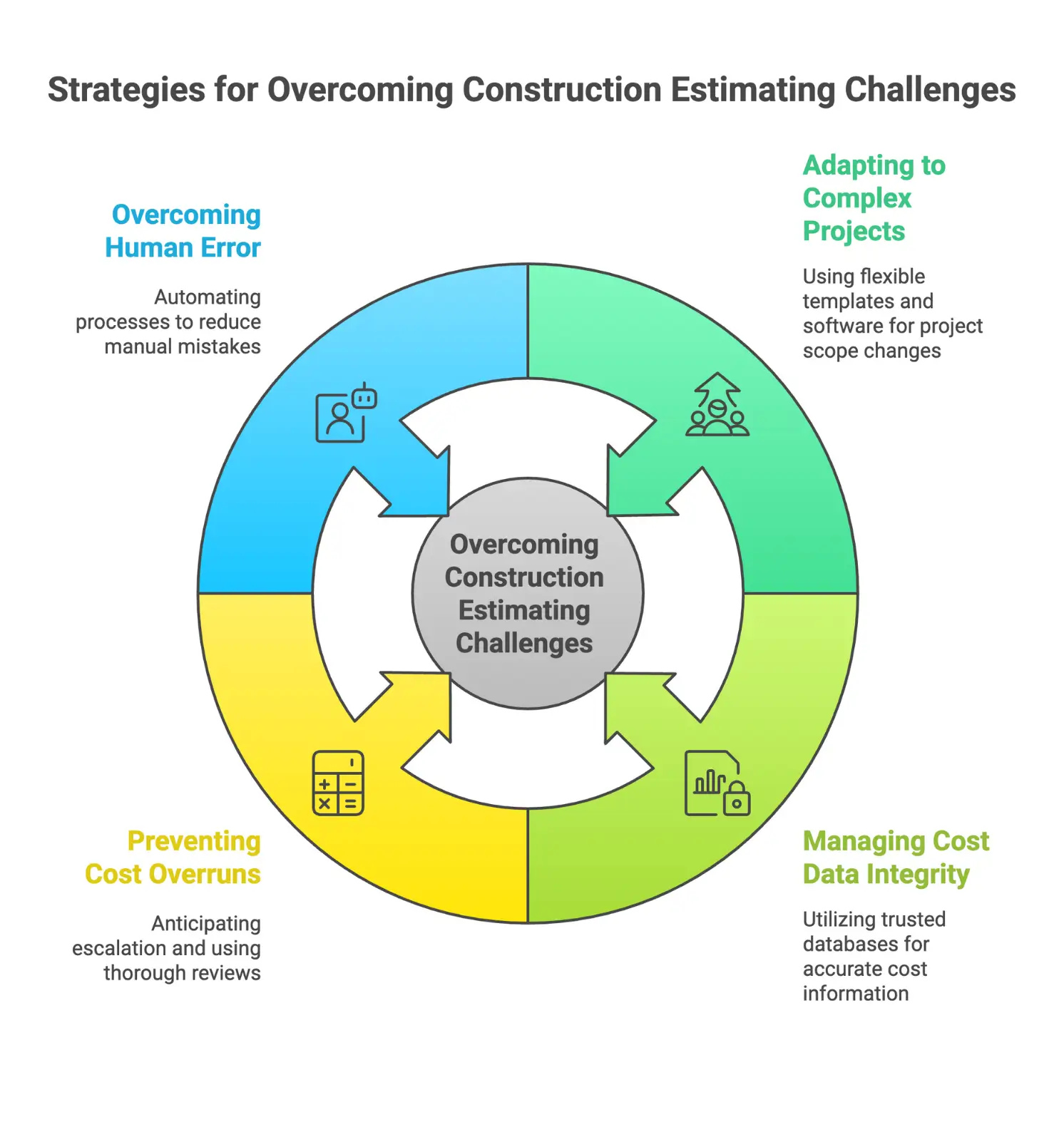
Construction Estimating Challenges and How to Overcome Them
1. Adapting to Complex Projects and Project Scope Changes
Complex projects require a detailed, flexible approach. Comprehensive templates and regular benchmarking ensure construction practices account for new project risks and avoid costly omissions. Construction estimating software supports efficient updates and rapid re-forecasting as the project scope evolves.
2. Managing Cost Data Integrity
Use trusted, up-to-date cost databases such as RSMeans and Richardson for region-specific construction materials, labor, and equipment costs. These resources help maintain accuracy and validity through frequent updates.
3. Preventing Cost Overruns and Scope Creep
Anticipate escalation with precise allowances for indirect costs. Use thorough construction document reviews and multiple material takeoff methods. What-if analysis with modern estimating software improves flexibility and cost control.
4. Overcoming Human Error with Technology
Automated and cloud-based construction estimating software drives efficiency, reducing the risk of manual mistakes, version control issues, and project management headaches.
Frequently Asked Questions About Construction Cost Estimation
What makes construction cost estimating essential for infrastructure and civil works?
Accurate cost estimating is the cornerstone of successful project delivery. Without precise estimates, construction projects face higher risks of budget overruns and missed schedules. Reliable estimates guide everything: resource allocation, contract negotiations, and client satisfaction.
How do modern estimating tools improve construction project outcomes?
Modern construction estimating software revolutionizes the estimating process by providing a single source of truth for all cost data, reducing manual work, and improving transparency among all project stakeholders. Integrating project management, design input, and historical cost data improves both accuracy and efficiency.
Why is integrating diverse data sources important for construction cost estimating?
Mixing cost information, including material costs, labor rates, similar past projects, and unique site conditions, provides a comprehensive three-dimensional project overview. This helps reduce errors and builds accurate forecasts for successful project delivery.
What are the main phases and types of construction cost estimates?
Construction project estimates progress from order-of-magnitude or preliminary estimate, to schematic and design development estimates, to construction document and bid estimates, followed by control estimates during the actual construction process.
How can construction teams overcome common estimating challenges?
Success comes from involving professional estimators early, using standardized systems, leveraging the right construction estimating software, and collaborating frequently with all project stakeholders. Phased rollouts and scenario testing build team knowledge and minimize disruption during adoption.
Best Practices for Cost Estimating in Civil Works Projects
- Involve cost estimators from the very start to ensure the project budget aligns with actual decisions.
- Create construction estimates using both direct and indirect costs, based on detailed construction drawings.
- Quantify all required materials using project plans and gather current cost data from multiple suppliers.
- List all key indirect costs, such as temporary offices, administrative salaries, bonding costs, and insurance.
- Apply contingencies and allowances within the estimate to minimize surprises and budget overruns.
- Use industry standard formats, like MasterFormat, to avoid missing categories or scope items.
- Validate and review each project estimate with a mix of common sense, benchmarks, and professional experience.
Technology Spotlight: The Evolution of Construction Estimating Software
Modern civil engineering relies on advanced software, like BIM and specialized construction estimating software, for cost estimating. These tools:
- Manage the complexity of construction cost estimation across the project lifecycle
- Increase transparency, consistency, and speed
- Provide robust scenario analysis and version control
- Streamline material takeoff, unit cost estimating, and document management for maximum efficiency
- Allow cloud-based team collaboration, keeping project managers, estimators, and field staff aligned
- Empower construction project managers with the data necessary for successful project delivery and risk management
Fact: The expertise of cost estimators remains crucial even with powerful automation. The software augments, but does not replace, human judgment and experience.
Ensuring Data Quality and Reliability in Construction Cost Estimates
- Use regionally accurate, regularly updated cost books and databases for labor, construction materials, and equipment costs.
- Rely on specialized construction databases (Richardson, RSMeans), which organize cost data based on project type, location, and scale.
- Centralized cost estimating databases reduce guesswork and streamline the construction estimating process for all stakeholders.
Future Trends: AI, BIM, and Next-Gen Construction Estimating
Embracing New Technologies for a Competitive Edge
Forward-thinking construction businesses are integrating AI and machine learning to harness historical data from thousands of completed projects, enabling more precise construction cost estimates by identifying patterns, productivity trends, and resource allocations previously overlooked. These innovations help project managers and owners get closer to actual costs, reducing budget overruns and improving project feasibility.
BIM-connected platforms now allow cost estimators, designers, and suppliers to collaborate in real time. As a result, everyone works off the latest project documents and drawings, reducing risk, increasing transparency, and accelerating project delivery.
Bottom line: Companies that balance cutting-edge software with seasoned, professional estimators set the pace in today’s construction industry.
Summary: Building Success with Construction Cost Estimation
Mastering construction cost estimation in infrastructure and civil works demands more than just number-crunching. It calls for:
- Scrupulous review of construction documents and project plans
- Selection of the most appropriate estimating method for the project phase
- Ongoing collaboration across all project stakeholders
- Effective use of modern construction estimating software and centralized cost data
- Commitment to best practices and constant communication among project managers, owners, and estimators
Done right, cost estimating builds the foundation for managing costs, minimizing unexpected costs, and consistently delivering successful construction projects.
Ready to Take the Next Step?
Interested in making your cost estimation more accurate and competitive? Explore Nomitech’s full suite of construction estimating software or contact us to discover which tools fit your team’s workflow and project needs. The right software, paired with the right estimating process, keeps your construction projects profitable, on time, and ready for what’s next.




Stay Up to Date
Subscribe to our Newsletter today and receive the latest updates, trends, expert insights, and exclusive offers tailored to your specific industry.