

Cost Escalation and Inflation in Project Estimating
TL;DR: Cost escalation is the time-based increase in project costs between the estimate date and actual spending. Treat it separately from contingency, apply it by cost category and link it to schedule, procurement timing and contract risk allocation.
Cost escalation and inflation can turn a solid estimate into a shaky one if they are handled too lightly. In construction, engineering and capital projects, materials, labor, equipment, freight and subcontracted work can all rise at different speeds for different reasons, which is why controlling escalation matters so much on long-duration and capital-intensive work.
That is why a single inflation percentage is usually too blunt. Good escalation planning starts with a clear base date, current market evidence, category-specific assumptions and a schedule that shows when costs will be committed. It also needs commercial clarity, because the contract determines who carries the risk when prices rise.
For estimators, project controls teams, procurement professionals and project decision-makers, this article explains what cost escalation means, what drives it, how to calculate it by cost category against the schedule, and how to manage the risk through contract pricing and practical delivery controls.
What Cost Escalation, Price Escalation and Inflation Mean in Project Estimating
Cost escalation is the increase in project costs over time. It happens between the date an estimate is prepared and the point when materials are bought, work is performed and invoices are paid. On long-duration or capital-intensive projects, that movement can represent a significant share of total cost.
Escalation is not the same thing as a cost overrun. If a project exceeds budget because the estimate was weak, the scope was unclear, change control failed or execution went off track, that is an overrun. Escalation is the time-based price movement that can happen even when the project is otherwise well controlled.
Broad inflation measures, such as CPI, PPI or the Employment Cost Index, can provide useful economic context. They are not a reliable substitute for construction-specific pricing. ECI is especially relevant when labor is a major driver of project cost.
Construction costs respond to different pressures. Steel may rise sharply while labor increases more gradually. Energy prices may soften while specialist subcontractor rates stay high. Equipment hire, freight, fuel, materials and overhead all have their own market behavior.
As the RICS notes, construction price movements reflect labor, materials, equipment, supply and demand, market capacity and contractor competition. The escalation basis should therefore match the cost elements and market being estimated.
Base Date and Pricing Assumptions
Every dependable estimate needs a clear base date. That is the point in time the pricing is tied to. If costs come from historical data, or if they will be incurred later in the project, the estimate should state the index used and show how prices were adjusted between dates, as recommended by UK Government cost estimating guidance.
This makes the assumptions easier to audit and gives estimators, project controls teams and decision-makers a practical way to update the estimate when the schedule, procurement strategy or market conditions change.
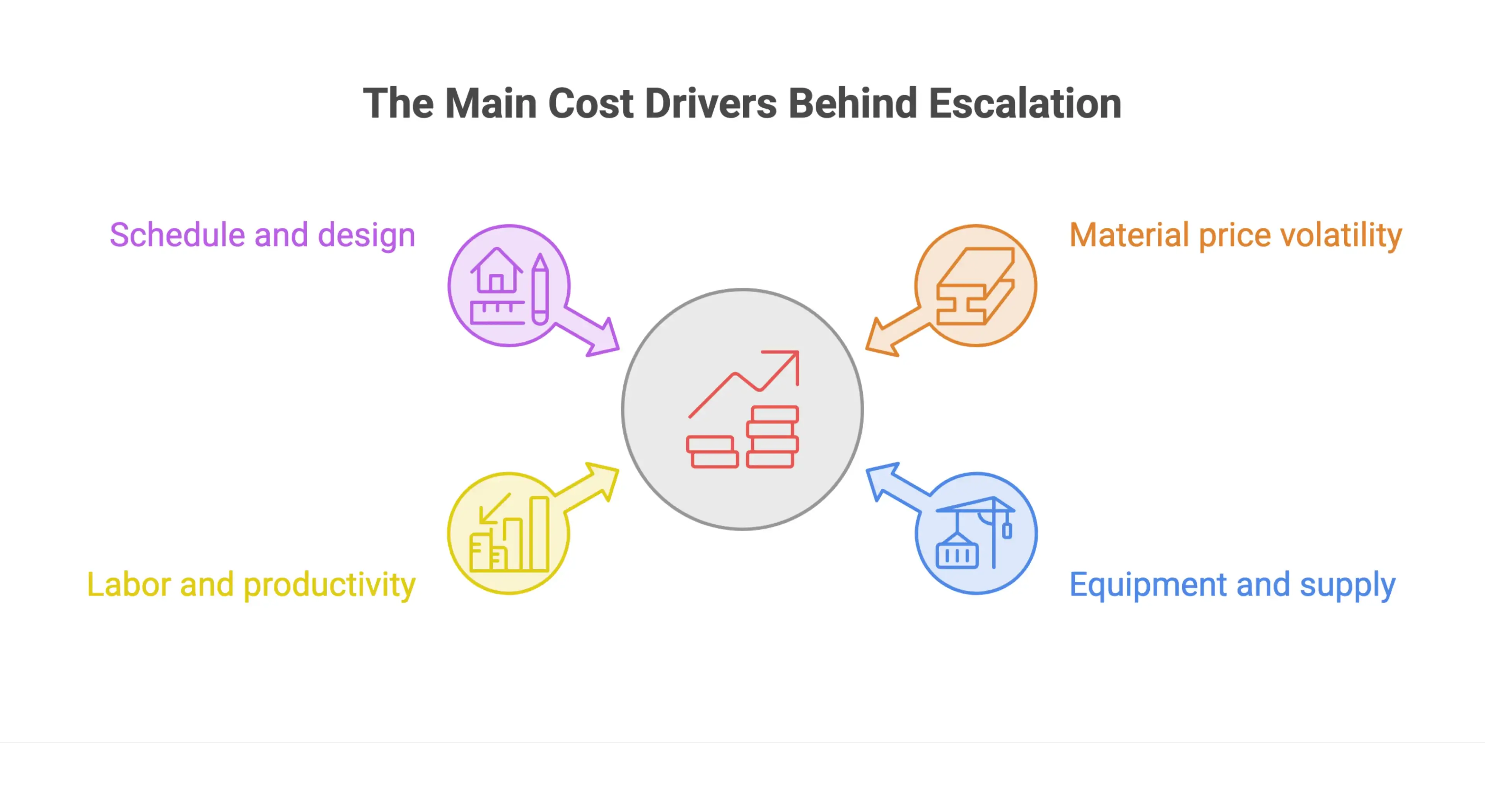
The Main Cost Drivers Behind Escalation
Escalation rarely affects a whole project evenly. The useful question is not simply, “What is inflation?” It is, “Which parts of this estimate are exposed, when will those costs be committed and what is driving the movement?”
Material Price, Equipment and Supply Chain Volatility
Material prices are one of the most visible drivers of cost escalation. Steel, concrete, copper, timber and specialist equipment can move sharply within a single project cycle. Commodity prices, import tariffs, trade restrictions and changes in global demand can all feed into the rates used in an estimate.
Equipment can add another layer of pressure. When demand is high for cranes, generators, earthmoving plant or long-lead process equipment, both cost and lead time can rise. A project may still be technically on budget at estimate stage, but if procurement is delayed, the market can move before the package is awarded.
Supply chain disruption widens the gap further. Logistics constraints, port congestion, shortages of critical components, fuel costs and transport costs can push costs beyond the original allowance, especially on projects with long delivery schedules.
Labor Costs, Productivity and Local Market Capacity
Labor escalation is not just wage inflation. Skilled trade shortages, union agreements, regional pay rates and local market capacity all influence what labor will actually cost when work starts.
If several major projects are competing for the same workforce, wage rates can rise above standard benchmarks. Even when the hourly rate is known, productivity can shift. Less experienced crews, constrained access, weather, site congestion or changed working conditions can increase the hours required to complete the same scope.
For estimators, labor escalation should reflect the location, project type, workforce availability and assumptions behind the productivity rates.
Schedule Delays, Design Changes and Procurement Timing
The longer a project runs, the more exposed it is to escalation. A delay that pushes procurement or construction into a later market period can raise costs even if the annual escalation rate looks modest.
Design changes create a similar issue. Late decisions can trigger rework, re-pricing or new subcontractor quotations at current market rates instead of the rates used in the original estimate.
Procurement timing is often where escalation becomes practical. If a long-lead package is priced early but awarded late, the estimate may no longer reflect the market. That is why escalation needs to be linked to the project schedule, not just added as a final percentage.
How to Calculate Escalation in an Estimate
Escalation should be modelled, not guessed. The process starts with a base estimate tied to a specific date, then breaks the cost down by category and maps those costs to the periods when they are likely to be committed.
Use Cost Categories Instead of One Blanket Escalation Rate
Different cost elements move in different ways. Steel and concrete may follow commodity cycles. Labor depends on wage agreements and workforce availability. Equipment and long-lead items are shaped by supplier capacity and manufacturing lead times. Fuel and freight move with energy and logistics markets.
A better approach is to split the estimate into practical categories, such as civil works, structural materials, MEP equipment, labor, subcontracts and indirect costs. Each category can then be assigned its own escalation rate and time period.
Those rates should reflect the project location, procurement plan and main drivers behind each cost type. The goal is not false precision. The goal is a set of assumptions that can be explained, challenged and updated.
Compound Escalation Formula and Scenario Modelling
The standard compound escalation formula is:
EC = IC x (1 + ER)^TP

In this calculation, EC is escalated cost, IC is initial cost, ER is the escalation rate expressed as a decimal, and TP is the time period, usually in years. A simple example helps figure how compounding affects the final number.
Compounding matters. A 4% annual escalation rate over three years produces a cumulative increase of about 12.5%, not 12%. On a large capital project, the difference can be material, and the rate should be calculated from documented assumptions rather than picked arbitrarily.
Scenario modelling helps show the possible range. Running low, central and high escalation cases by cost category gives decision-makers a clearer view of where the estimate is most sensitive to market movement. It also supports better conversations about procurement timing, contingency and contract risk allocation.
Indexes, Quotes and Historical Cost Data
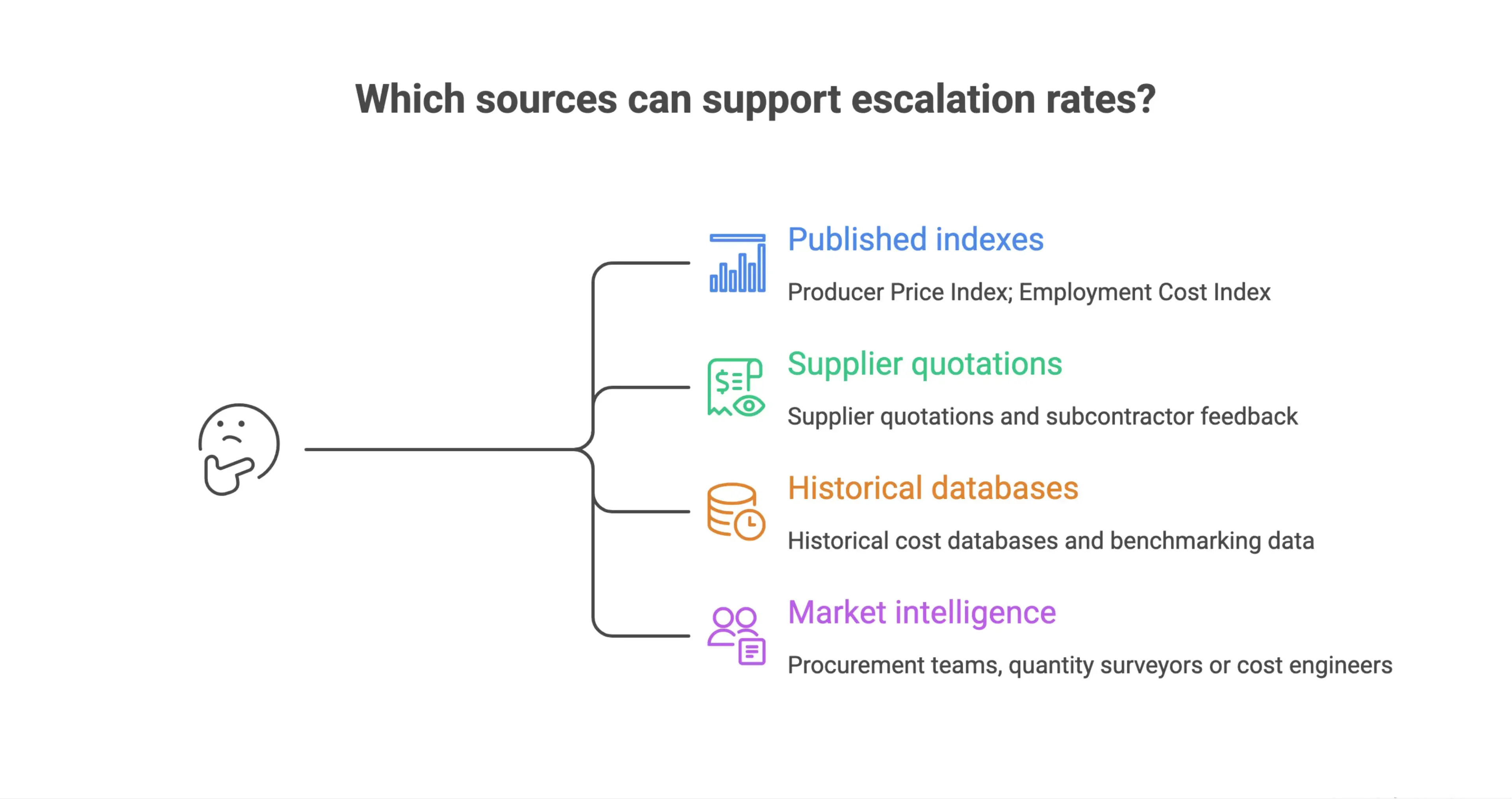
Every escalation rate in the estimate should be defensible. Useful sources include:
- Published cost indexes such as the Producer Price Index, which tracks price changes received by domestic producers across construction inputs. The U.S. Bureau of Labor Statistics notes that construction estimators should select a producer- or construction-specific index rather than a consumer price index when updating construction input costs, and for labor-heavy work the Employment Cost Index is generally a strong reference; it rose by 3.4% for the year ending June 2026.
- Supplier quotations and subcontractor feedback for current market pricing
- Historical cost databases and benchmarking data from comparable projects
- Market intelligence from procurement teams, quantity surveyors or cost engineers with recent project exposure
Index selection still requires judgment. As research published by the International Cost Estimating and Analysis Association notes, construction cost series can be nonstationary, which means their statistical behavior changes over time and affects how well historical trends predict future movement. A broad measure of the economy may be less useful than an index aligned to the project’s specific cost drivers.
Escalation assumptions should be documented and justified, not copied forward without review. Annual escalation figures in the 2 to 5% range are sometimes used as rough planning context, but a generic percentage should not replace a documented, reasonable rate supported by a named index or market evidence. Actual rates can differ significantly by region, category and market conditions.
Contingency, Escalation Risk, Escalation Clauses and Contract Pricing
Escalation and contingency are both cost allowances, but they are not interchangeable. Contingency covers uncertainty inside the estimate, including incomplete design, quantity risk, productivity assumptions, pricing accuracy and other known unknowns linked to scope. Escalation covers price movement over time between the base estimate date and the date costs are incurred.
If escalation is left out and contingency is expected to absorb it, the estimate becomes less transparent. It is harder to see whether the reserve is covering estimating uncertainty, market movement or both.
Contract structure determines who carries escalation risk, so it should influence how the estimate is built.
Under a firm fixed-price arrangement without an escalation or economic price-adjustment mechanism, the contractor generally carries the risk of price increases after award. On long-duration jobs, or projects with volatile material prices, a fixed price with no escalation protection can lead to inflated risk premiums or underpriced exposure. That also affects profitability if actual labor or material costs rise after award.
Escalation clauses and price escalation clauses shift some or all of that risk back to the owner by allowing the contract price to adjust against agreed indices for labor, materials or energy. FIDIC's guidance on price adjustment describes how contracts can identify relevant labor and goods indices, assign coefficients aligned to cost categories, and apply an adjustment formula at defined intervals. In US federal procurement, FAR 16.203 covers fixed-price contracts with economic price adjustment, which can be based on established prices, actual costs of labor or material, or specified cost indexes.
Allowances and provisional sums can ring-fence cost categories where uncertainty is high at estimate stage but the scope is reasonably defined. They are not a replacement for an escalation allowance. They deal with scope uncertainty, not time-related price movement.
Change order procedures provide a formal route to adjust the contract price when scope changes, delays or owner-directed variations push work into a higher-cost period. If a delayed instruction forces a subcontract package to be repriced after steel or labor markets have moved, the change-order mechanism or contract-price adjustment clause can translate the timing impact into a priced adjustment instead of a dispute.
The estimator should model escalation clearly before the contract is priced. This is especially relevant for contractors preparing multi-year proposals for base and option periods, because rates should account for likely cost movement. Support the rate with a documented basis, such as a named cost index, rather than an arbitrary number. How the risk is shared between owner and contractor is a commercial and contractual decision, and contract language should be reviewed by qualified legal or commercial professionals.
Practical Controls for Managing Escalation During Delivery
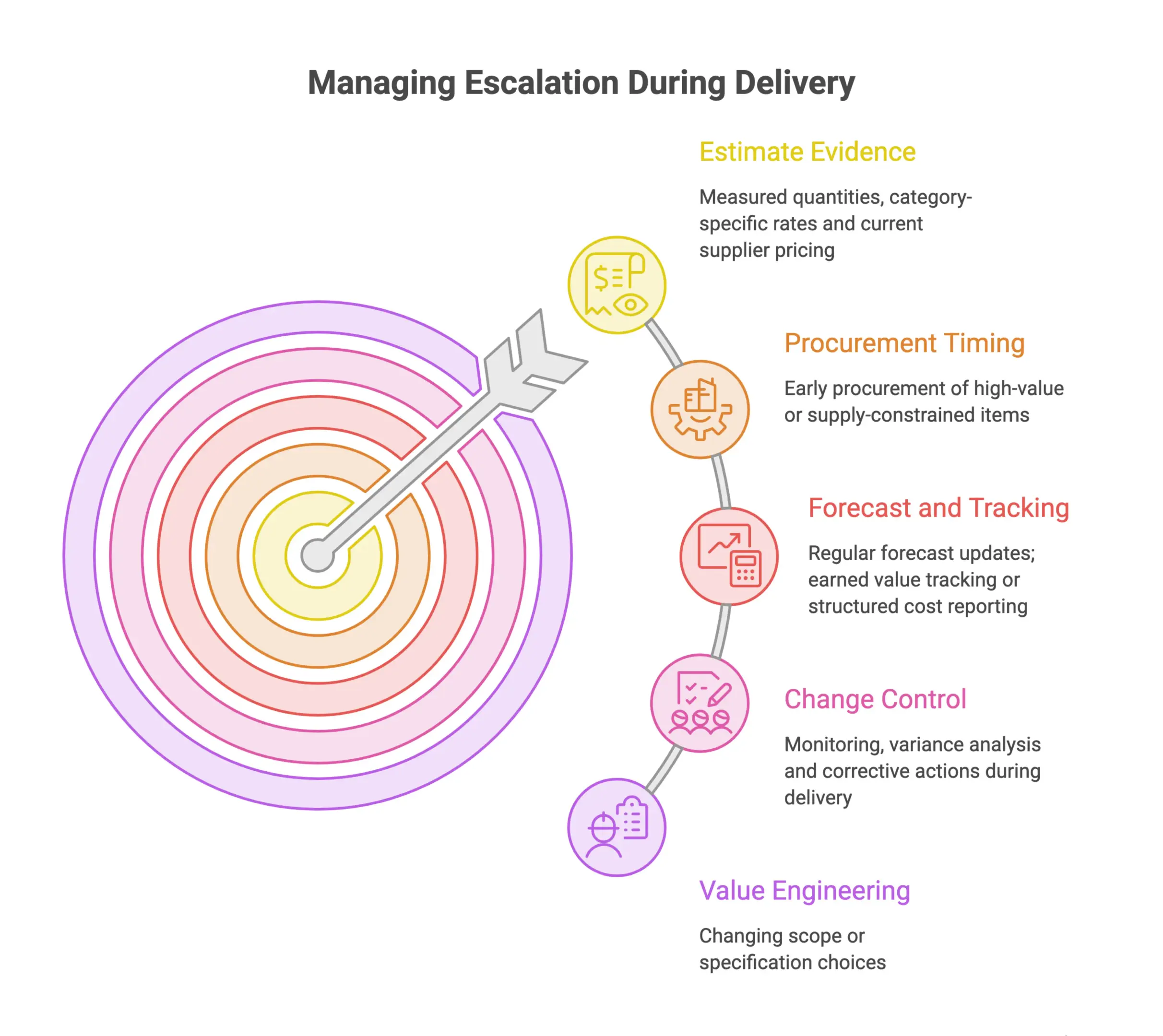
Estimating escalation well is only half the job. Once the project moves into procurement and construction, escalation becomes a live exposure. The teams that manage it best work from real quantities, current market evidence and disciplined cost controls.
Build Estimates from Quantities, Rates and Market Evidence
A strong bottom-up estimate is one of the best defenses against escalation risk. When costs are built from measured quantities, category-specific rates and current supplier pricing, it is easier to see where assumptions are drifting. Reliable quantity takeoff, including BIM-linked quantities where available, helps reduce the grey areas where cost increases often get buried.
Using current market pricing at category level gives teams a more defensible view than applying a blanket uplift to an old estimate. An estimating platform such as CostOS can support structured project estimates built from BOQs, rates and estimating databases, while an up-to-date pricing index for estimators can help teams keep material, labor and equipment assumptions closer to current market conditions.
Structured cost benchmarking in construction and historical cost data also help teams compare rates with similar projects and spot where unit prices have moved materially.
Procurement Planning and Long-Lead Work Packages
Procurement timing has a direct effect on escalation exposure. If long-lead equipment, structural steel or major subcontract packages are left too late, the project remains exposed to future market conditions.
Early procurement of high-value or supply-constrained items can lock in pricing and reduce the window for escalation. Scenario modelling helps procurement teams compare different ordering strategies, especially when markets are volatile and supplier lead times are uncertain.
Forecast Updates, Cost Tracking and Change Control
A cost estimate that is not refreshed against actual commitments, current material pricing and labor costs quickly loses value as a control tool. Regular forecast updates help project teams see where costs are moving before the impact becomes unmanageable.
Earned value tracking or structured cost reporting gives project controls teams the visibility to identify which cost drivers are moving away from budget. Strong project cost control techniques help connect the estimate baseline with monitoring, variance analysis and corrective actions during delivery.
Value engineering can also reduce escalation exposure by changing scope or specification choices. Simplifying a package, substituting a less volatile material or revising a non-critical specification can reduce the amount of cost exposed to future price movement.
Key Takeaways for More Reliable Escalation Planning
Cost escalation is not a rounding adjustment added at the end of an estimate. It is a real project risk that should be modelled, assigned and managed from early planning through to closeout.
A few principles make escalation planning far more reliable:
Anchor every estimate to a clear base date. Without a documented base date, escalation rates and time periods lose meaning.
Apply escalation by category, not by a single blanket rate. Materials, labor, equipment, fuel and subcontractor rates move differently.
Link escalation to the project schedule. The rate matters, but timing matters just as much. Delays in procurement or construction can push costs into a later market period.
Ground inflation assumptions in evidence. Published cost indexes, supplier quotations, benchmarking data and historical cost records all help support a defensible allowance.
Keep escalation separate from contingency. Contingency covers estimating uncertainty, while escalation covers time-based price movement.
Document everything. The indexes used, rates applied, time periods assumed, contingency allowances and contract risk allocation should all be easy to trace.
Projects that treat escalation as a schedule-linked, category-specific input are better prepared for market shifts. They can make clearer contingency decisions, price contracts more realistically and avoid cost increases that could have been anticipated.
Frequently Asked Questions
What is the difference between escalation and inflation in estimating?
Inflation is a broad economic measure of price increases. Escalation is the project-specific adjustment applied to costs over time. In construction estimating, escalation should reflect the cost categories, location, procurement timing and market conditions affecting the project.
Should escalation be included in contingency?
No. Escalation and contingency should normally be shown separately. Contingency covers estimating uncertainty and scope-related risk, while escalation covers time-based price movement.
What is the best way to estimate future cost escalation?
Use a clear base date, break the estimate into cost categories, apply defensible escalation rates and link those rates to the project schedule so future estimates account for expected changes in wages, material prices, and benefit costs over the contract period. Published indexes, supplier quotes, historical cost data and market feedback all help make the assumptions more reliable, and if a future wage update is expected, estimators should anticipate it in the relevant period rather than blending it across all years. Document assumptions separately for each cost category and, where relevant, each one year or option period.
Ready to Take the Next Step?
To manage inflation exposure with stronger cost data, clearer escalation assumptions and more reliable project cost controls, explore Nomitech’s full suite or get in touch."





Stay Up to Date
Subscribe to our Newsletter today and receive the latest updates, trends, expert insights, and exclusive offers tailored to your specific industry.