

Construction Takeoff Software: Key Features for Quantity Estimating
TL;DR: Construction takeoff software, also called material takeoff software, helps teams measure quantities from drawings, PDFs, CAD files and BIM models with greater speed and traceability.
The best tools connect measurements to cost items, WBS structures, rate libraries and QA workflows so quantities can support reliable estimating decisions.
Construction takeoff software helps contractors, subcontractors, quantity surveyors, cost engineers, EPC teams and project controls professionals turn design information into structured, traceable quantities. Its value is not only faster measurement. The real gain is the ability to price, check, revise and control quantities as a project develops.
Whether a team works from 2D drawings, CAD files or BIM models, a good takeoff workflow reduces manual rekeying, supports collaboration and makes it easier to explain how quantities were calculated. This article covers the key features that matter for precise quantity estimating and how they fit into wider cost and project delivery workflows.
What Construction Takeoff Software Does in Quantity Estimating
Construction takeoff software helps teams measure work directly from drawings, digital plans or BIM models. Instead of counting materials by hand from printed sheets, estimators use digital project information to extract lengths, areas, volumes and counts that feed the cost build-up.
From Plans to Quantities and Cost Items
Construction takeoff is the first measurable step in the construction industry chain that moves from quantity takeoff to cost build-up, bid review, procurement planning and project cost management. If the takeoff sits outside the estimate, it quickly loses commercial value.
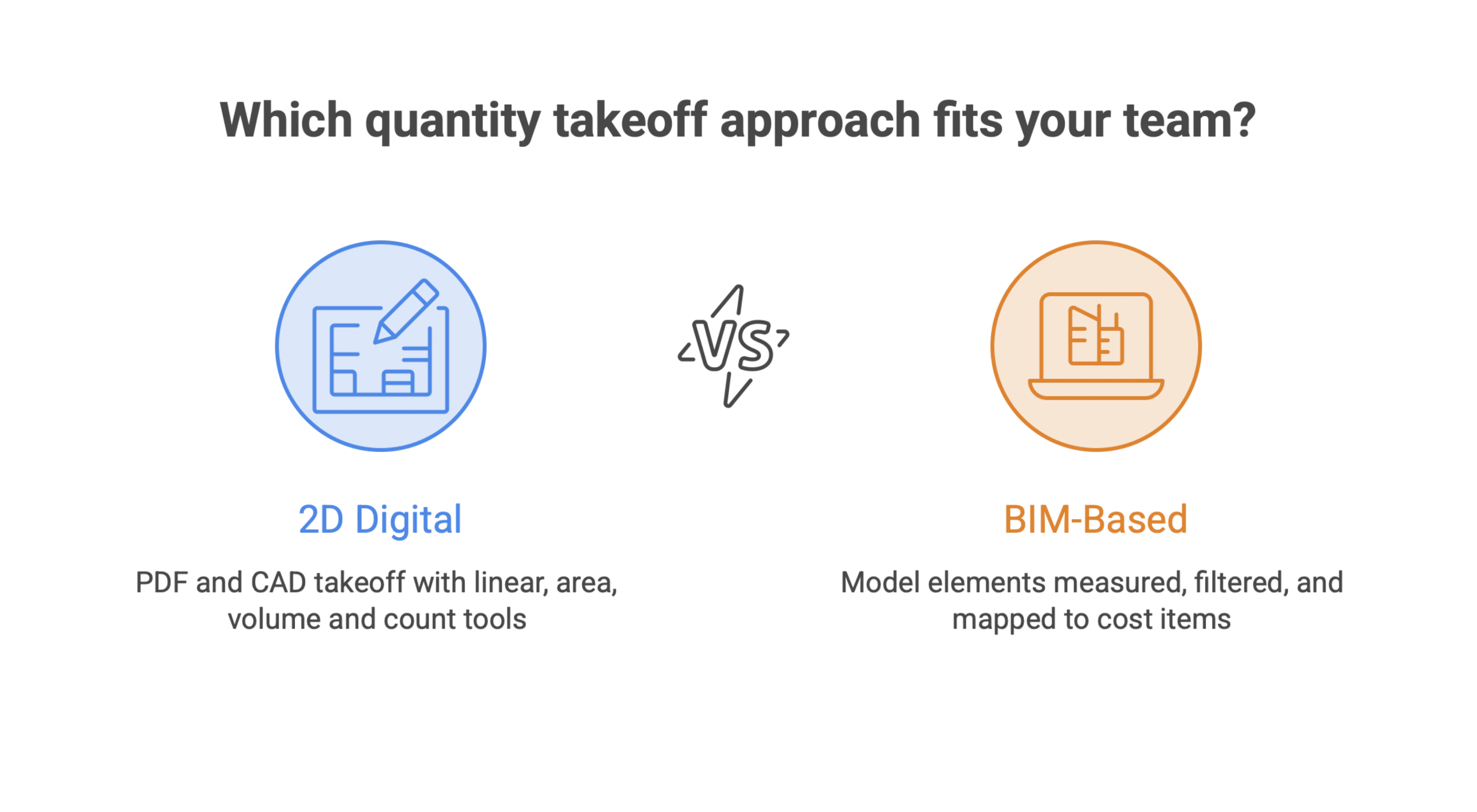
2D plan-based takeoff is often the best fit when the design is still developing, the project is documented mainly in PDFs or CAD files, or the team needs a fast way to measure from drawings. Model-based takeoff is more suitable when the BIM model is structured enough to support object-based measurement and disciplined classification. Many teams use both depending on project maturity and available design information.
Takeoff software focuses on measurement, drawing review and quantity organization for cost estimation. Estimating software focuses on pricing, rates, labor, equipment and productivity assumptions. Takeoff and estimating software brings those functions together, so measured quantities flow into cost items without rekeying. As Texas A&M University College of Architecture notes, software should connect document review, takeoff and estimating rather than treat measurement as an isolated task.
The strongest workflows keep a clear link between the source drawing, the measured quantity and the relevant construction plans behind the cost item it supports. That link turns a technical measurement into an estimate that can be reviewed, defended and updated.
Core Features for Accurate Quantity Estimating
Reliable quantity estimating starts with measurement tools that match how work is built and help teams produce accurate estimates. Good construction takeoff software should cover the main measurement types an estimating team needs across trades, disciplines and project stages, including the material quantities required for pricing and review.
Measurement Tools: Lengths, Areas, Volumes, Counts and Assemblies
Linear measurements are used for piping runs, conduit routes, road kerbs, partition walls, drainage trenches and similar items. Area measurements support area takeoffs for finishes, earthworks surfaces, formwork faces, roofing and cladding. Volume measurements are needed for concrete pours, excavation, fill and compaction. Count tools handle discrete items such as fixtures, doors, valves, equipment, fittings and structural connections.
Assemblies group related materials and labor assumptions into one takeoff action. For example, measuring a drainage trench once can generate quantities for excavation, bedding, pipe, backfill and reinstatement. That reduces missed scope, keeps related items aligned and helps produce a more precise estimate.
Units, Coding and Measurement Rules
Measurement tools are only part of the job. Accurate takeoffs also depend on consistent units, clear descriptions and scope boundaries that are applied the same way across the project. Standards such as RICS NRM 2 exist because measurement rules need to be understood by everyone involved, from the estimator building the quantities to the procurement team reviewing bid packages.
Good takeoff software supports that discipline with configurable units, naming conventions, custom labels, tags, custom columns and fields. Quantities can then be organized through standardized takeoff workflows by zone, trade, work breakdown structure or bid package, turning raw measurements into structured reports that cost and procurement teams can use.
Digital Takeoffs, BIM and Automation
Unlike digital takeoffs, manual methods in paper-based workflows and spreadsheet-only takeoffs create avoidable risk. Measurements get repeated, quantities are copied incorrectly, scope is missed, and items can be counted twice, while digital workflows cut repeated entry and other manual work that slows review. Digital takeoffs reduce those risks by tying quantities back to the drawing or model, which improves traceability and reduces human error.
2D Digital Takeoffs Versus BIM-Based Quantity Takeoff
For many teams, the move starts with 2D PDF and CAD takeoff. Estimators work directly on digital blueprints using linear, area, volume and count tools, often from PDF, CAD, and image files. Because each measurement remains linked to the source document, reviews and revisions are faster than rebuilding a spreadsheet from scratch. Purpose-built tools such as QuantX Takeoff Software support this drawing takeoff and quantity extraction workflow by helping teams move from digital documents to structured measurable outputs.
BIM and 3D model-based quantity takeoff go further. Model elements can be measured, filtered by discipline or system, and mapped directly to cost items. As the National Institute of Building Sciences describes, an IFC-based approach allows measured BIM objects to be combined with construction recipes for direct cost projection, creating a tighter link between design geometry and estimate output. Autodesk Takeoff also integrates 2D and 3D workflows for material quantification. For teams working with model-based estimating, 5D BIM and cost loading can further connect quantities, model data and cost information for better project decisions.
AI-Assisted Takeoff Tools and Estimator Review
AI-assisted takeoff tools are a digital tool that can speed up repetitive work such as area recognition, symbol counting and model object extraction. That can save time on large drawing sets and support faster estimating by reducing repetitive takeoff steps, but automation does not replace drawing knowledge or estimating judgment. Scope boundaries, specification intent, design maturity and drawing quality all affect whether an extracted quantity is ready for pricing.
Estimator review and structured QA/QC remain essential, even when automated tools generate the initial quantities. Automation works best when it handles repetitive work and gives professionals more time to review, challenge and refine the result.

Connecting Takeoff Data to Estimating and Cost Systems
Measured quantities become commercially useful when they flow directly into the estimating process, making it easier to understand and control project costs. If an estimator completes a digital takeoff and then has to re-enter the numbers into a spreadsheet or another tool, the team slows the takeoff process and introduces new opportunities for error.
Linking Quantities to Unit Rates, Resources and Historical Cost Data
Good takeoff and estimating software keeps a live quantity link between measured quantities and the cost build-up behind them. Each line item should connect to the unit rate, labor hours, equipment allowances, material inputs and productivity assumptions used to price the work. When quantities change, the estimate should update without manual recalculation across disconnected files.
Rate libraries and historical cost data are central to that process. FHWA guidance recommends developing unit prices from historical bid data adjusted for project conditions, combining equipment, labor, materials and production rates, and comparing approaches across major work items. A takeoff tool that connects to current and historical rate libraries, ideally through a centralized cost estimating database, while supporting location or market adjustments, gives estimators a stronger basis for each cost decision.
Clean exports also matter. Estimating teams often need to send data to Excel, procurement systems, accounting tools and project management software. The handoff should be controlled and consistent, not a patchwork of copied values and disconnected files. Structured exports support faster estimating and a precise estimate because quantities do not need to be rekeyed.
Preserving WBS, Assumptions and Risk Context
Correct quantities are not enough on their own. The link between measured scope, cost codes, work packages and any risk or uncertainty inputs needs to stay intact throughout the estimating process. Once quantities are stripped of their WBS context or underlying assumptions, they become harder to review and control.
Software that preserves this structure makes it easier to revisit decisions, adjust scope boundaries, support value engineering and keep estimates aligned as project information changes. It also helps teams maintain continuity across the wider cost estimating vs cost control lifecycle, from bid baseline through monitoring and corrective action.
Collaboration and Document Control Features
Construction estimating is rarely a solo exercise. Estimators, QS teams, project controls, design reviewers, subcontractors and commercial leads often need access to the same takeoff information. Cloud based takeoff software gives them a shared workspace with document management, without duplicate files, conflicting updates or unclear ownership.
Revision Control and Drawing Management
A quantity can be measured perfectly and still be wrong if it is tied to the wrong drawing revision on a construction project. Good cloud based takeoff software keeps each measurement linked to the correct drawing issue or model version, flags superseded sheets and prompts users to check quantities when a revision is released, helping construction teams work from the right sheet set.
Drawing comparison tools add another layer of control by showing what has changed between revisions. Instead of remeasuring an entire set, estimators can focus on the areas that changed.
Shared Markups, Permissions and Audit Trails
Role-based access in cloud based software lets teams control who can measure, annotate, approve or view takeoff data. Shared markups and comments keep review discussions on the drawing, rather than buried in email chains. Audit trails show who changed what, when it changed and which drawing version was current at the time.
These features allow teams to split takeoff work across multiple people without losing traceability or ending up with competing quantity sets, and shared markups are especially useful when teams collaborate from different locations with only an internet connection.
How to Choose the Right Takeoff Software
Choosing takeoff software is a practical decision for the wider construction business, not just the estimating team. The right platform also helps teams handle more bids and potentially take on more projects by improving estimating throughput. In practice, that fit is often how buyers compare the best construction takeoff software: how your team works, the types of projects you estimate and how tightly takeoff needs to connect with pricing, procurement and cost control.
Evaluation Checklist for Estimators, Quantity Surveyors and Cost Engineers
Start with the work you deliver and the complexity of your measurements. Civil and infrastructure projects have different takeoff requirements from MEP, structural steel or fit-out work. You also need to be clear on whether your team works mainly from 2D PDFs and CAD drawings, or whether BIM and 3D model-based quantity takeoff are part of the normal workflow. Many teams need both.
From there, look at:
- Integration requirements: Does it export cleanly to your estimating software, cost databases, procurement systems or Excel workflows without rekeying?
- Team size and collaboration: Can multiple users work at the same time, with role-based permissions, audit trails and revision tracking?
- Reporting formats: Does the output line up with your bid structure, cost codes or client reporting needs?
- Custom organization: Can you use tags, custom fields or similar structure to sort quantities for reporting and review?
- Ease of use and implementation effort: Be realistic about onboarding time, the learning curve for new users, and the effect on active work.
- Training and support: Solid support matters when drawing sets change or projects become more complex.
- Data governance and scalability: Can the software grow with your workload and protect sensitive cost data properly?

Implementation, Training and Repeatable Templates
Long-term value often comes from repeatable templates and standard assemblies, giving construction professionals the consistency they need across estimates. When estimators can apply the same measurement structure across similar project types, they produce faster and more consistent quantity reports without losing control of the process.
Good takeoff software should speed up the work without weakening QA, and implementation should include training team members to minimize disruptions during transition. Faster measurement only helps if estimators still check scope boundaries, confirm drawing revisions and validate assumptions. When that discipline is built into the workflow, the payoff is stronger bid confidence, clearer margin visibility, better procurement planning, less overordering and tighter cost control, which helps teams improve their chances of winning bids without sacrificing precision.
Frequently Asked Questions
What is the difference between takeoff software and estimating software?
Takeoff software is a digital tool construction professionals use to measure quantities and scope from drawings, plans or models. Estimating software applies pricing logic, including labor, equipment, materials, productivity and rates, to turn those quantities into pricing for cost estimation. Some systems combine both, allowing measured quantities to flow directly into cost items without manual re-entry.
Is BIM quantity takeoff more accurate than 2D takeoff?
BIM quantity takeoff can improve speed and traceability when the model is well structured, but accuracy still depends on model quality, classification, scope rules and estimator review; many teams still work from paper plans early in adoption, even when BIM can be more traceable. BIM improves accuracy only when it reduces manual interpretation and reduces human error through structured model data. Many teams use both BIM and 2D takeoff depending on project maturity and available design information.
What features matter most for construction quantity estimating?
The most important features in the best takeoff software are reliable measurement tools, revision control, clear item coding, WBS alignment, integration with estimating systems, audit trails, reporting flexibility, and, when comparing free and paid options, limits and additional features. Together, these features help teams produce quantities that are measurable, reviewable, and ready for pricing, creating a more accurate estimates workflow for the wider construction business.
Ready to Take the Next Step?
If you want to connect quantity takeoff more closely with estimating, cost data and project cost control, explore Nomitech’s full suite or get in touch. For the broader construction industry, the right software helps efficient estimating teams work faster.




Stay Up to Date
Subscribe to our Newsletter today and receive the latest updates, trends, expert insights, and exclusive offers tailored to your specific industry.