

Cost Estimating vs Pricing: Build Profitable Projects
TL;DR: Cost estimating lays the groundwork for understanding project expenses, while pricing transforms those internal figures into client-facing offers that support profitability. Mastering both ensures smarter bids, robust project management, and firm control over margins. No matter the project phase.
Cost Estimating vs Pricing: Why Both Matter for Successful Projects
Every construction manager and contractor recognizes the chaos that comes when cost overruns or incomplete bids undermine a construction project. Accurate cost estimation and thoughtful pricing are more than accounting steps; they are key to maintaining healthy profit margins and achieving project success.
Cost estimating vs pricing are not interchangeable. The cost estimate is an internal assessment, preparing you for what it really takes, in terms of labor costs, construction materials, equipment costs, and all direct and indirect costs, to complete the job. Pricing, on the other hand, is an external, strategic decision that sets your offer for the client and incorporates market realities, overhead, risk, and desired profit.
To regain control of your construction project finances, minimize surprises, and deliver projects that meet stakeholder expectations, it's critical to know how cost estimators and your overall team use cost estimating methods and specialized software to assemble reliable numbers. Pricing strategies then convert those estimates into winning bids.
Let’s break down what sets cost estimating apart from pricing, how cost estimation supports project management, and how these essential processes guide a construction project's journey from budget to completion.
Fundamentals of Cost Estimating
What Is a Cost Estimate, and Why Is It Important?
A cost estimate is an approximation of all the financial resources, both direct costs (like labor and materials) and indirect costs (such as overhead and permits), necessary to complete a project within specific requirements and deadlines. Accurate cost estimating helps establish realistic budgets, evaluates project feasibility, protects against cost overruns, and builds trust among project stakeholders. In construction management, high-quality cost estimates are required in the early phases for decision-making, resource allocation, risk management, and to support bids and funding requirements.
Cost estimators use a structured process to develop credible, reliable, and defensible cost estimates for construction projects:
- Define project scope and specific requirements by thoroughly reviewing construction documents.
- Collect cost data from historical projects, market rates, labor statistics, and equipment costs.
- Break the work down into parts (Work Breakdown Structure), tracking both unit costs and labor hours at each step.
- Account for all resources needed including construction materials, labor costs, equipment, and overhead.
- Include contingencies for future costs and unknowns.
- Prepare a Basis of Estimate (BOE) documenting methods, assumptions, inclusions, and exclusions.
- Review and update estimates as new information and construction documents become available.
In project management, the cost estimate often provides the probable cost that determines whether a project can move forward or if scope, quality, or budget adjustments are needed.
Types of Construction Cost Estimates
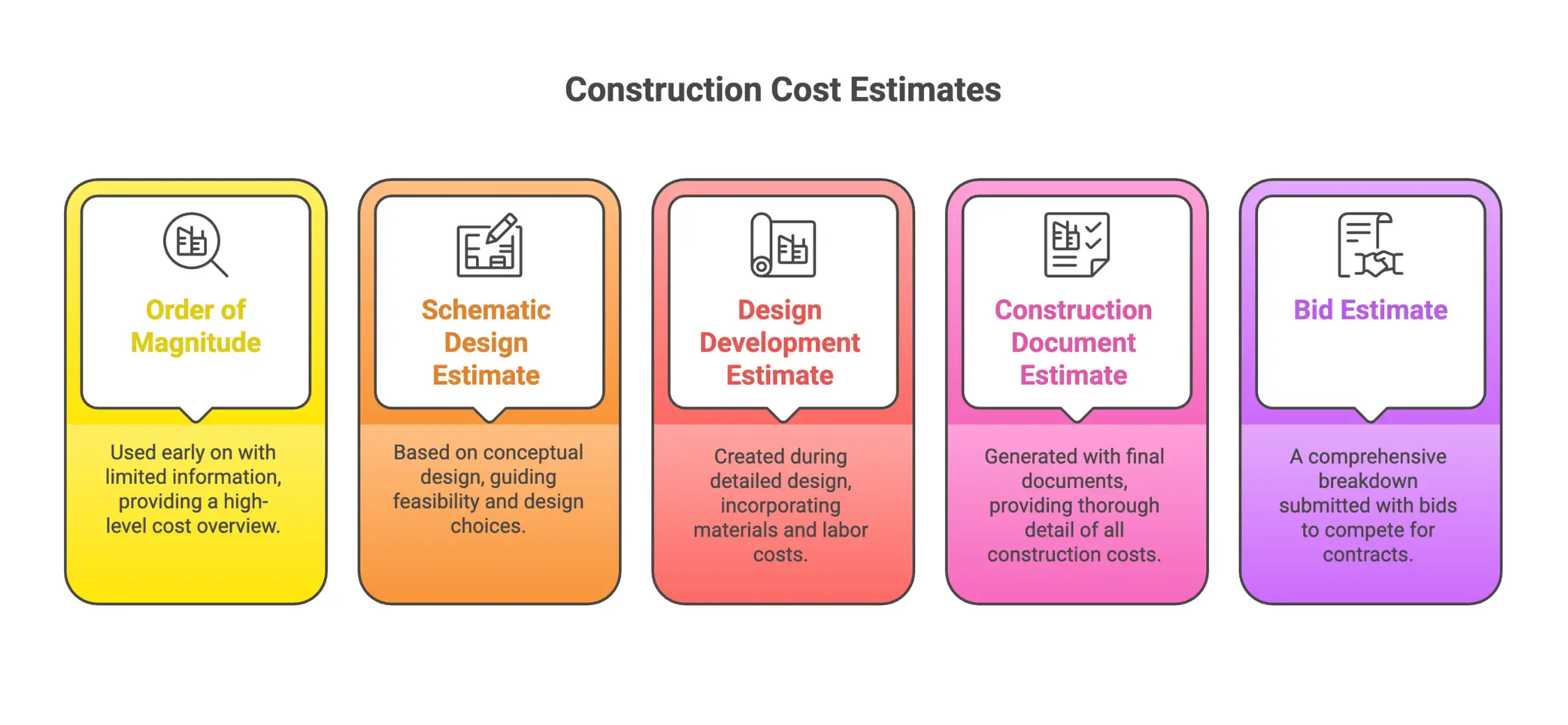
There are several types of construction cost estimates, each tailored to different project phases and needs:
- Order of Magnitude (Rough Estimate): Used early on when only program scope or square footage is known. This method gives a high-level overview of expected costs.
- Schematic Design Estimate: Based on conceptual or schematic design and used to gauge feasibility and guide design decisions.
- Design Development Estimate: Created during detailed design, incorporating specific construction materials and labor costs.
- Construction Document Estimate: Generated when final construction documents are available, providing thorough detail of all costs included in the construction process.
- Bid Estimate: A comprehensive, component-by-component breakdown, submitted with bids or tenders to compete for contracts.
A construction cost estimate is commonly needed for budgeting, feasibility studies, and supporting funding requests.
Cost Estimating Methods: Analytical Approaches for Accuracy
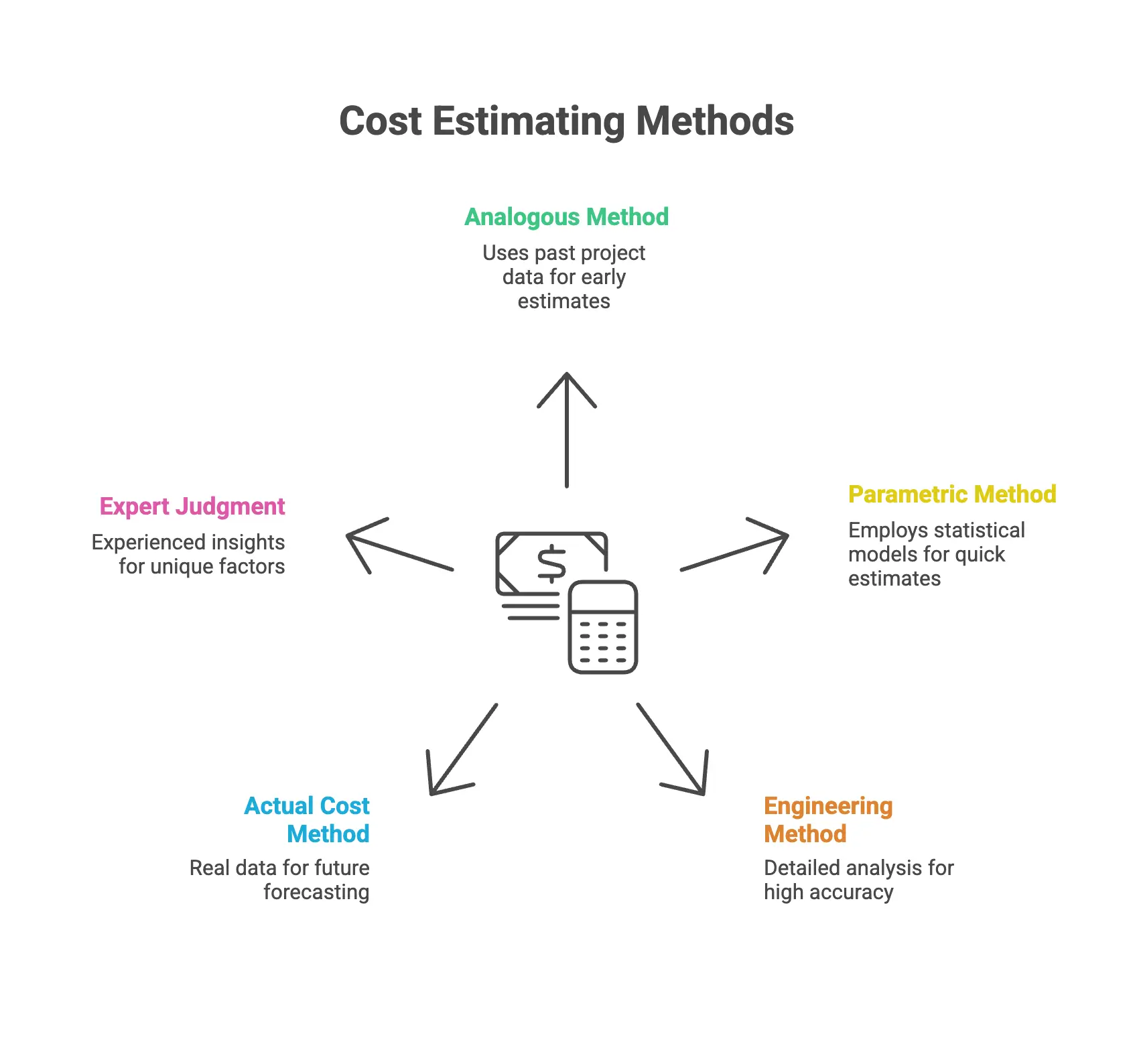
Professional estimators use various techniques to prepare cost estimates that reflect both the actual cost and market context:
- Analogous (Analogy) Method: Relies on cost data from past, similar projects. Useful in early project phases when details are scarce.
- Parametric Method: Uses statistical models and cost estimating relationships tied to project parameters, such as square footage, to quickly develop cost estimates.
- Engineering (Bottom-Up) Method: Involves detailed quantity survey, evaluating every element in the construction documents. This highly accurate approach is usually adopted when detailed information about materials and labor costs is available.
- Actual Cost Method: Applies once the construction process has started and real cost data is available for future cost forecasting and project control.
- Expert Judgment: Engages experienced construction cost estimators to assess unique factors or risks that may impact costs.
Including a contingency in every estimate guards against unforeseen expenses not yet identifiable. Experienced estimators select the most suitable method based on the stage of the project and available information.
Key Elements of a Cost Estimate
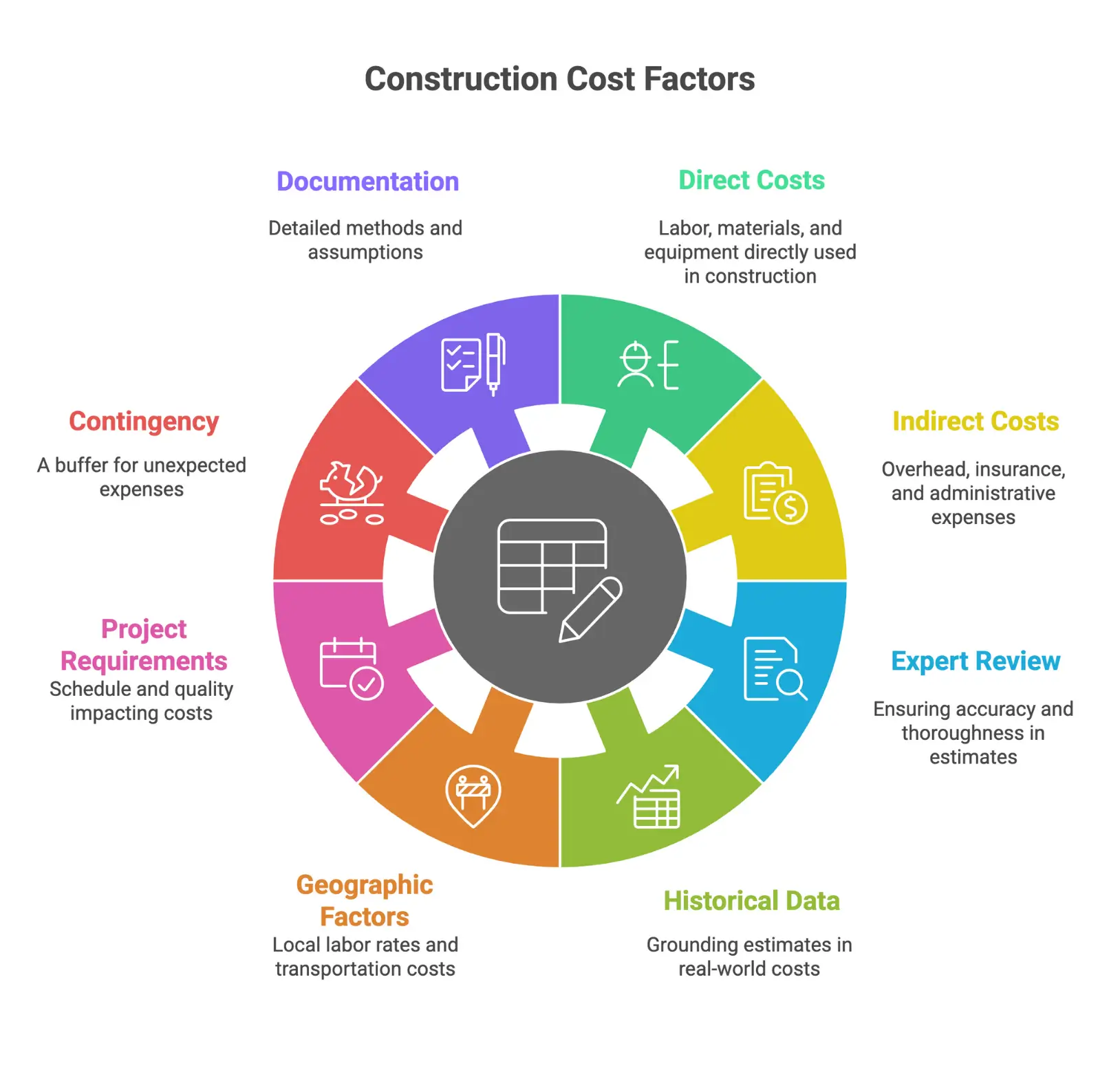
A defendable cost estimate in construction takes into account the following factors:
- Direct Costs: Labor, labor hours, material costs, and equipment costs directly required for the construction project. This includes costs captured in construction documents.
- Indirect Costs: Overhead, insurance, permits, administrative costs, and any expense not tied directly to a specific work component but essential to the construction process.
- Construction Cost Estimators and Quantity Survey: Experts review construction documents and project scope to ensure thoroughness and accuracy.
- Cost Data and Historical Benchmarks: Reliable reference data ensures estimates are grounded in reality and reflect probable cost.
- Geographic Location and Site Conditions: Local labor rates, transportation, and building costs can significantly impact construction cost.
- Quality Requirements and Schedule: Project schedule, required quality, and general requirements often drive costs higher or lower.
- Contingency for Future Costs: A buffer for unanticipated expenses not covered elsewhere.
- Basis of Estimate (BOE): Detailed documentation outlining methods, sources, assumptions, inclusions, and exclusions.
Indirect Costs: An Essential Component
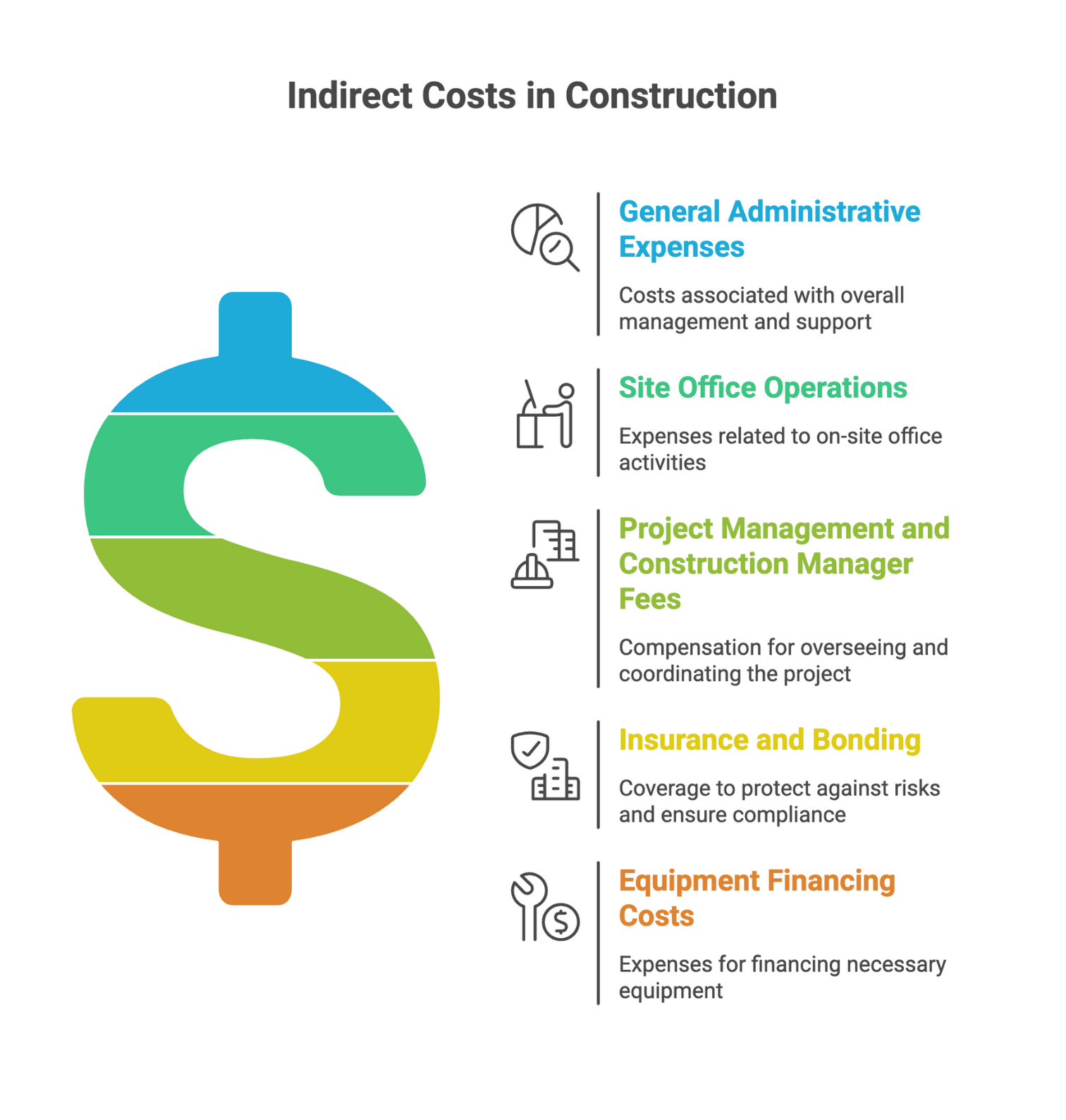
Indirect costs are frequently underestimated but can significantly influence a project's total cost. Examples of indirect costs in construction include:
- General administrative expenses
- Site office operations
- Project management and construction manager fees
- Insurance and bonding
- Equipment financing costs
A comprehensive construction cost estimate must document both direct and indirect costs to be reliable and prevent profit erosion.
Preparing Estimates: Process, Quality, and Control
Preparing estimates is a foundational activity in project cost management. A professional estimator, or construction manager, takes responsibility for assembling and documenting the total estimate using structured, transparent, and repeatable processes. This helps:
- Set rational contracts with subcontractors and vendors
- Avoid scope creep and cost overruns
- Secure funding and build owner confidence
- Support feasibility studies and resource allocation
- Ensure the project stays on budget through the construction lifecycle
A well-prepared estimate is the product of the cost estimating process and serves as the primary input for the project's budget and contract award decisions.
Pricing in Construction: Strategy, Revenue, and Market Position
Definition and Role of Pricing in Construction
Pricing is the business decision that transforms an internal cost estimate into a customer-facing offer, factoring profit margins, competitive position, and risk. The price is the final amount the customer pays. Pricing determines the project's profitability and influences market conditions. While the cost estimate outlines what the project should cost, pricing sets what you will charge, a figure shaped by both internal calculations and external strategic considerations.
Developers use pricing to forecast revenues, determine break-even points, and compare investment opportunities. The pricing process ensures that, besides recovering all project costs, there's a buffer for profit and risk.
Cost-Plus Pricing: Simple and Transparent
The cost-plus pricing method is widely used in the construction industry, especially for government or public works contracts. Here’s how it works:
- The construction company prepares an accurate construction cost estimate, including all direct and indirect costs, then adds a pre-agreed markup percentage for profit.
- Selling Price = Total Unit Cost + (Total Unit Cost × Markup Percentage)
The reliability of this approach depends entirely on the accuracy and completeness of the original estimate. Missed costs, such as indirect costs or inaccurate labor costs, can quickly erode anticipated profits. For complex projects where scope changes are common, cost-plus contracts can provide flexibility and transparency, but require diligent cost estimation and ongoing control.
Pricing Analysis: Ensuring Fairness and Competitiveness
Price analysis is a vital procurement tool that ensures you pay and charge competitive rates, even when you cannot fully review supplier cost data. Price analysis compares your offers to:
- Quotes from multiple construction contractors or suppliers (same spec, same delivery)
- Past awards for similar projects or building costs
- Industry benchmarks and parametric cost models
- Your own in-house construction cost estimate
Routine price analysis lets project management teams stay fair, negotiate smartly, and build better supply relationships while keeping the process efficient.
Cost Estimating in Project Management
Cost estimation is essential to every aspect of project management and construction contracting. A project estimator calculates both direct and indirect costs, building a foundation for budgeting, resource allocation, feasibility, and risk control.
Accurate cost estimation secures stakeholders, prevents unexpected losses, and supports rational contract negotiations. High-quality cost estimates ensure projects remain feasible and stay within the allocated construction budget. Without accurate cost estimation, a project faces increased risk of cost overruns, poor resource allocation, and ultimately, failure.
Frequently Asked Questions
What is the core difference between cost estimating and pricing?
Cost estimating is an internal, structured calculation of the probable cost required to deliver a defined scope of work, including all direct and indirect costs. Pricing takes that foundation and adds a strategic layer, determining what the market will bear, desired profit margins, and external requirements to set the final amount the client pays.
Why is accurate cost estimation crucial in construction projects?
Accurate cost estimation is vital to business survival and project feasibility. It supports realistic budgeting, helps allocate resources efficiently, and secures project stakeholders from unexpected overruns. High-quality estimates help avoid losses and support funding and bid submissions.
What are the main methods used in cost estimation for construction projects?
The major cost estimating methods are analogy, parametric, engineering (bottom-up), and actual cost methods. Each is used at different stages. Analogy for early planning, parametric throughout the life cycle, engineering once detailed design is available, and actual cost as the project progresses.
What are direct and indirect costs, and why do both matter?
Direct costs are expenses like labor, labor hours, materials, and equipment used on the project. Indirect costs are overhead, insurance, site supervision, and similar costs that support the project but are not tied to specific tasks. Both must be included to arrive at an accurate, defendable total estimate and price.
How does price analysis support smarter supplier selection and procurement?
Price analysis benchmarks supplier quotes against past projects, industry data, and your own internal cost estimate, ensuring you pay a reasonable, competitive amount without requiring full cost breakdowns from every supplier.
What should a well-documented cost estimate include?
A credible estimate must include a detailed Basis of Estimate (BOE) that spells out the project scope, pricing basis, methods used, all assumptions, inclusions, exclusions, and identified risks. This documentation helps protect against disputes and supports decision-making.
Summary: Build Profitable Projects with Confidence
A successful construction project depends on accurate, defensible cost estimation and informed pricing strategies. Incorporating both direct and indirect costs, using the proper estimating methods for each project stage, and documenting your approach with a strong Basis of Estimate are essential steps. Pricing, meanwhile, must weigh risks, margins, competition, and market realities to set figures that protect your business and attract clients.
By following disciplined cost estimating processes, professional estimators and construction managers secure the project’s feasibility, align with budgets, and give stakeholders peace of mind. Regular review, updating cost data, and using advanced construction cost estimation software makes the difference between thin margins and predictable success.
Ready to Take the Next Step?
If you want to improve your cost estimation workflow, explore Nomitech’s full suite or connect with our team to discover solutions designed for confident, profitable project delivery.




Stay Up to Date
Subscribe to our Newsletter today and receive the latest updates, trends, expert insights, and exclusive offers tailored to your specific industry.