

Cost Estimating in Oil and Gas: Strategies for Project Success
TL;DR: In the oil and gas industry, cost estimating isn’t just about competition. It’s about the success and survival of every project. Accurate cost estimation builds strong bids, realistic budgets, and effective risk management, vital for navigating unpredictable prices, regulations, and complex project demands. Modern estimating software like CostOS transforms guesswork into confident, transparent project cost management. These platforms cover everything from bidding to operations, cost control, and resource allocation.
Introduction to Cost Estimating in Oil and Gas
Working in oil and gas means constantly battling cost overruns, unexpected risks, and budgets that quickly become outdated. Too often, teams are bogged down in spreadsheets, dealing with unreliable data or patchy project scope definition, and making last-minute updates under pressure. In the gas industry, missing just one project cost factor can flip a project from success to loss.
Cost estimation in oil and gas projects requires more than spreadsheet math. It demands structured processes, robust historical data, and a clear understanding of both direct costs and indirect costs. Accurate cost estimation is the critical foundation for project success. It impacts everything from project cost management and decision making to stakeholder confidence and financial planning. Labor costs, material costs, regulatory compliance, and unforeseen costs all play a vital role.
Let’s explore what makes oil and gas cost estimate strategies competitive, and how digital platforms, cost engineering professionals, and evolving best practices are driving transparency, cost control, and project success in the process industries.
Fundamentals of Cost Estimation in Oil and Gas
Cost estimation is the process of forecasting the total project cost required to execute, deliver, and close a project. In the oil and gas sector, this involves breaking projects into manageable parts using a Work Breakdown Structure (WBS) and applying a structured estimation process across all project stages.
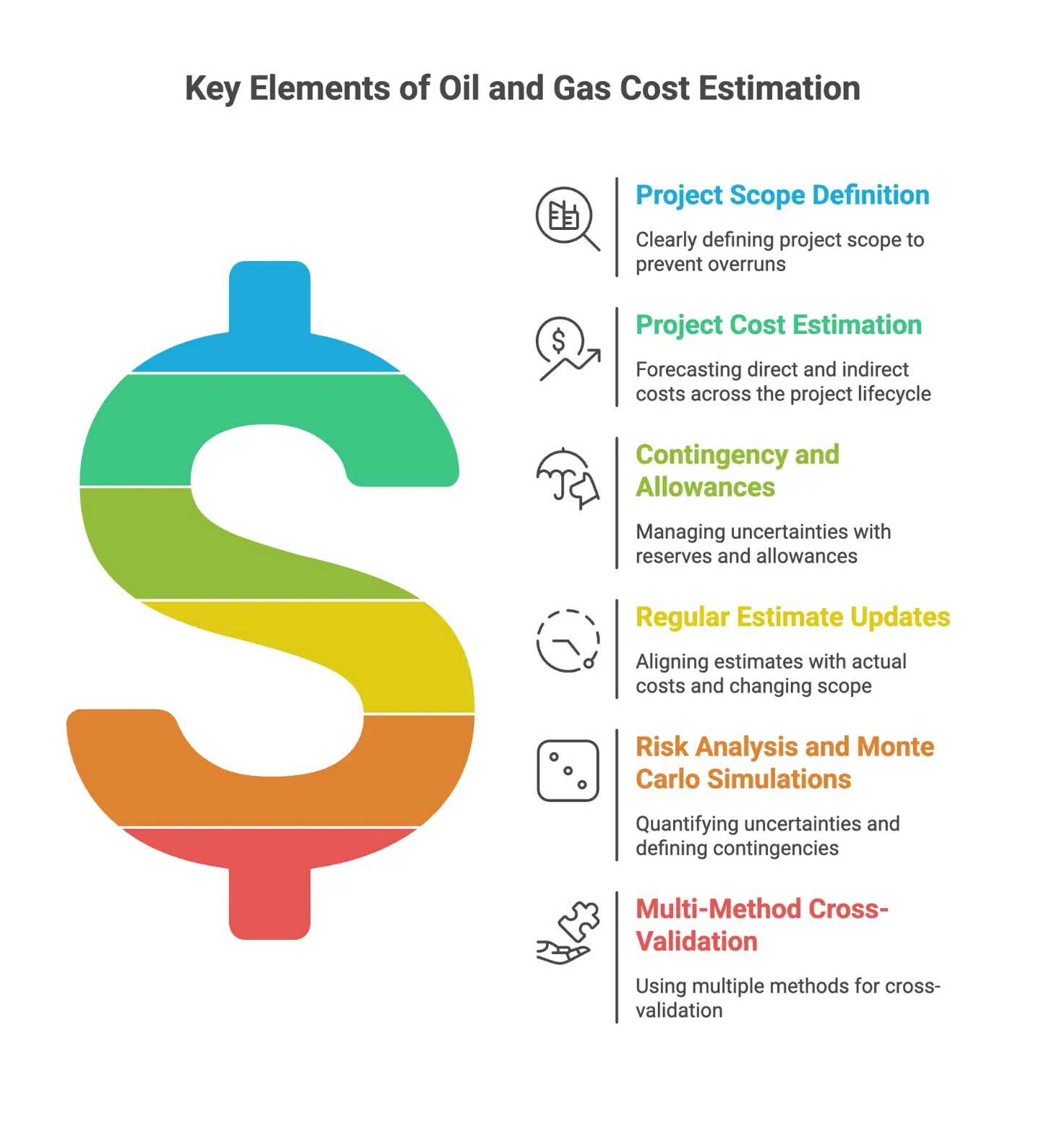
Key Elements of Oil and Gas Cost Estimation
- Project Scope Definition: Clearly defining project scope prevents costly overruns. The project lifecycle includes multiple key stages where the accuracy of the estimate depends on the detail of scope definition.
- Project Cost Estimation: A robust project cost estimation strategy forecasts direct costs (labor, material, equipment) and indirect costs (overheads) across the entire project lifecycle.
- Contingency and Allowances: Contingency reserves manage uncertainties. Given the unpredictability of drilling and evolving market trends, allowances must be included.
- Regularly Update Estimates: Oil gas project estimates should be regularly updated as projects progress to align with actual costs and changing scope.
- Risk Analysis and Monte Carlo Simulations: Quantitative risk management techniques like Monte Carlo simulations quantify uncertainties and define necessary contingencies.
- Multi-Method Cross-Validation: Analogous, parametric, and bottom-up cost estimating methods should be used together for cross-validation. Software like Cleopatra Enterprise and CostOS allow for this kind of integrated approach.
Drivers and Cost Factors in Oil and Gas Project Cost Estimation
Regulatory Compliance and Political Environment
Project cost estimation in oil and gas projects is significantly affected by regulatory compliance and the political environment. Strict regulations and global stability concerns can introduce additional costs, delays, and complexity, making proactive risk management and early stakeholder involvement essential.
Geological Uncertainty and Drilling Complexity
Geological uncertainty plays a critical role in cost factors for the gas industry. The difficulty of drilling, sophistication of required equipment, and overall project risk are all influenced by subsurface conditions, which can dramatically change the cost estimate. For example, deeper and more complex formations require advanced technologies and higher labor costs.
Market Trends: Prices, Material Costs, and Labor Rates
Market volatility can shift material costs, labor rates, and equipment availability overnight. Crude oil prices, local conditions, and supplier prices all feed into project economics. Material costs are shaped heavily by supplier pricing and tariffs, while labor costs vary based on local productivity levels and regional regulatory demands.
Cost Breakdown Structures: Direct and Indirect Costs
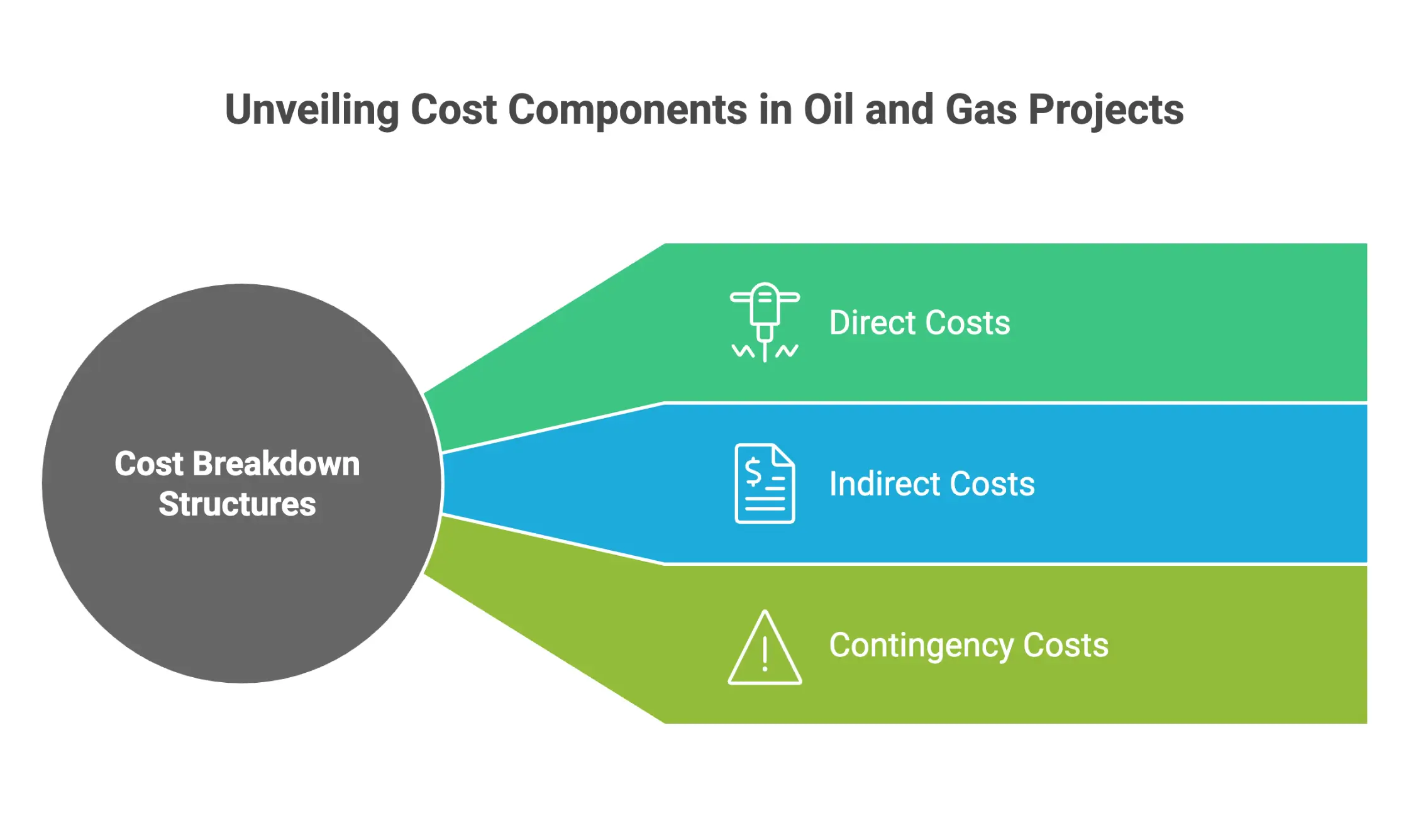
Breaking a project into logical segments using WBS and breakdown structures is vital for cost control. Each cost estimate should include:
- Direct Costs: Labor costs, material costs, equipment, and production facilities.
- Indirect Costs: Overheads, regulatory compliance, and escalation costs.
- Contingency Costs: Allowances for unforeseen costs due to uncertainty in market and technical factors.
Software tools like Cleopatra Enterprise and CostOS help to collect and benchmark historical data, track actual costs, and establish a cost baseline for ongoing cost control and risk mitigation.
Stages of Project Cost Estimation in Oil and Gas Projects
Concept Screening and Early Project Scope
During concept screening, project teams define the scope, break down work, gather available data, and assess different cost factors using estimation methods like parametric models. At this stage, cost engineering professionals often rely on historical data from past projects to inform early-stage estimates.
Detailed Estimate and Work Breakdown Structure
As projects progress, detailed estimates become essential. A robust WBS decomposes projects into manageable parts, allowing for precise pricing and data-driven estimates. Cleopatra Enterprise provides detailed estimates for EPC projects and supports process industries by incorporating escalation costs and allowances.
Estimating Process Through Project Lifecycle
Project cost estimates evolve through key stages of the project lifecycle:
- Feasibility Study
- Front-End Engineering and Design (FEED)
- Procurement
- Construction
- Commissioning
- Operations and Maintenance
- Abandonment
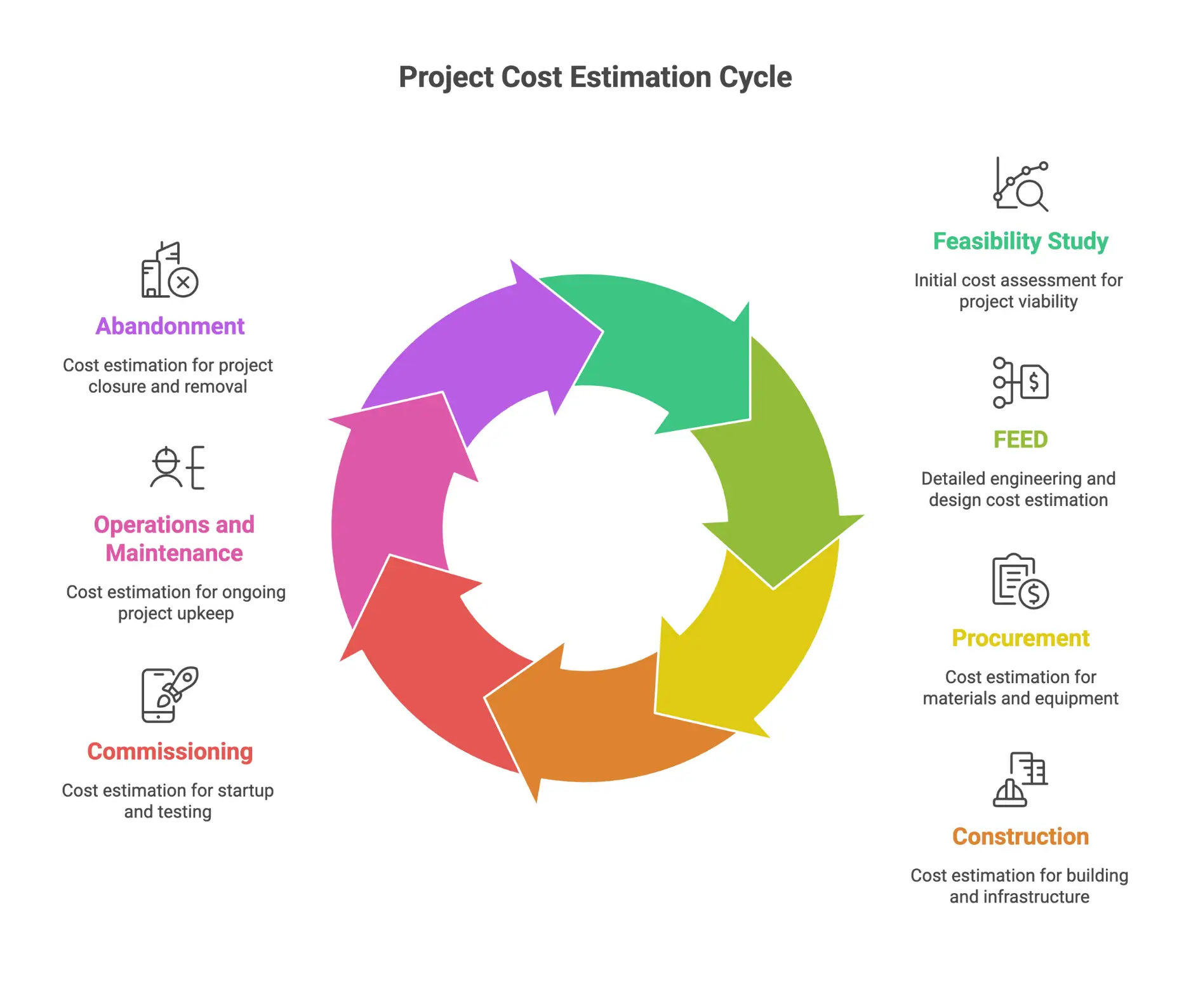
At each stage, cost estimators regularly update estimates, increasing accuracy as scope and data quality improve.
The Critical Role of Cost Estimation Methods and Tools
Overview of Estimating Processes
Modern estimating processes in oil and gas use a blend of techniques. Analogous estimating uses historical data as a reference. Parametric estimating leverages patterns and project parameters to predict costs. Bottom-up estimating builds from the smallest task to the total project cost.
By integrating all three, estimators improve both accuracy and defensibility of the project cost estimate. This enables better decision making and resource allocation.
Digital Platforms: CostOS, Cleopatra Enterprise & QUE$TOR
CostOS and Cleopatra Enterprise are widely used for cost estimation in EPC projects due to their ability to handle the complexities of process industries:
- CostOS: Connects real-time market data, benchmarks actual costs, and allows for cost control, scenario analysis, and cost baseline establishment.
- Cleopatra Enterprise: Allocates allowances, supports escalation management, and enhances budget transparency, which is crucial for EPC projects and project execution.
- QUE$TOR: Offers CAPEX/OPEX cost estimates, concept screening, and detailed cost modeling, particularly in oil gas projects.
These digital tools automate the estimating process, minimize human error, allow for Monte Carlo simulations, and support project controls by providing workflows customized for the project stage and available data.
Building Accurate Cost Estimates: Best Practices
Early Scope Definition and Work Breakdown Structure
A well-defined project scope and a detailed WBS are essential for accurate cost estimation. Early stakeholder involvement improves estimate reliability and builds stakeholder confidence.
Regularly Updating Estimates and Transparent Documentation
Updating cost estimates as the project progresses, using a detailed Basis of Estimate (BOE), ensures assumptions and inclusions are documented for auditability and transparency.
Using Multiple Estimation Methods
Validating each cost estimate with multiple methods enhances accuracy and helps identify gaps or omissions in direct costs, indirect costs, or escalation costs.
Risk Management and Contingency Reserves
Proactive risk analysis using Monte Carlo simulations quantifies potential risks and guides the allocation of contingency reserves. This protects project margins and ensures reliable cost control.
Labor Costs and Material Costs in Oil and Gas Projects
Labor Costs: Local Productivity and Tariffs
Labor costs in oil and gas projects can constitute a significant share of the total project cost. Local productivity, labor availability, and tariffs all cause labor costs to fluctuate dramatically from region to region. Accurate labor cost estimating requires constant market data updates and knowledge of local employment conditions.
Material Costs: Supplier Pricing and Regional Factors
Material costs are shaped by supplier pricing, tariffs, and transportation logistics. Unexpected market trends or supply chain disruptions can quickly escalate material costs, affecting overall profitability.
Managing Cost Control Through Project Lifecycle
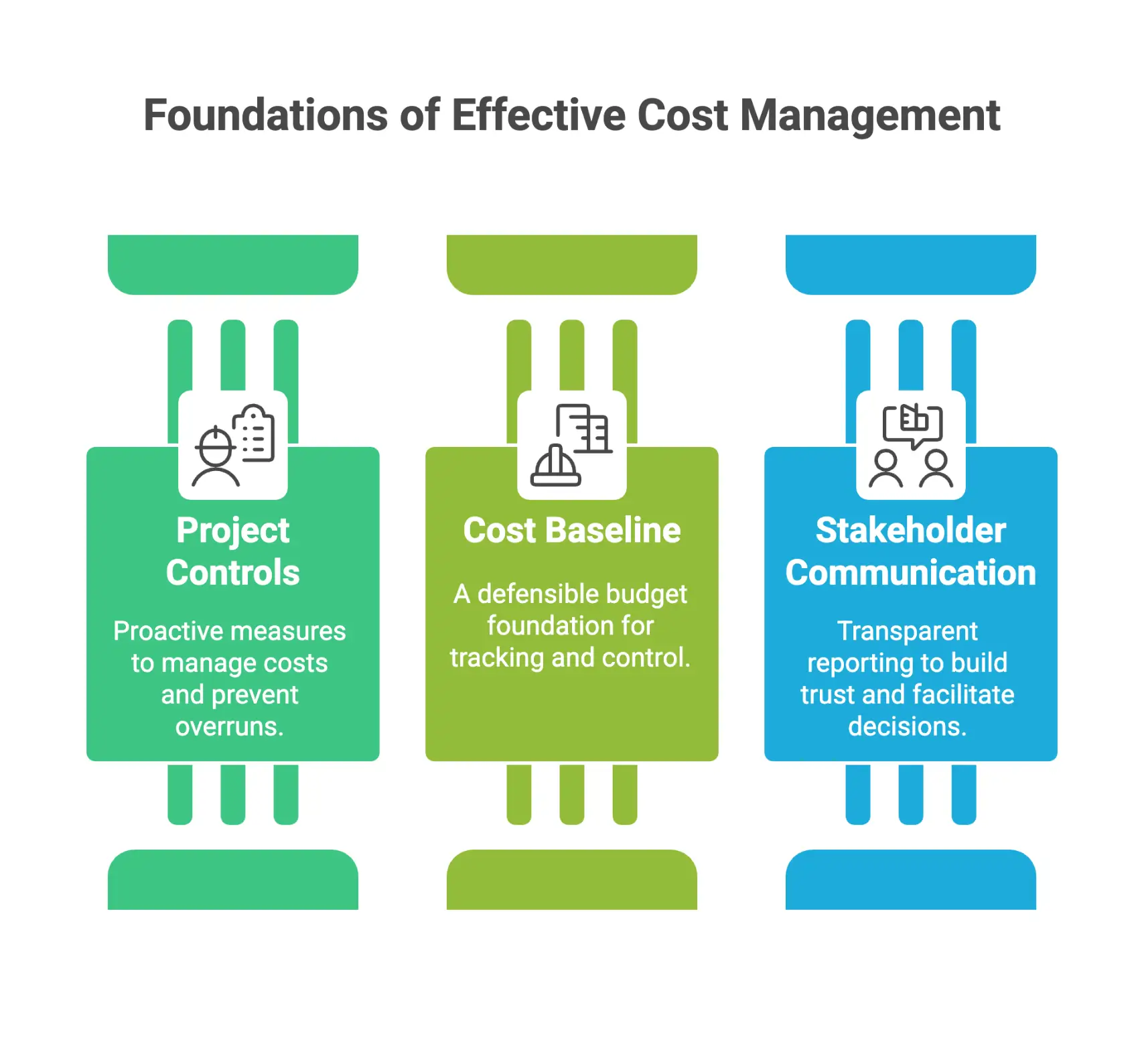
Effective project cost management is anchored in accurate cost estimation, robust project controls, and ongoing stakeholder communication. Cost engineering professionals play a pivotal role in integrating estimation, budgeting, forecasting, and cost tracking across all project stages.
- Project Controls: Implementing project controls is essential for proactive cost management and identifying cost overruns.
- Cost Baseline: Establish and maintain a defensible cost baseline for budget tracking.
- Stakeholder Communication: Transparent reporting and regular updates build trust and support timely decision making.
EPC Projects: Unique Challenges in Estimation
EPC projects (Engineering, Procurement, and Construction) within process industries require special attention to detail and ongoing estimate updates. Each EPC project must address direct, indirect, and contingency costs and regularly update the cost estimate to reflect project changes.
Cost engineering in EPC projects includes:
- Integrating allowances for potential risks.
- Decomposing scope into granular WBS components.
- Maintaining transparency with stakeholders via BOE reports.
- Utilizing software solutions like Cleopatra Enterprise for cost database management.
Ensuring Project Success through Accurate Estimation
In oil and gas, accurate cost estimation directly impacts project success. It aligns project goals with financial constraints and helps:
- Enable resource allocation based on data-driven estimates.
- Reduce the risk of cost overruns and unforeseen costs.
- Strengthen stakeholder confidence with transparent, auditable documentation.
- Empower decision makers with reliable cost data during project execution.
Accurate estimates and regular estimate updates are the foundation of effective cost control and profitability in process industries.
Modern Approaches: Advanced Cost Estimation Techniques
Parametric Models and Scenario Analysis
Parametric models allow cost estimation teams to run fast, data-driven scenarios. By changing a few key project parameters, estimators can see the impact on total cost, make smarter resource allocation choices, and stress-test project assumptions.
Integration with Upstream Data and Market Trends
The best modern platforms integrate upstream data, supplier pricing, and real-time market trends into every estimate, keeping projections current and realistic. This approach avoids relying solely on outdated information and ensures better project outcomes.
Frequently Asked Questions
What are the key drivers that impact cost estimates in oil and gas projects?
Major drivers include project scope, local geology, equipment requirements, local labor and material costs, and market conditions. Breakdown structures help identify all primary cost factors and ensure the cost estimate includes every critical component.
Why do oil and gas projects face frequent cost overruns?
Uncertain market trends, regulatory changes, poor scope definition, and unforeseen technical challenges can all lead to cost overruns. The solution is accurate cost estimation, cross-validation, and robust risk analysis at every project stage.
How do long-term operating costs affect project profitability?
Long-term costs like maintenance, aging infrastructure, and inflation can erode project margins if not modeled accurately. Updating estimates frequently and tracking actual costs ensures more effective cost control.
How do digital estimation tools enhance bid accuracy and project cost management?
Platforms like CostOS and Cleopatra Enterprise connect historical data, enable detailed project controls, automate reporting, and benchmark against actual costs. This drives transparency, improves stakeholder confidence, and reduces manual errors in the estimation process.
What makes parametric estimating valuable for oil and gas cost estimation?
Parametric estimating uses project-specific variables and historical benchmarks to quickly build cost estimates and test multiple scenarios, supporting early-stage decision making. Such models help project teams stay agile and competitive.
Best Practices Checklist for Accurate Oil & Gas Cost Estimation
- Define the project scope and key stages early.
- Create a detailed Work Breakdown Structure for cost allocation.
- Combine multiple cost estimation methods for cross-validation.
- Regularly update estimates throughout the project lifecycle.
- Document all estimating assumptions in a Basis of Estimate report.
- Engage stakeholders for better accuracy and buy-in.
- Use advanced software for estimate management and market data integration.
- Employ risk management techniques, such as Monte Carlo simulations, to forecast uncertainties.
- Report transparently and communicate updated project costs with decision makers.
- Benchmark estimates against actual project costs for continuous improvement.
Conclusion: The Vital Role of Cost Estimation in Oil and Gas Project Success
Cost estimating in oil and gas plays a critical role in every project’s success. The process combines project scope definition, robust project controls, and the expertise of cost engineering professionals to ensure each project stays within budget, aligns with stakeholder requirements, and remains competitive despite market volatility. Modern tools like CostOS and Cleopatra Enterprise drive accurate, defensible cost estimates, transparent project execution, and continuous improvement in cost control.
Ready to Take the Next Step?
If you want your oil and gas estimating workflows to match today’s demands, explore Nomitech’s full suite of estimating solutions or contact us for tailored guidance on project cost management, estimating process improvement, and achieving project success in the oil and gas industry.





Stay Up to Date
Subscribe to our Newsletter today and receive the latest updates, trends, expert insights, and exclusive offers tailored to your specific industry.