

Conceptual Estimating: What It Is and How It Works
TL;DR: Conceptual estimating is an early-stage method for forecasting project cost before detailed design is complete. It uses high-level scope, historical cost data, benchmarks, parametric models and assumptions to produce a defensible cost range for feasibility, funding and option decisions.
Conceptual estimating helps project teams answer one of the first big questions on any project: can this be delivered within a realistic budget? For project owners, estimators, cost engineers, quantity surveyors, EPC teams, project controls professionals and senior decision-makers, it provides an early basis for budgeting, funding decisions and scope trade-offs before major design and procurement effort begins.
At the beginning, only functional requirements or a very high-level scope may be known, while drawings are incomplete, quantities are not ready and specifications may still be open. Even so, these teams still need a credible view of likely cost. A conceptual estimate gives them that view by turning limited project information into a structured cost range.
It is not a replacement for detailed estimating later in the lifecycle. Its job is to support early decisions, such as comparing options, testing affordability, setting budget expectations and spotting the cost drivers that need closer attention as the project develops. This article explains what conceptual estimating is, where it fits in the estimating lifecycle, the key inputs and methods used, the process for building an estimate, and the accuracy, risk and best practices that make early cost forecasts more reliable.
What Conceptual Estimating Is
Conceptual estimating is an early-stage approach to forecasting project costs before detailed design, complete drawings or a fully defined scope are available. You may also see it called conceptual cost estimating or conceptual estimation.
At this point, the goal is not to produce a final price. It is to create a defensible cost range using the best information available, so teams can make decisions with more confidence and less guesswork.
Where It Sits in the Estimating Lifecycle
Every project moves through several estimate stages as the scope becomes clearer. At the very beginning, when the project is still closer to an idea than a design, teams rely on rough order of magnitude estimates built from high-level parameters, benchmarks and professional judgment. As design progresses, those early estimates are refined and eventually replaced by detailed estimates supported by quantity takeoff and confirmed scope.
Conceptual estimating sits at the front end of that lifecycle. AACE International's estimate classification system places the least-defined estimates at Class 5, where project definition is roughly 0% to 2% complete and methods such as capacity factoring, parametric models, and analogy are the right tools for the job.
That distinction matters. A conceptual estimate is not a rough draft of a detailed estimate. It is a different type of estimate, built for a stage where uncertainty is still part of the work.
What a Conceptual Estimate Typically Includes
Even without drawings or final quantities, a conceptual estimate should still be organized, traceable and easy to review. It usually includes the basis of scope, the estimating method used, key assumptions, relevant benchmarks or historical cost data, allowances for known unknowns and an accuracy range that reflects the current level of definition. For a broader foundation, it helps to understand the main types of cost estimates and how they support project budgeting decisions.
What it should not include is false precision. A single clean number may look useful, but when the scope is still moving, it can create more risk than clarity. A range, supported by clear assumptions, is usually more honest and more useful.
Why Conceptual Estimating Matters
Before a single drawing is produced, project owners and delivery teams are already asking whether the project is affordable. Conceptual estimating helps answer that question early, when there is still time to change direction.
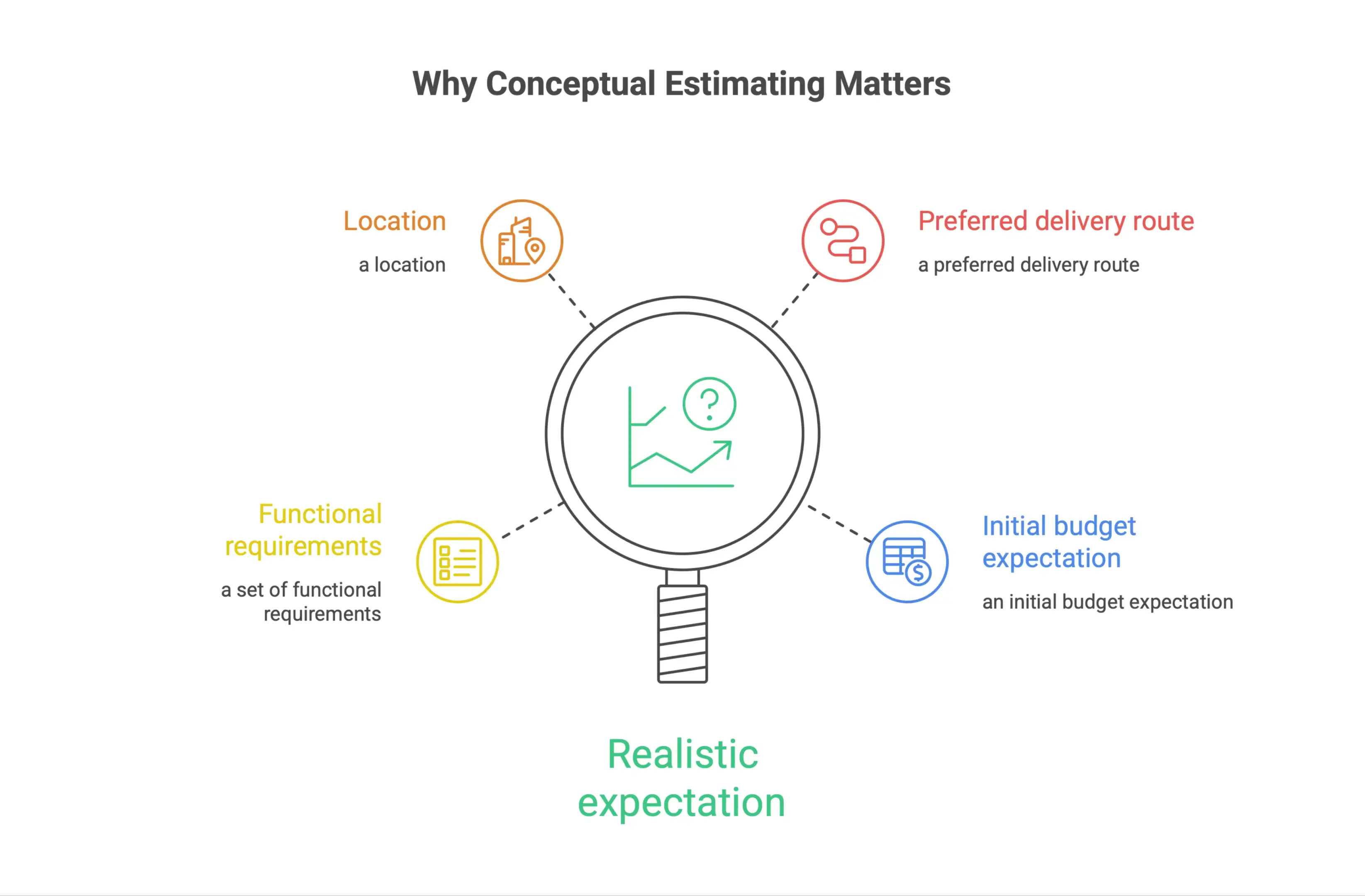
At feasibility stage, there is usually no complete scope, no detailed design and no firm quantity takeoff. What teams often have is a set of functional requirements, a location, a preferred delivery route and an initial budget expectation. A well-built conceptual estimate tests whether that expectation is realistic before major time and money go into design, approvals or procurement.
Testing Affordability Before Design Begins
As RICS notes, the main purpose of conceptual estimating is to test affordability, support project feasibility, and establish a realistic cost limit based on the client’s core requirements. That limit then becomes a reference point for later design and delivery decisions.
In construction and engineering, this often means developing a project budget range from broad parameters such as floor area, occupancy type, building type, structural system, location or infrastructure capacity. An owner comparing a steel-framed warehouse with a concrete distribution facility needs a credible cost comparison to help guide the design process before selecting a route. The same applies when an infrastructure team is weighing highway alignments, facility capacities or different site options.
Supporting Scope Trade-offs and Funding Decisions
Conceptual estimates also play a major role as early cost estimates used for funding approvals, investment screening, portfolio planning and feasibility ranking across a group of options. Capital programmes, public infrastructure pipelines and private developments all rely on early cost figures to rank projects, allocate budgets and decide what should move forward.
They also give teams a cost basis for scope trade-offs against budget constraints. If the team is considering a larger facility, a different procurement strategy, a compressed schedule or a higher specification, the discussion needs numbers behind it. Without an early estimate, go or no-go decisions lean too heavily on opinion. With one, teams move into design with clearer expectations and a stronger financial starting point, improving the chances of project success.
Key Inputs for a Conceptual Estimate
A conceptual estimate is only as useful as the information behind it. Detailed designs and full quantities are usually not available yet, but the estimator still needs enough project definition to build a cost forecast that means something.
The Minimum Project Definition You Need
At the conceptual stage, useful inputs typically include:
- Building type and function: building, infrastructure, industrial facility, civil works
- Size and capacity: gross floor area, lane kilometers, throughput, MW capacity
- Project location: country, region, urban or remote site
- Site conditions: topography, ground conditions, accessibility, existing infrastructure
- Functional requirements: number of floors, structural system, fit-out standard
- Schedule and procurement assumptions: phasing, delivery model, contracting strategy
- Performance expectations: quality level, sustainability targets, operational requirements
In the early stages, this high-level information often stands in for detailed plans.
As the Federal Highway Administration notes, even broad project parameters such as location, project type, length or area, site characteristics, and major design assumptions are enough to start structuring a conceptual cost estimate.
The Role of Historical Data, Cost Data, and Benchmarks
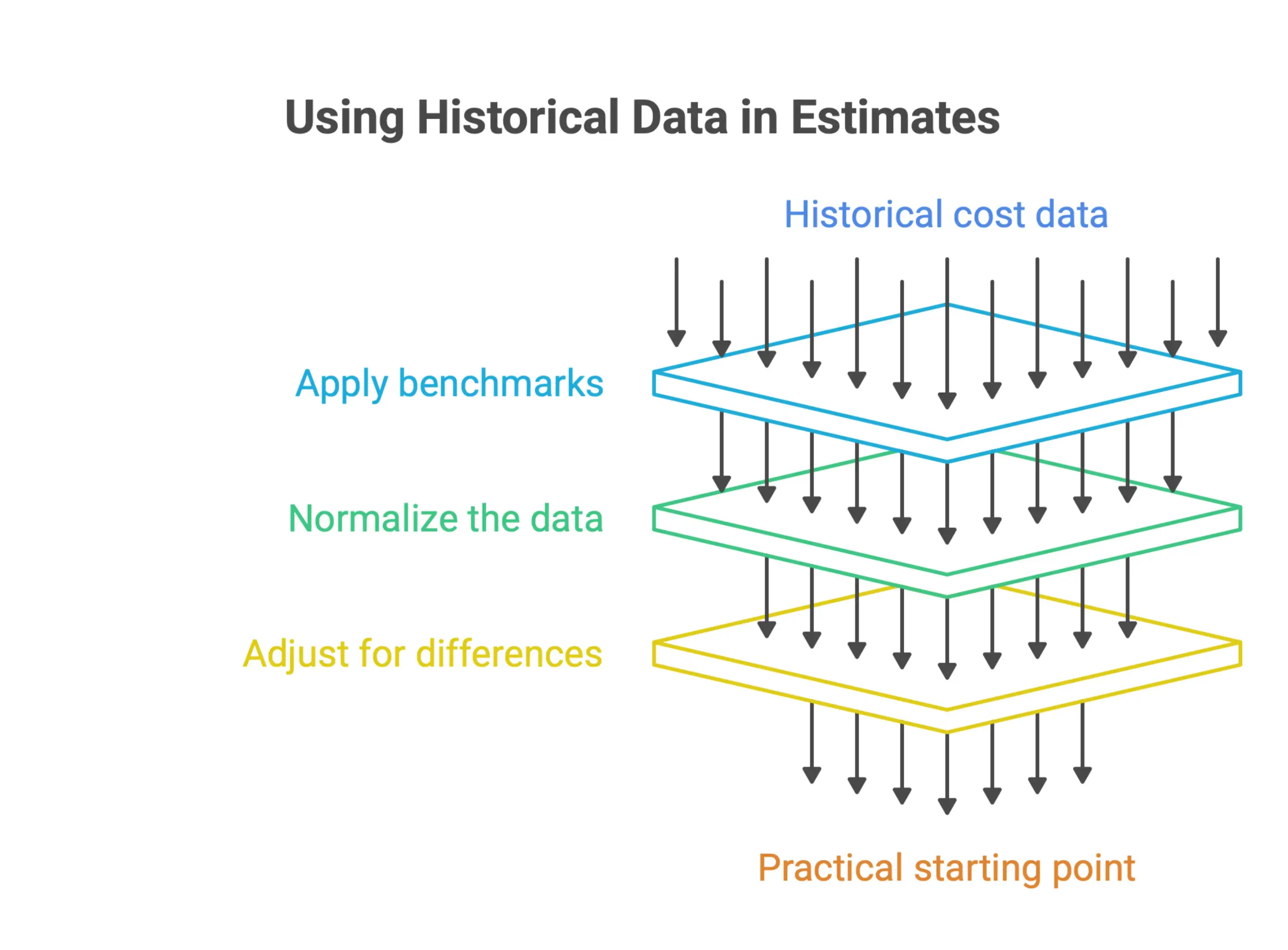
When detailed quantities are missing, estimators rely heavily on historical cost data from previous projects and similar projects. Benchmarks such as cost per square metre for a hospital, cost per lane kilometre for a highway or cost per installed capacity unit for a plant can provide a practical starting point, especially when creating conceptual estimates with limited project data.
The key is normalization. Past project data has to be adjusted for:
- Time and escalation: previous costs need to reflect current or forecast market conditions
- Location: labor rates, productivity and material prices vary by region and country
- Currency: especially on international or cross-border projects
- Project complexity and scope differences: a similar project is rarely an identical one
Published cost databases can also supplement internal records when firms do not have enough comparable data.
If those adjustments are skipped, a benchmark can look reliable while still being badly misleading. Dedicated estimating platforms such as CostOS can support teams working with cost estimates, estimating databases, BOQs and bids as project information becomes more defined.
Key Cost Drivers to Test Early
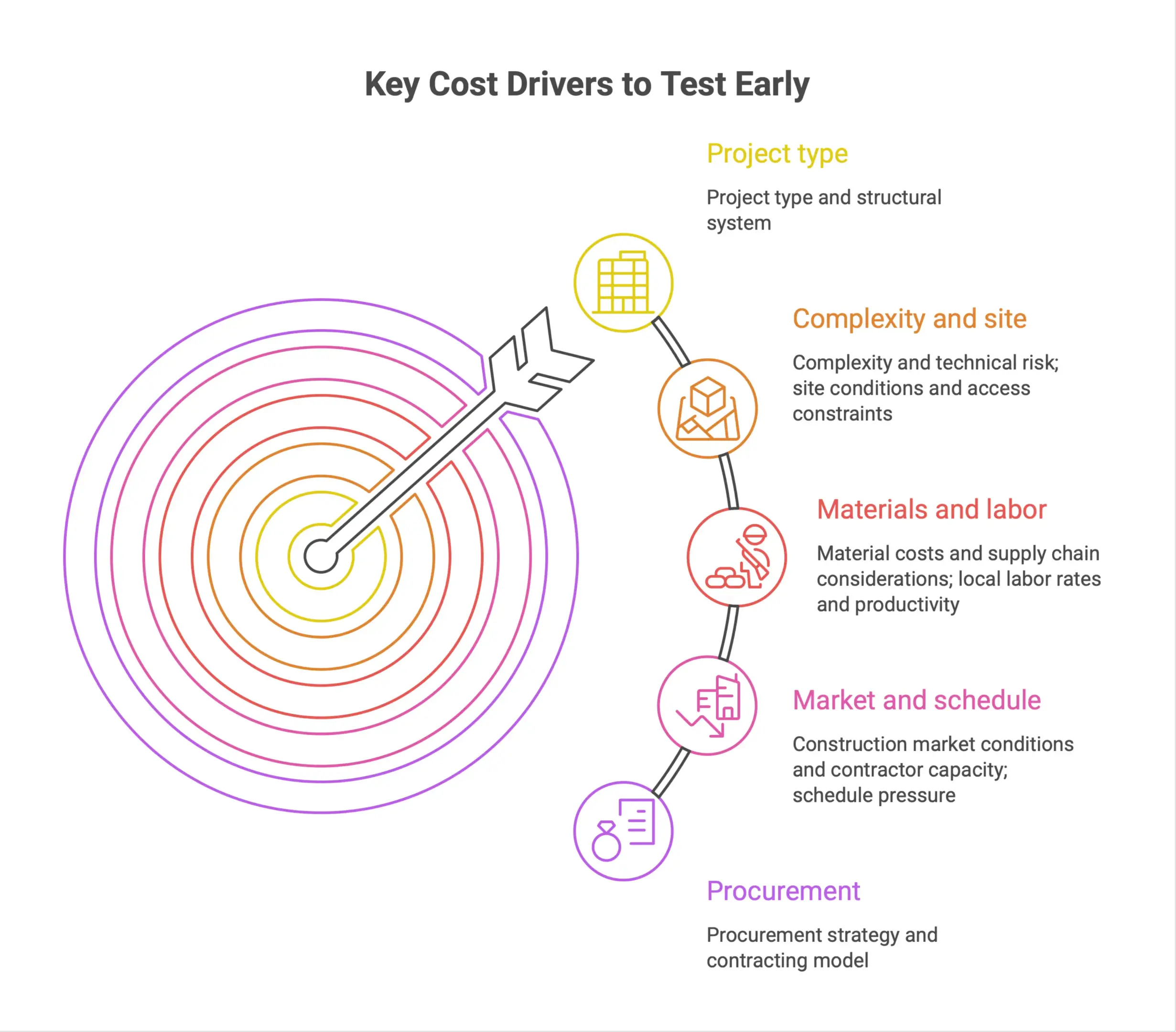
Some variables influence cost long before design is complete. Identifying them early helps the team test assumptions, compare options, and spot potential challenges to understand where the estimate is most exposed.
Major cost drivers include:
- Project type and structural system
- Complexity and technical risk
- Site conditions and access constraints
- Material costs and supply chain considerations
- Local labor rates and productivity
- Construction market conditions and contractor capacity, which can quickly affect anticipated costs
- Schedule pressure, which can significantly inflate construction costs and shift anticipated costs
- Procurement strategy and contracting model
Testing these drivers early does not remove uncertainty, but it makes the uncertainty visible. That alone can prevent poor decisions from hardening into budgets that later become difficult to defend, while improving estimate accuracy over time as assumptions are refined.
Common Methods Used in Conceptual Estimating
When detailed drawings and quantities are not yet available, estimators rely on a few proven methods to build a defensible cost picture. Each method uses different inputs and fits a different level of scope maturity. In practice, most teams use more than one. Cross-checking methods is one of the best ways to catch weak assumptions before they become expensive.
Analogous Estimating
Analogous estimating starts with the actual cost of a completed project or comparable past projects and uses it as the basis for a new one. If a similar facility was delivered for a known cost, that history can provide a solid anchor.
It works best when the reference project is genuinely comparable in type, size, specification and delivery context, and current enough to support an accurate estimate. The estimator then adjusts for location, timing, market conditions, labor rates and scope differences. The quality of the result depends on how well the reference project is understood and how carefully those adjustments are made.
Unit-Based Estimating
Unit-based estimating expresses cost as a rate per measurable quantity: cost per square metre or per square foot of floor area, cost per linear metre of pipeline, cost per hospital bed, cost per seat or cost per installed capacity unit.
These rates are easy to understand and explain, especially for owners and senior decision-makers who do not need a detailed cost build-up at this stage, and they are most useful in the conceptual phase before more detailed quantities are available. The risk is choosing a benchmark that looks convenient but does not fit the project. A constrained site, unusual structural system or high-spec fit-out can make a simple unit rate too blunt unless it is adjusted carefully.
Parametric Estimating
Parametric estimating takes the unit-based idea further by using cost-estimating relationships, or CERs, and cost models built from historical cost data and measurable project variables. Instead of applying one fixed rate, the model shows how cost changes as parameters such as capacity, span, height or throughput change.
As described in NASA's cost estimating methodology, building a CER means selecting a relevant independent variable, collecting and normalizing historical data, analyzing the statistical relationship, and applying it to the proposed project. In construction and engineering, that might mean modeling how the cost of a water treatment plant scales with daily processing capacity, or how structural steel costs shift with building height.
Parametric models require more data than simple unit rates, but they are better suited to scenario testing. When they are well calibrated, they show how cost moves as the project changes. With better project information, software-backed parametric models can evolve into more detailed estimates.
The Conceptual Estimating Process
A conceptual estimate still follows a clear, iterative process, even when information is limited, treating conceptual estimating as part of ongoing project planning rather than a one-time calculation. That discipline is what turns an early forecast into something decision-makers can actually use, supports better project outcomes as estimates are reviewed and updated, and aligns with broader project cost estimation principles used as estimates mature.
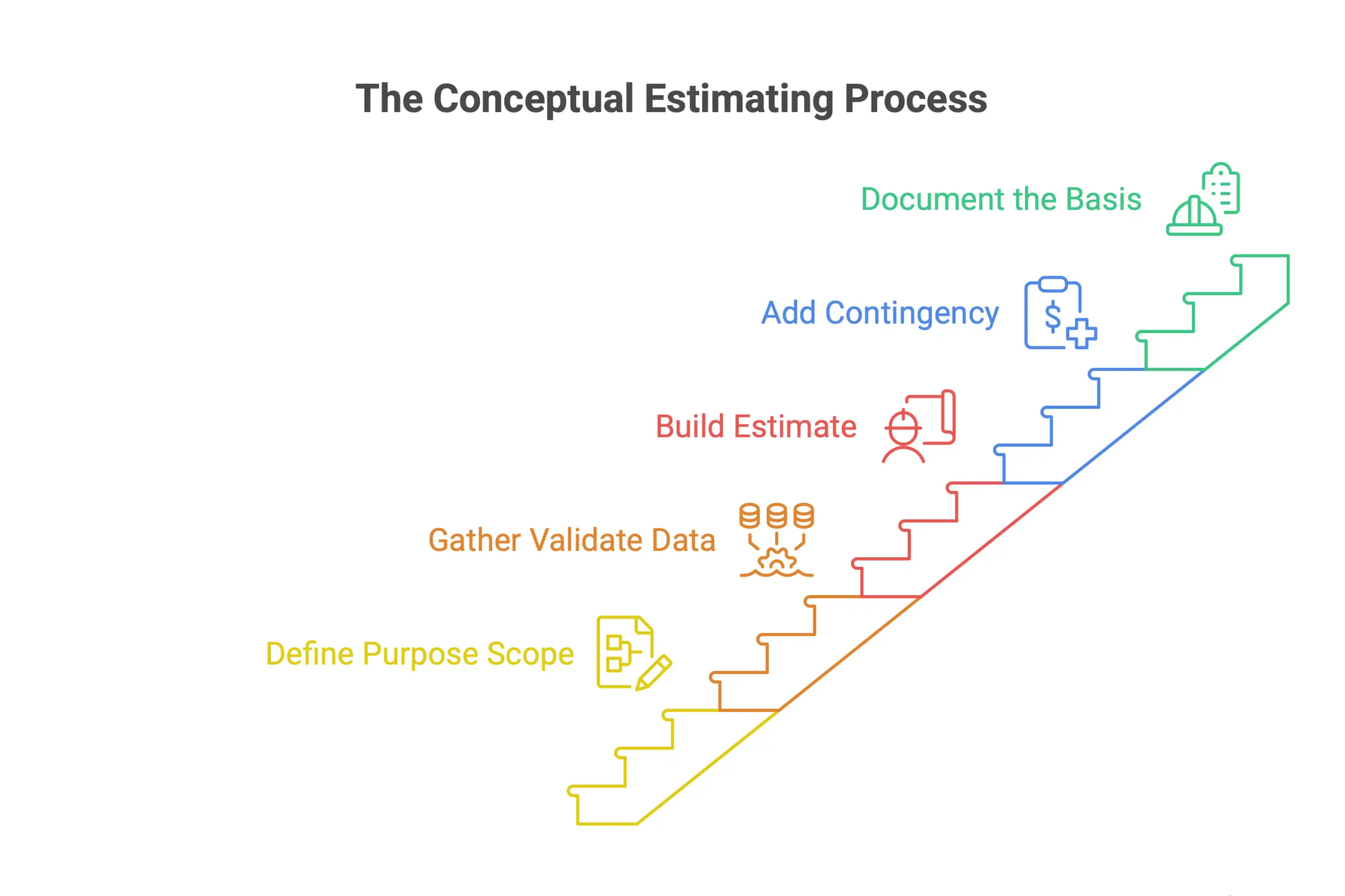
1. Define the Estimate Purpose and Project Scope
Before any numbers are developed, the estimator needs to understand why the estimate is being prepared. Is it for a feasibility study, a funding request, a feasibility analysis or an option comparison? What is known about the project size, location, function, capacity, procurement approach and schedule?
Scope boundaries matter just as much as the cost calculation and should be part of a clearly defined scope. An estimate for a 10,000 m² office building with a steel frame is a different exercise from one for a reinforced concrete facility of the same size. Everyone involved needs to know what is included, what is excluded and what is still assumed, and the estimate purpose and scope should reflect the entire project, including major non-construction inclusions where relevant.
2. Gather, Normalize and Validate Cost Data
Once the scope is defined, the estimator gathers relevant historical cost data from construction projects with similar scope, scale, and conditions. When internal records are limited, published cost databases may also be used. That data rarely transfers directly. Costs from past jobs need to be adjusted for location, timing, labor rates, material prices, procurement conditions and project complexity before they can be used with confidence.
A benchmark from a project completed three years ago in another region may still be useful, but only after proper adjustment. Without that step, the estimate can drift far from reality before anyone notices, especially since early-stage data quality is often constrained by resource restrictions.
3. Build the Estimate and Apply Adjustments
With validated data in hand, the estimator selects the most suitable method, whether analogous, unit-based, parametric or a combination. The base cost is then adjusted for project-specific conditions such as site constraints, structural complexity, phasing and market conditions.
4. Add Contingency and Document the Basis of Estimate
Contingency is added to reflect the uncertainty that remains. At the conceptual stage, an appropriate contingency is usually broader than it would be in a detailed estimate because many scope decisions are still open. It should be a structured response to real uncertainty, not a patch for missing scope.
A conceptual estimate is only as strong as its documentation. The National Park Service Cost Estimating Requirements Handbook recommends that the basis of estimate captures the project scope, data sources, assumptions, exclusions, adjustments, markups, contingencies, and calculations in enough detail to support independent review and consistent updates as the project moves forward. More broadly, conceptual estimating involves documenting assumptions, inclusions, exclusions, and revisions clearly.
In practice, this documentation becomes the starting point for review. When owners, the design team, and project managers can see what is driving the cost, they are better placed to challenge assumptions, refine scope and make informed decisions.
Accuracy, Risk, and Contingency
Conceptual estimates are developed when design maturity is low and many scope decisions are unresolved, so their accuracy is limited and they rely on incomplete information. That should shape how the estimate is built, presented and used.
If that lower accuracy is not communicated clearly, it can lead to planning inefficiencies.
A single figure suggests a level of precision that does not exist yet. An early estimate is usually more useful as a range, with the lower end reflecting a more favorable scope and the upper end allowing for a more complex outcome. As the project progresses and scope definition improves, the estimate should narrow, its accuracy should improve, and the confidence behind it should increase. The range gives decision-makers a clearer view of where the project stands, while the spread shows how much definition still needs to be resolved.
Using Risk Analysis to Structure Uncertainty
Risk analysis moves the discussion beyond a generic contingency line. It helps teams understand what is actually uncertain and which variables matter most.
Sensitivity testing can show which cost drivers have the biggest effect on the estimate, whether that is material pricing, site conditions, procurement strategy or schedule assumptions. When uncertainty sits across several variables, methods such as Monte Carlo simulation can combine probability distributions for individual cost items and model how they interact. The result is a total cost distribution rather than one isolated number. The U.S. Government Accountability Office recommends this approach for identifying the contingency needed to achieve a chosen confidence level.
This is especially useful on large capital, infrastructure and EPC projects, where the difference between an optimistic estimate and a realistic budget can be significant.
Contingency and Its Limits
Contingency should be a structured response to real uncertainty, not a patch for missing scope. Adding a percentage allowance does not fix an estimate built on vague assumptions. If a major element is still undefined, the better approach is to call it out, widen the estimate range and close the definition gap as early as possible.
Common mistakes include treating conceptual estimating in construction as if an early number were fixed before scope is stable, underestimating location or market factors, and treating benchmark data as directly transferable. Teams that catch these issues early are less likely to face the classic conceptual estimating problem: a provisional number that becomes a fixed budget long before the project is ready for one, which can undermine a successful project long before execution begins.
Best Practices for Conceptual Estimating
Reliable conceptual estimating works best as a strategic tool, not just a spreadsheet exercise. The quality of the result depends on disciplined inputs, the right expertise and a clear understanding of how the estimate will be used.
Use reliable cost data and normalized benchmarks. Historical cost data only works when it is adjusted for time, location, labor conditions and project type. Raw figures from past jobs should not be reused as-is. A structured library of reference projects makes it easier to compare like with like, keep data current and understand what each benchmark includes.
Involve the right specialists early. Structural, mechanical, civil and process engineers often understand cost drivers that a generalist estimator may not fully capture at concept stage. Bringing in specialist input early, even informally, helps close gaps before they show up as budget surprises.
Keep the estimate current as scope develops. A conceptual estimate should not sit unchanged while design moves forward. As scope decisions are made, the estimate should be updated and refined through the design development phases as more information becomes available. Once design is mature enough, compare the conceptual estimate with quantity takeoff, BIM-derived quantities, procurement feedback and detailed estimates. The differences are useful because they show where assumptions changed.
Document assumptions thoroughly. Every estimate depends on assumptions about scope, specification, site conditions, schedule and market conditions. Writing those assumptions down makes the estimate easier to defend, easier to update and less likely to be misunderstood later, while clear documentation helps align collaboration around budget constraints and project goals.
The value of conceptual estimating is not perfect accuracy. Effective conceptual estimating supports better project outcomes and stronger project success by improving early judgment, giving project owners and delivery teams the clarity to make decisions before commitments become hard to unwind.
Frequently Asked Questions
How accurate is a conceptual estimate?
A conceptual estimate is less precise than a detailed estimate because the design, quantities and scope are still developing. It should usually be presented as a range, not a fixed number. The more reliable the input data, assumptions and benchmarks are, the more useful the estimate becomes.
Is conceptual estimating the same as preliminary estimating?
The terms are sometimes used interchangeably, and in early project planning a conceptual estimate is often treated as a preliminary estimate, when scope definition is limited. Preliminary estimating can also describe later early-stage estimates, once more design information, quantities or technical assumptions are available.
Who uses conceptual estimates?
Conceptual estimates are used by project owners, estimators, cost engineers, quantity surveyors, EPC teams, project controls professionals and senior decision-makers. They support feasibility studies, funding approvals, option comparisons, budget setting and early risk reviews before the project moves into detailed design.
Ready to Take the Next Step?
If you want to make early project cost decisions more structured, traceable and data-driven, explore Nomitech’s full suite or get in touch to discuss how your team approaches conceptual estimating."





Stay Up to Date
Subscribe to our Newsletter today and receive the latest updates, trends, expert insights, and exclusive offers tailored to your specific industry.