

What Are Benchmarks? Understanding Standards in Every Industry
TL;DR: What are benchmarks? Benchmarks are standards every industry uses to measure, compare, and keep performance on track. Once you know how benchmarks work, their different types, real-world uses like benchmarking studies, and common benchmarks, you can set smarter goals, make stronger decisions, and keep your team ahead in fast-changing markets.
What Are Benchmarks? Understanding the Fundamentals
Ever feel like your projects are slipping, bids tightening, stakeholders asking for more proof, all while data’s scattered across a dozen disconnected tools? When everyone’s expecting more and project details keep multiplying, just trying to keep pace can be overwhelming.
That’s exactly where benchmarks step in. In today’s high-stakes, fast-moving industry environments, having trusted standards is no longer a nice-to-have. It’s mission-critical. What are benchmarks, and why do they matter? Benchmarks are standard reference points used to measure and compare the performance, quality, or processes of products, services, or systems against industry leaders or specific criteria. If you lack good benchmarks, organizations end up guessing, making decisions in the dark, and risking their entire workflow.
With robust cost estimation systems like CostOS, you can centralize benchmarking data, compare against industry-relevant benchmark indexes, and finally turn all that scattered information into a real competitive advantage. This article shows you how performance benchmarking and benchmarking studies give teams a way to regain their footing, set targets that actually make sense, and start winning on consistency.
So, what are benchmarks in practice, why should you care, and how do they fit into business performance and investment strategies? Let’s explore the different types of benchmarks and their impact on organizational improvement.
Different Types of Benchmarks Across Key Industries
Benchmarks aren’t just dry numbers. They’re the fundamental tool teams across industries use to measure exactly where they stand and how to improve performance. The goal is always the same: set a standard, compare, and improve performance. But whether you’re involved in business, technical benchmarking, investing, or computing, the way benchmarks apply and benchmarking data is used can differ greatly. Leading solutions like Nomitech’s industry cost estimating suite demonstrate how benchmarks shape business performance, from construction and mining to energy and beyond.
Let’s break down several different types of benchmarks and their importance across industries.
Common Benchmarks and Benchmark Indexes in Investing
In investing and financial markets, a benchmark index serves as a critical standard for comparing performance. Investors use common benchmarks, such as the S&P 500 and Dow Jones Industrial Average, to evaluate the performance of portfolios, mutual funds, or specific securities. Benchmark indexes like the S&P 500, Dow Jones, and the Bloomberg Commodity Index (BCOM) represent the performance of a class of assets or securities, providing reference points for evaluating stocks, commodities, and more.
Fixed income indexes track assets like bonds and treasuries, often focused on capital preservation during market swings. Commodity indexes such as the Bloomberg Commodity Index allow investors to monitor performance across a range of commodities. When evaluating your investment portfolio’s performance, always compare it with the most relevant benchmark index. That’s the index matching your portfolio or holdings. Benchmarks provide insights into market health by reflecting broader market trends and the relative performance of specific asset classes.
Today, investors of all sizes rely on benchmarks to guide investment strategies, improve performance, and support capital preservation. Tools like cost benchmarking tools convert raw benchmarking data into actionable, comparable insights.
Technical Benchmarking in Computing and Technology
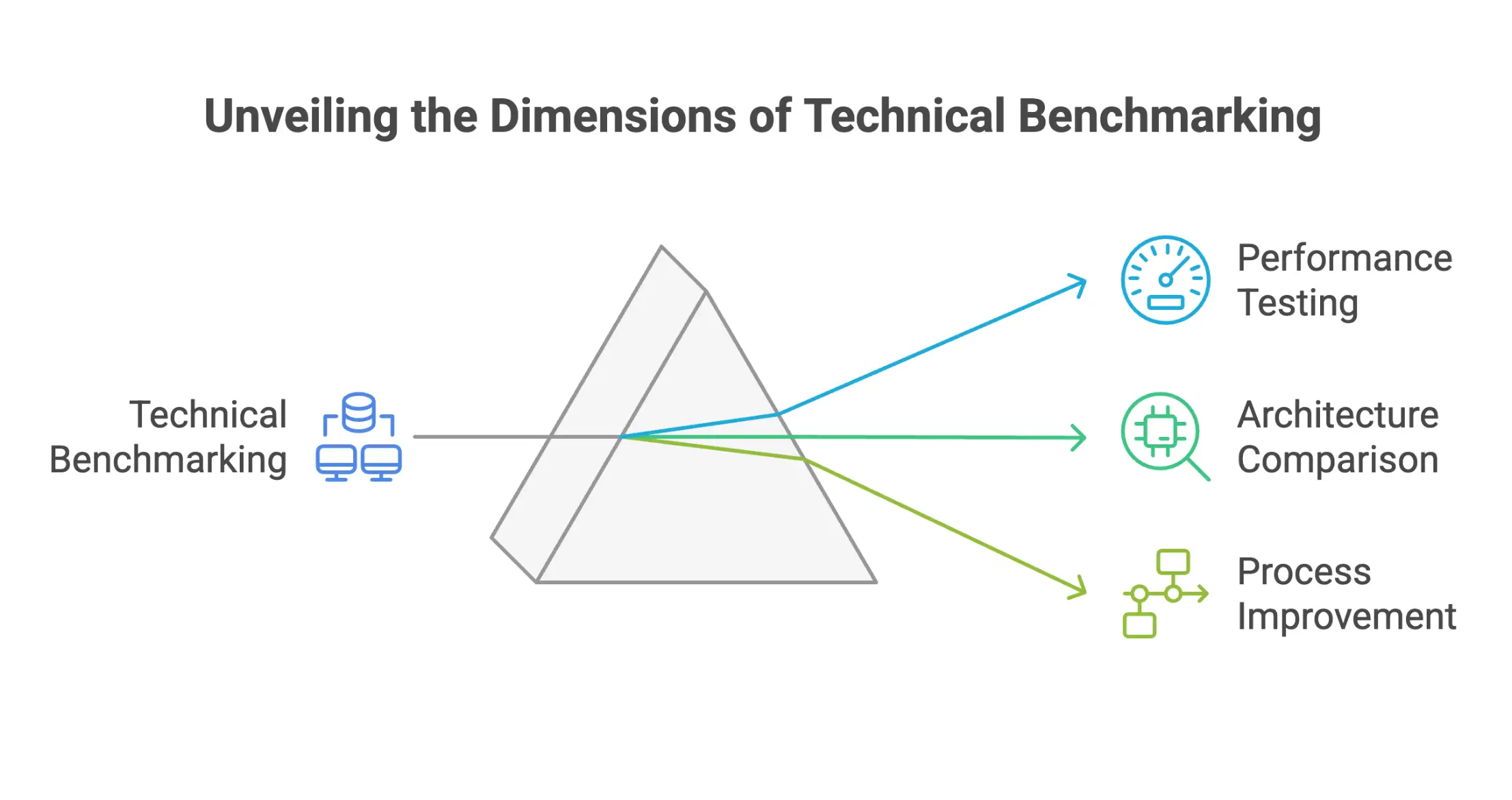
Technical benchmarking is essential for comparing the speed, efficiency, and performance of systems, from hardware architectures to software products. In the realm of technology, performance benchmarking ensures organizations evaluate IT resources against industry standards and competitors.
Benchmarks in this sector measure the real world performance of systems. Synthetic benchmarks apply artificially controlled tests, while application benchmarks test systems under typical real world workloads. For example, BIM rendering engine tools help process mapping and technical benchmarking by visualizing and comparing different chip architectures, reflecting the range of use cases.
Benchmarks are crucial for:
- Sorting which CPU, GPU, or memory setups deliver a competitive advantage
- Revealing bottlenecks in services and systems
- Evaluating whether upgrades improve business performance or just add complexity
- Informing technology investment strategies and guiding product management
Computer companies sometimes optimize for specific benchmarks, which highlights the importance of using a good benchmark that genuinely reflects user experience, not just synthetic test scores.
Benchmark Indexes in Surveying and Geodetic Engineering
Surveying benchmarks refer to physical reference points, etched markers that ensure accuracy in elevation and mapping. They provide a fixed, reliable starting point for measuring, enabling infrastructure projects to stay consistent and grounded. Survey benchmarks keep teams in sync, anchor mega projects, and prevent mistakes in construction and land management.
Types of Benchmarking: Key Approaches
There are four key types of benchmarking:
- Performance Benchmarking: Collection and comparison of quantitative data to identify performance gaps. This form is used to support organizations in competitive markets.
- Practice Benchmarking: Qualitative comparison of how organizations conduct activities; this encompasses process mapping, identifying best practices, and implementing new methods.
- Internal Benchmarking: Metrics or practices compared between different departments or business units within the same company.
- External Benchmarking: Performance benchmarking against other organizations or industry leaders.
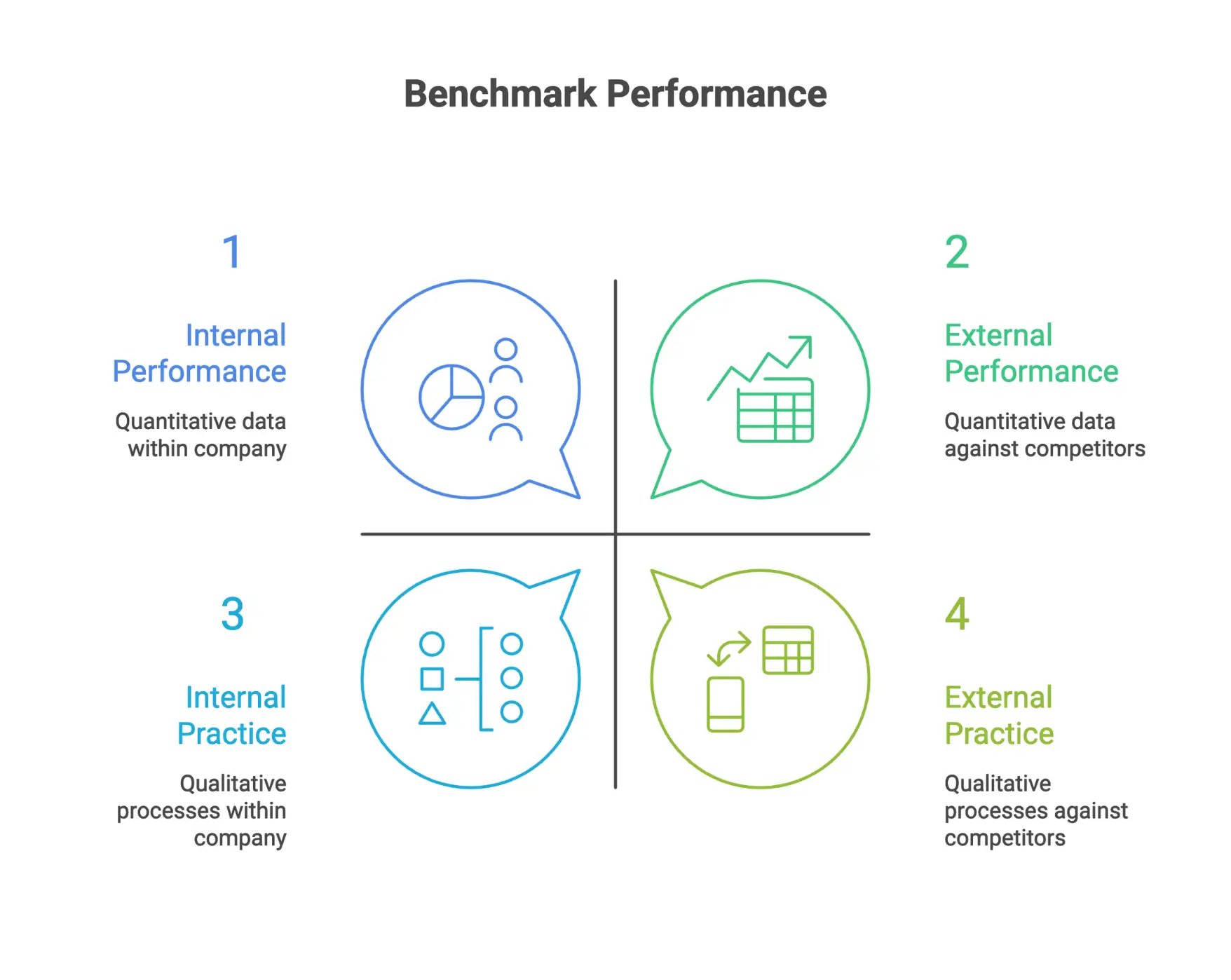
Performance benchmarking and practice benchmarking both provide the foundation for benchmarking studies, helping organizations improve performance through continuous improvement.
Benchmarking: The Process and Its Organizational Value
Benchmarking is more than a tool. It’s a systematic, data-driven process of compare and analysis that drives excellence. Regular benchmarking aligns organizational effort with top market standards, enabling companies to adapt, measure, and improve.
Benchmarking Data Collection and Analysis
The benchmarking process starts with careful planning: deciding which aspects to compare, selecting meaningful benchmark indexes, and using reliable benchmarking data. Best practice benchmarking methods:
- Repeatable, structured data collection for consistent comparisons
- Statistical analysis to distinguish meaningful trends from outliers
- Normalizing data so organizations can compare apples to apples
- Implementing insights drawn from top benchmarking studies to drive development and continuous improvement
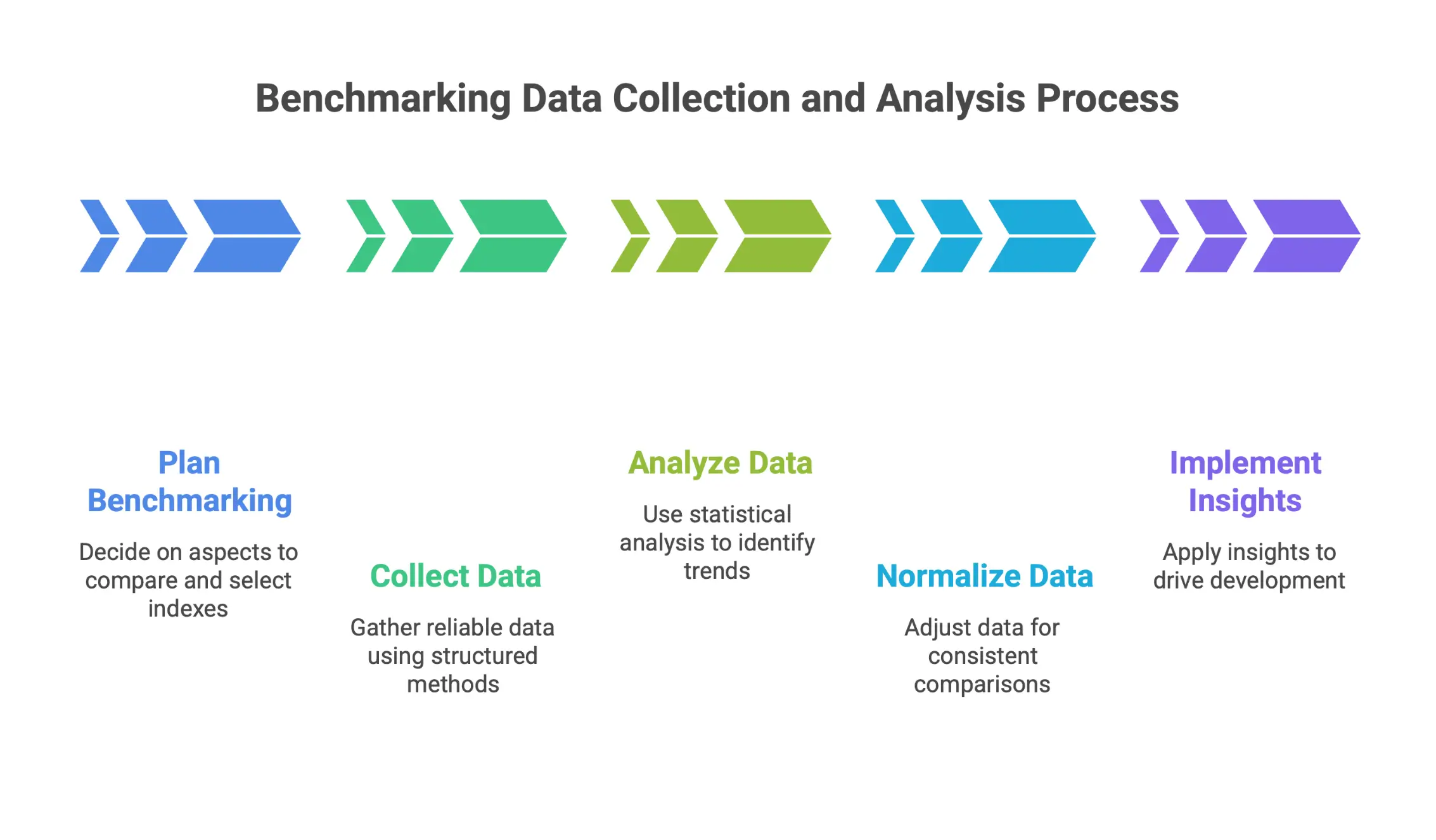
Validation is vital. For example, technical benchmarking in IT uses real world performance checks and process mapping to ensure the selected benchmarks continue to reflect operational realities.
Benchmarking Studies: How Organizations Use Them to Improve Performance
Benchmarking studies allow organizations to compare themselves directly to industry benchmarks, identifying business performance gaps and unlocking strategies for rapid improvement. Common benchmarking studies include:
- Market benchmarking: Compare sales, customer services, and operations across competitors for identifying market opportunities.
- Process benchmarking: Map out and refine internal processes to adopt best practices from global leaders.
- Investment benchmarking: Use benchmark indexes like the S&P 500 and Bloomberg Commodity Index for portfolio comparison and strategic allocation.
By using benchmarks, organizations identify weaknesses, address inefficiencies, and develop innovative strategies for staying ahead in a rapidly changing environment.
What Makes a Good Benchmark?
A good benchmark is transparent, relevant, and precisely mirrors the performance measures vital for a company’s success. It allows for effective comparison, supporting both business and investment strategies. Features of a good benchmark include:
- Relevance to the industry, services, or asset classes
- Frequent and transparent data updates to capture current market dynamics
- Wide acceptance among organizations evaluating similar aspects or asset groups
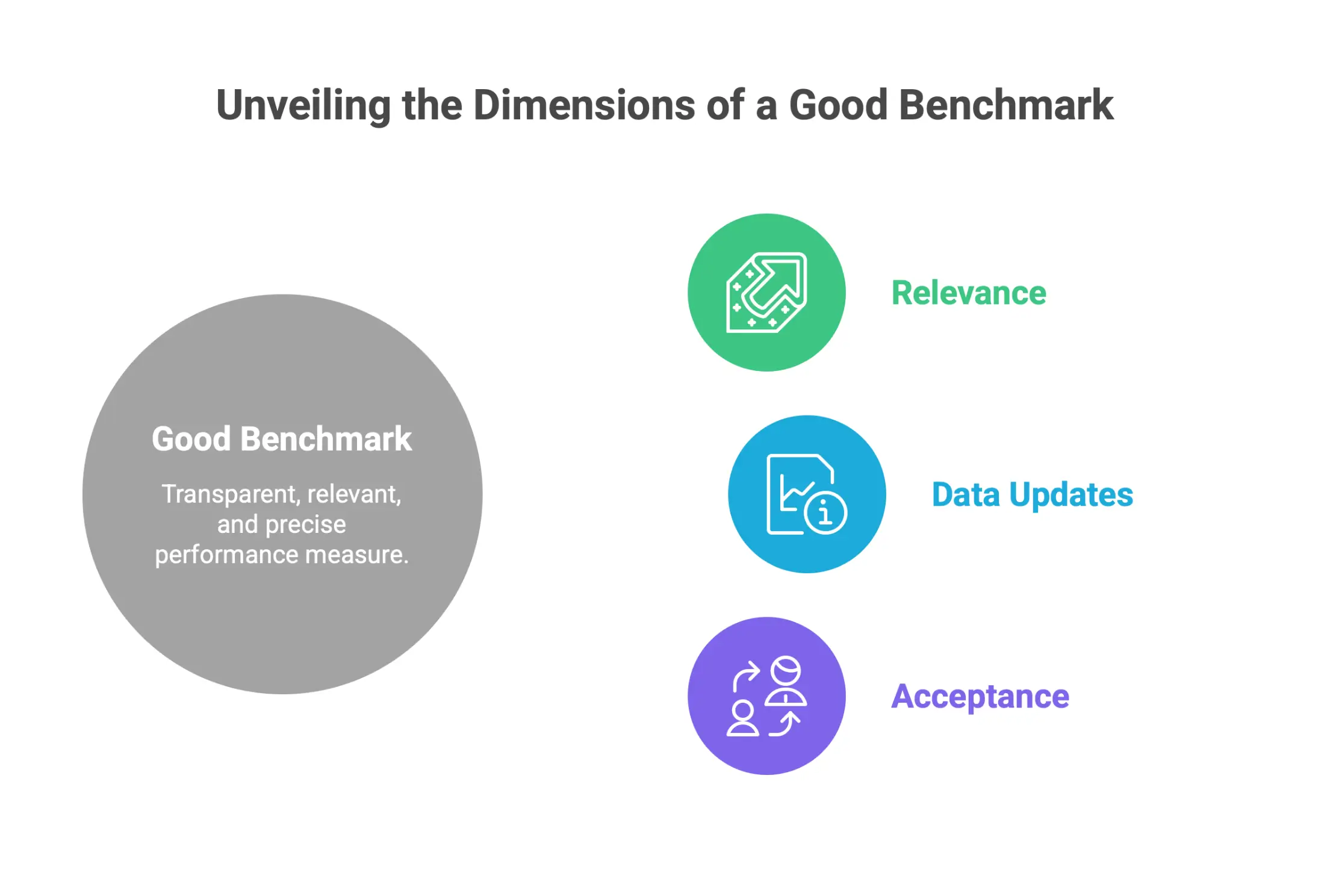
For example, a good investment benchmark matches your portfolio’s composition and risk profile, whether tracking equities, fixed income assets, or commodities. Investors often use the S&P 500 or Dow Jones as the gold standard benchmark index for evaluating relative performance, but specialized benchmarks like the Bloomberg Commodity Index provide a tailored gauge for commodities.
Benchmarking Methodologies: How Good Benchmarks Are Established and Used
Solid benchmarking relies on actionable data and a methodical process. Steps to establish reliable benchmarks include:
- Identify performance indicators that influence objectives
- Select relevant comparison groups or organizations
- Explain and document methods of data collection for transparent benchmarking studies
- Apply process mapping or technical benchmarking practices for accuracy in both internal and external comparison
Benchmarking is as much about learning the “why” behind performance leaders as it is about the numbers. Leading organizations consistently implement benchmarking programs that not only focus on outcomes, but also on improving processes, services, and systems across sectors and asset classes.
Benchmarking in Investment Strategies and Financial Markets
Benchmarks and benchmark indexes are foundational tools for investors evaluating holdings, implementing capital preservation strategies, and maximizing investment returns. Here’s how they factor in:
- Investors use benchmarks like the S&P 500, Dow Jones, or Bloomberg Commodity Index to measure portfolio returns against a relevant benchmark index, reflecting performance in securities, mutual funds, and diverse asset classes.
- Market indexes compile a range of securities or asset classes, giving a broad measure of market health.
- Fixed income indexes track bonds or treasuries, crucial for income strategies and capital preservation, especially when markets decline.
- Commodity indexes such as the Bloomberg Commodity Index are widely used to compare commodity investment performance.
- Selecting the best benchmark, one that shares the same types and proportion of assets as your portfolio, is essential for effective evaluation.
- Investors regularly compare their results against benchmark indexes to determine if their investment strategies outperform or need adjustment.
- Benchmarking studies reveal which asset management approaches deliver a competitive advantage, supporting ongoing development.
- In some fields, benchmarks for investment strategies and business performance have become legally required, with financial penalties for failing to meet standards.
Regular benchmarking studies empower investors to refine their investment strategies, manage risk, adjust portfolios, and maintain alignment with changing market conditions and industry best practices.
Technical Benchmarking: Importance in Computing and Technology Development
Technical benchmarking is at the heart of IT and technology management, from processor development to enterprise systems. It involves:
- Running both synthetic and real-world tests for performance benchmarking
- Comparing different chip architectures or software approaches
- Applying benchmark studies to measure improvements in process mapping, delivery velocity, and code quality, particularly as AI plays a bigger role
A good technical benchmarking study reflects actual production runs, not just idealized testing. Process mapping and benchmarking data from real applications provide the grounding for effective technology strategy, helping organizations implement changes that reflect real user needs, not just marketing numbers.
Benchmarking in Human Resources and Services
Benchmarks are not limited to products or systems. They’re crucial for business services, operations, and human resources. For example, time-to-fill benchmarks for staff roles vary by position. In 2026, a Staff Accountant might take 21 to 30 days to fill, while a Mechanical Engineer may take 35 to 60 days. These benchmarks allow organizations to compare and improve performance across recruiting processes and align departmental goals.
Implementing a Benchmarking Program: Steps to Improve Performance
Developing an effective benchmarking program supports organizations in achieving greater value, quality, and consistency. Here’s a typical process:
- Planning Phase: Determine what to measure, which groups or organizations to compare, and set clear outcomes.
- Data Collection: Gather relevant benchmarking data from internal and external sources via benchmarking studies.
- Analysis: Compare side-by-side, identify business performance gaps, and highlight opportunities for improvement.
- Implementation: Translate findings into new processes or services, using tools and management support.
- Continuous Improvement: Regularly revisit and update benchmarks as industry or organizational needs change.
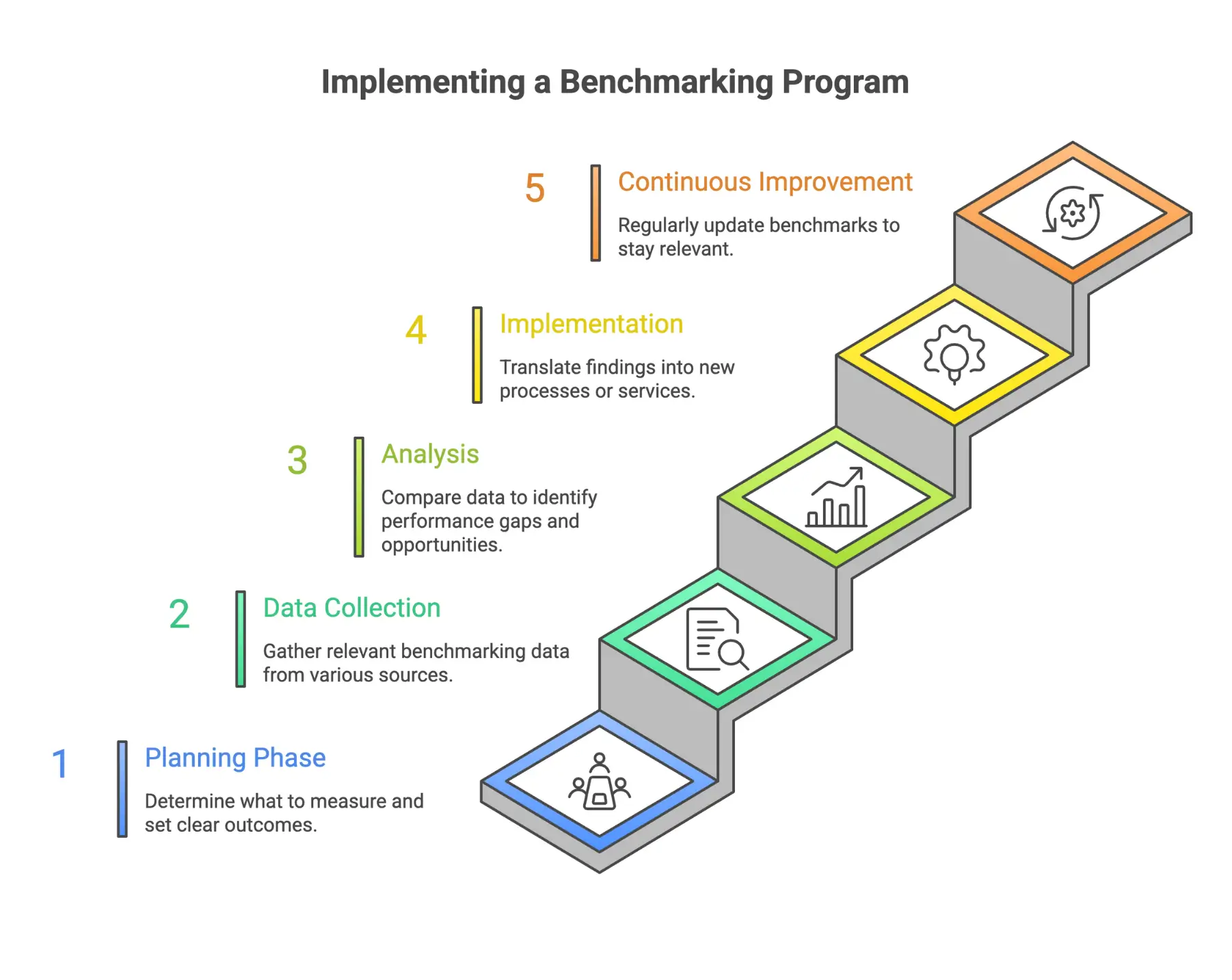
Benchmarking drives smarter decisions, sharper execution, and a culture of excellence that thrives on change and innovation.
Common Challenges and Limitations in Benchmarking
While powerful, benchmarking is not without challenges:
- Data Quality: Reliable outcomes depend on high-quality, comparable data. Confidentiality issues can limit access to the best benchmarking data.
- Context: Benchmarks must be interpreted in relation to organization size, sector, and market realities.
- Standards Shift: The “good benchmark” for yesterday may need revisiting as markets and industries evolve.
- Comparison Issues: Apples-to-oranges scenarios crop up if teams don’t align on process mapping and definitions.
A well-maintained, centralized cost estimating database, rich with historical benchmarking data, can address many of these limitations, supporting effective benchmarking programs at scale.
Emerging Trends and the Future of Benchmarking
The future of benchmarking is dynamic and increasingly technology-driven. Key trends include:
- Technology Integration: Real time benchmarking and automation, powered by cloud and AI, allow for rapid comparison, process mapping, and predictive insights.
- Community and Gamification: Benchmarking is becoming democratized through collaborative benchmarking studies and volunteer-driven data collection. Bigger, more current data sets are possible thanks to crowdsourcing.
- AI Metrics: Integration of AI in benchmarking allows organizations to measure not just speed, but code quality and team health, offering new benchmarks for development and management.
Organizations that keep pace with these trends secure a true competitive advantage and are poised to improve performance, no matter the market.
Benchmarking in Action: Examples and Case Studies
Practical benchmarking delivers tangible value. Here are several examples:
Process Benchmarking in Business Innovation
Companies engage in practice benchmarking to compare and improve processes, leading to efficiency gains and operational breakthroughs. Nomitech case studies demonstrate how process mapping, benchmarking studies, and best practice adoption drive continual improvement.
Investment Performance Versus Benchmark Indexes
Investors and portfolio managers rely on benchmark indexes like the S&P 500, Dow Jones, and Bloomberg Commodity Index to assess whether their portfolio outperforms or lags behind. Britannica Money discusses how tracking mutual fund or portfolio returns against a benchmark index provides objective feedback, vital for refining investment strategies and ensuring capital preservation.
Technical Benchmarking in Infrastructure and Surveying
Surveyors rely on physical benchmarks and technical benchmarking to maintain accuracy and consistency in building large-scale infrastructure. This ensures all team members are guided by the same standard and that safety is prioritized in the final product.
Frequently Asked Questions
What are benchmarks and why do they matter?
Benchmarks (or benchmark indexes) are reference points organizations use to compare how they perform, spot strengths and weaknesses, and focus efforts for growth and efficiency. They are critical for measuring relative performance in business, technology, and investment strategies.
How are benchmarks used in different industries?
In business, practice benchmarking helps compare operations and identify areas for improvement. In technology, technical benchmarking evaluates system speed and efficiency. In finance, benchmark indexes like the S&P 500 track investments and inform strategies. In surveying, benchmarks ensure consistent measurements in infrastructure and mapping.
What makes a benchmark valid and reliable?
A good benchmark is built on accurate, current benchmarking data, reflects industry standards or leading services, and is transparently documented for consistent usage in benchmarking studies.
What challenges are common in benchmarking?
Teams encounter data privacy, inconsistent definitions, and missing data, all of which complicate effective process mapping and benchmarking. High-quality results depend on clear standards and continuous improvement.
How can organizations implement benchmarking effectively?
Effective benchmarking programs start with clear planning, consistent data gathering, process mapping, and regular comparison through benchmarking studies. Tools and centralized databases help support every step.
Conclusion: The Value of Good Benchmarking
Benchmarks aren’t just numbers. They’re essential standards that keep decisions practical, strategies focused, and efforts aligned toward excellence. Whether you’re refining investment strategies, analyzing business performance, or conducting technical benchmarking, high-quality benchmarks and regular benchmarking studies reveal where to improve and how to achieve a sustainable competitive advantage.
Ready to Take the Next Step?
If you’re weighing your options for cost estimation solutions, explore Nomitech’s full suite or connect with our team to find out what fits your needs and goals.





Stay Up to Date
Subscribe to our Newsletter today and receive the latest updates, trends, expert insights, and exclusive offers tailored to your specific industry.